“The city (I thought) is so horrible that its mere existence and perdurance, though in the midst of a secret desert, contaminates the past and future and in some way even jeopardizes the stars.”
— Jorge Luís Borges, ‘The Immortal’
It is entirely appropriate that of the two film-festivals at which Yoni Goldstein and Meredith Zielke’s genre-straddling essay-film A Machine To Live In had its initial screenings, one (True/False) was a traditional physical experience and the other (Visions du Réel) was, due to the exigencies of the #Coronavirus pandemic, an online-only, «virtual» affair. A dizzyingly, sometimes exasperatingly multi-layered portrait of the Brazilian capital #Brasília, the picture moves freely between the actual, the meta-physical, and the purely conceptual—detailing «the failure of the most spectacular success of the world» – with illuminating, provocative results.
21st-century metropolis
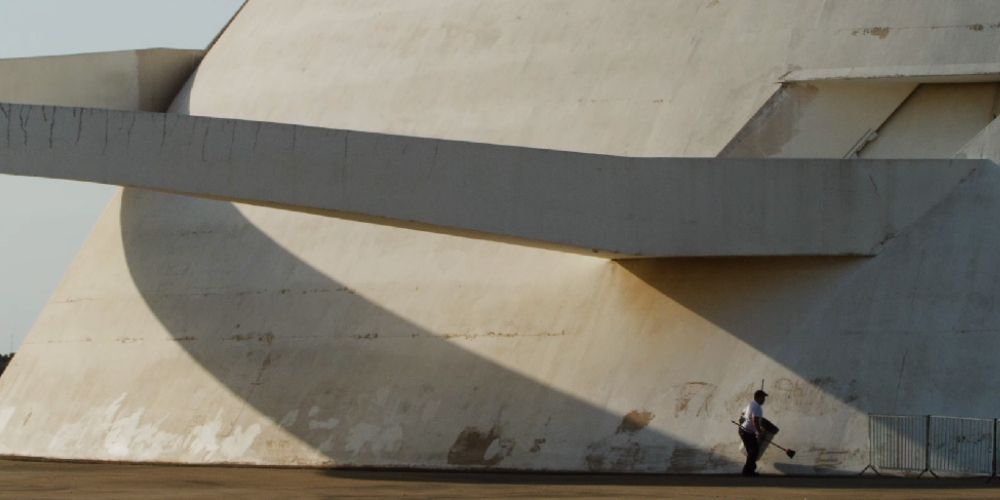
Brasília was constructed (as we here are informed) pretty much from scratch in one thousand days between 1956 and 1960, planned and envisioned as a city of the future: arguably the first truly 21st-century metropolis. Across the whole of the dense text of their 89-minute running-time, Goldstein and Zielke pointedly elect never to mention the man who could plausibly be dubbed the «father» of this whole gargantuan enterprise, Juscelino Kubitschek de Oliveira, Brazil’s president from 1956-1961 (British polymath Jan [then known as James] Morris, in a 1968 essay, noted that «some people call this city the crazy flourish of a megalomaniac politician»). And indeed Kubitschek is largely forgotten outside Brazil; the name most people associate with Brasília is that of #Oscar Niemeyer#, the extremely long-lived (1907-2012) architect responsible for most of the capital’s landmark civic structures.
Niemeyer’s main rival as the 20th century’s most famous architect — #Le Corbusier# — provides the film with its title, although his phrase actually referred to a building rather than a city. The impact of Niemeyer and Le Corbusier, enduringly controversial, can be discerned in new structures the world over: Brasília immediately became a byword for radical new visions. When the council-leader of Newcastle-upon-Tyne, T Dan Smith, in 1960 described his desire to make the old north-east English port «the Brasília of the north,» everybody knew what he meant. As Morris wrote, «It is not, to my mind, any architectural marvel that warrants such punctuation, but simply the idea of the place… There never was a city, old or new, more self-consciously bursting with a kind of Ozymandian symbolism…»
Another reality
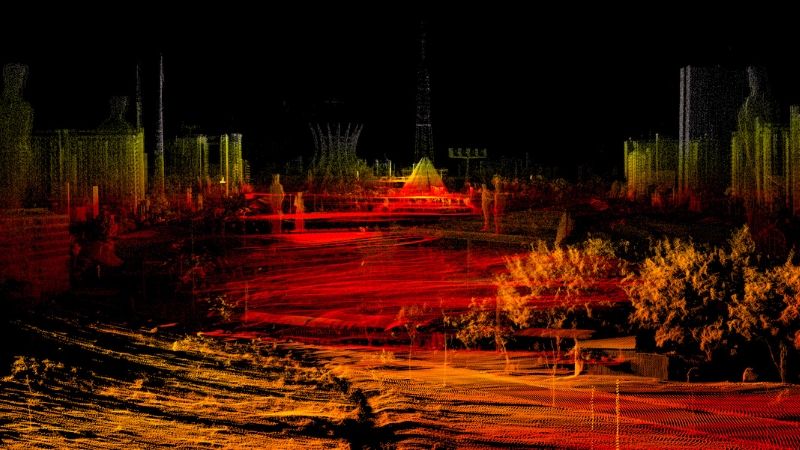
Chicago-based duo Goldstein (an #Israeli who hails from another 20th-century neo-metropolis, #Netanya) and #Detroit native Zielke thus deal with Brasília as a complex state of mind — an «opening to another reality» — as much as a colossal concrete gestalt. In Zielke’s phrase, they adopt «a highly mediatized, cinematographic approach for observing the way people live in, talk about and navigate space,» deploying a wide range of old and new technologies including geospatial mapping and CGI renderings which at times approximate the effect of 3D and #virtual reality# without the need for special glasses or helmets.
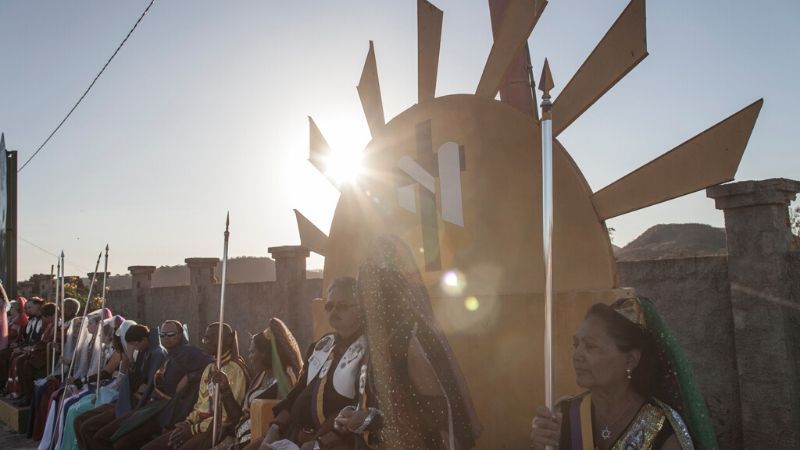
Time and again they peer beyond, and through, the city’s curved, elegant surfaces: through their lenses, the city takes on not merely «extra-terrestrial» aspects but what they dub the «ultra-terrestrial,» reaching into psychological, sociological, supernatural, and spiritual dimensions which connect this highly sophisticated urban space with the ancient rituals of the savannah dwellers who have inhabited these geographical zones for centuries. Folk-beliefs, such as the cult of truck-driver-turned-medium #Tia Neiva#, centered around the «Valley of the Dawn» (a miniature, «duplicate» Brasília), move steadily centre stage in the film’s second half; helping to hold things together, extracts from the writings of Brazil’s literary innovator, #Clarice Lispector#, who wrote two widely-read diaries in the city in 1964 and 1974, dubbing it «the image of my insomnia.»
Never enough
The style of this colourful widescreen sensual extravaganza (a fine advertisement for the 4K RED RAW camera and the cinematographic skills of DoP Andrew Benz) is graceful and stately — including one stunning 83-second aerial shot pulling slowly back from the city’s main bus terminus, a genuine coup de cinéma. Benz tweaks the colour-palette to harden the blues and rustify the reds; clouds in the sky take on a hyper-real air.
clouds in the sky take on a hyper-real air.
The content is, by profitable contrast, an overload, bombarding us with teeming superabundance of details, theories, «esoteric knowledge» and many, many voices — from occultists to oculists, bikers to bankers — polymorphous and vibrantly diverse, as befits the quicksilver gallimaufry which marks this nation of 200 million, where «too much» is never enough. Brazil’s last century has been marked by regular, often convulsive political upheavals. The film was being assembled during last year’s rapid and dramatic ascent to power of far-right President #Jair Bolsonaro# who makes a final-reel intrusion into affairs here via a nightmarish flourish of #deepfake technology (his face gradually replacing that of an actor playing Niemeyer), and whose astonishingly cavalier handling of the Corona crisis has kept the country in the global spotlight.
Goldstein and Zielke dedicate A Machine To Live In to «the future of the Amazon,» over which deep shadows now hang thanks to Bolsonaro’s «business-friendly» approach to this most sensitive of biospheres; even with so many rival focuses of attention, the world’s eyes remain drawn, again and again, to #Brazil and its improbable, impractical, inspirational capital.
A Machine To Live In world-premiered at True/False, Columbia MO (5-8 March) and had its international premiere (online) at Visions du Réel, Nyon, Switzerland (17 April-2 May)