When social networking sites such as #Facebook popped up and became popular around the globe, few could have imagined the extent to which they would transform the way we interact with each other — and their capacity to manipulate our behaviour. With the #addiction that comes with the dopamine hits a «like» brings built into their very design, the reality has emerged that they were built not, perhaps, to bring us together, but to distract and control us. The revolution could not be starker than in Bhutan, and its isolated village of Laya, nestled 4,000 feet up in the Himalayas, and until the turn of the millennium without even electricity. French filmmaker Thomas Balmès documented lights and television sets coming on in Laya as cables were laid in his prior documentary Happiness (2013), named in reference to a comment by King Jigme Wangchuck that the «gross national happiness» of the masses would shoot upward as a result of the development. This was seen through the eyes of Peyangki, an eight-year-old monk-in-training. With Sing Me A Song (2019), gorgeously shot with a clear reverence for Laya’s ritual-punctuated simplicity, Balmès returns to the village to determine whether the king’s prediction has come to pass and to see how Peyangki has responded to this seismic shift, as the outside world is now beamed in daily.

Second-hand simulation
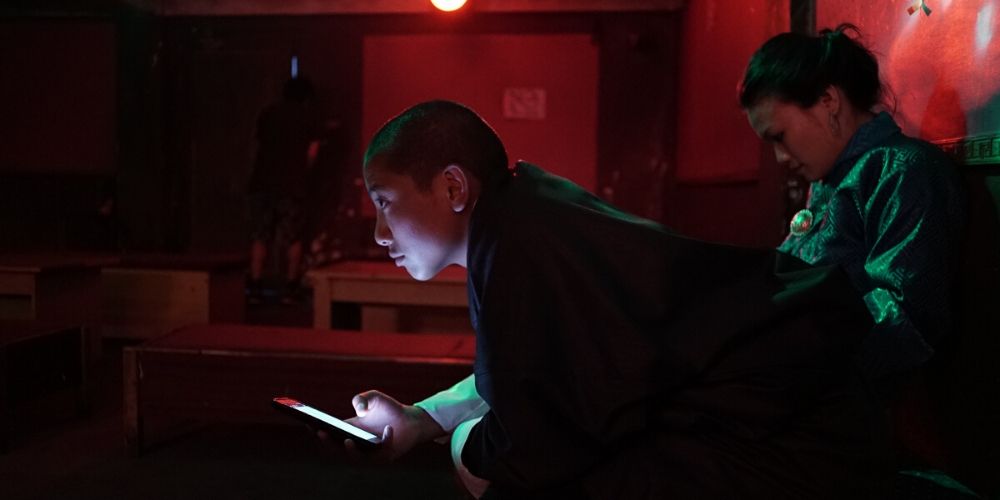
Footage of Laya a decade ago, and Peyangki as an eight-year-old, is shown at the beginning of Sing Me A Song. The boy, whose temple study sprung from his own interest in Buddhism, expresses excitement about electricity, but also fear, as he has heard it is «one of the main causes of houses catching fire.» The fact that the impact may be greatest in its psychological and social aspect, of course, does not occur to him, for how could even an adult grasp the ramifications of a kind of second-hand simulation they had never before known? The site of a picturesque temple far removed from the bustle of the capital Thimpu, Laya has enabled prospective monks to focus on their #meditation and prayer-learning. But, ten years on, when we see Peyangki, now grown into a young man, he is carrying out his duty of ringing the temple bell while simultaneously scrolling through a mobile. As the camera pans over a group of young monks in prayer, we see that they are almost without exception glued to their phone screens, watching videos or playing games, even as they chant together. It almost seems too bluntly extreme of an example of the corrupting impact of technology to be unstaged — until we recall that the cultural incursions of western consumerism and the devalued attention that goes hand in hand with its entertainments usually establish their hold with a seductive fury long before their full detrimental impact is recognised.
he is carrying out his duty of ringing the temple bell while simultaneously scrolling through a mobile.
Who’s to say with such certitude that all this online activity is bad for the young monks, one might ask. You could argue that the film just reinforces pastoral cliches about technology as a pollutant to pre-urban purity, amid very normal teenage angst. But in the case of Peyangki, we see not only his loss of interest and lack of progress in his spiritual practice (and what more than meditation requires an undivided focus on the here and now), but the way in which the internet enables him to project desire onto a fantasy with little bearing on reality, in the form of Ugyen, a woman living in the capital he meets online through networking site #WeChat. They meet in one of its groups singing songs, and the love songs that Peyangki requests (with lyrics such as «I will wait for you always») fuel delusions of deferred desire, and a propensity for him to project his attention onto a future naively constructed in his imagination. It comes as no surprise that Ugyen’s online persona is a somewhat selective edit of reality, leaving out the information that she has a child, and is planning to go to work in Kuwait, an opportunity far more lucrative than her current job singing to male bar-goers. Ugyen is herself scarcely away from her mobile screen, but what’s on offer from a global stream of information veers only between new consumer yearnings (bags and shoes on #Amazon) to confounding cross-cultural horrors (#ISIS beheadings).

Flights of fancy
For his part, Peyangki’s professed readiness to marry is shown up as a flight of fancy. When he makes the journey to the city, having earned money collecting and selling medicinal mushrooms, the task of communicating in person overwhelms him and the stress of his insufficient emotional tools is compounded by the noise and clamour of stimuli. Playing first-person shooter games in a gaming room offers escape but no solace — while the familiar world of the monastery pushes him to return. «I’m too far from Buddha now,» he tells a friend, as he wavers in indecision, in a film that suggests networked life and traditional spirituality are innately incompatible, and may never be reconciled.