#Karim Sayad’s# #My English Cousin# is a much-needed counterbalance to the slew of refugee-themed docs of recent years. Refreshingly surprising in directorial choices – starting with the opening shot of an industrial pier set to the sound of The Specials’s classic ska lament for the UK’s once-vibrant manufacturing sector, Ghost Town – Sayad’s film takes as its subject not the plight of today’s asylum seeker trying to find his way in a foreign new world, but the struggle of a middle-aged immigrant grappling mentally to make his way back home.
A crisis (of sorts)
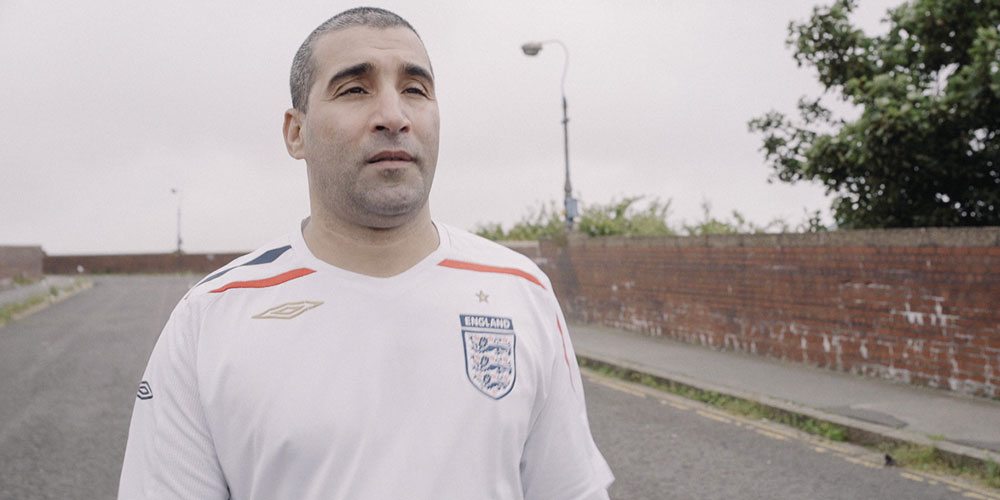
The director’s «English cousin» (by way of Algeria) is going through a midlife crisis of sorts. Fahed had arrived in the UK 17 years prior, illegally and initially reduced to sleeping on the streets. In the intervening years, he worked his way up the blue-collar ladder to a small flat and a steady job, chopping cabbage and creating kabobs at Pizzo Centro. Now, however, he’s at a crossroads, suffering from what red words on a black screen succinctly sum up as «The Shit Life Syndrome».
Indeed. Fahed’s life seems to run on an exhausting, and increasingly tedious, Groundhog Day-style loop. Sayad captures his cousin at home alone, listlessly eating dinner on a couch. He catches up on the phone with a relative back in Algeria, sleeps for a few hours, and then awakes at half-past five for work. Rinse and repeat. (That said, living in the unfortunately appropriately named town of Grimsby, with his prospects apparently as dim as that of this near-dead locale, what more can one expect?) Only once do we catch a glimpse of the longtime girlfriend of this paunchy man whose «dream» has turned into a relentless struggle, a hardworking guy who’s done everything «right» to earn his place in his adopted country – and now wants nothing more than to reverse migrate. The distant blond Brit is literally seated nearly out of frame in another room. No wonder they split before the end of the film’s first «chapter».
«Working Class Heroes»
In part two, we encounter a newly single Fahed, still slicing for skewers at Pizza Centro but going home to the flat he shares with a group of white Brits. (Who, it should be said, are just as much in need of translating subtitles as Fahed, which the director helpfully provides.) Fahed demonstrates a breezy openness in front of the lens (perhaps because he is not addressing the audience so much as his filmmaker relative), which lends to a shared sense of intimacy that even extends to the roommates. «I’ll see you in the morning,» one tells Fahed as he makes his way to bed. To which another swiftly responds, «You haven’t seen him in the morning in fucking weeks».
My way
Soon, however, Fahed readies his return to Algeria, shopping at an outdoor market for gifts to take home. There’s a terrific sequence – once again set to a dynamite soundtrack choice – in which Fahed attempts to pack up nearly everything he’s accumulated over the years (including a heavy safe!) to the beat of Sid Vicious’s My Way. And yet the song simultaneously seems to clash with the images onscreen – not unlike Fahed himself, forever out of sync with his adopted land.
And here we’ve reached the third chapter – the «Algerian Wedding»…or not. Back in his native country, Fahed also struggles to get himself in sync. As he prepares to marry an Algerian woman he barely knows, his aunt confronts him with several harsh truths – not just that he’s not fully comfortable in Algeria, but also that he is a wholly different man when in England. His future is there, she asserts. His «mentality» is now British, not Algerian.
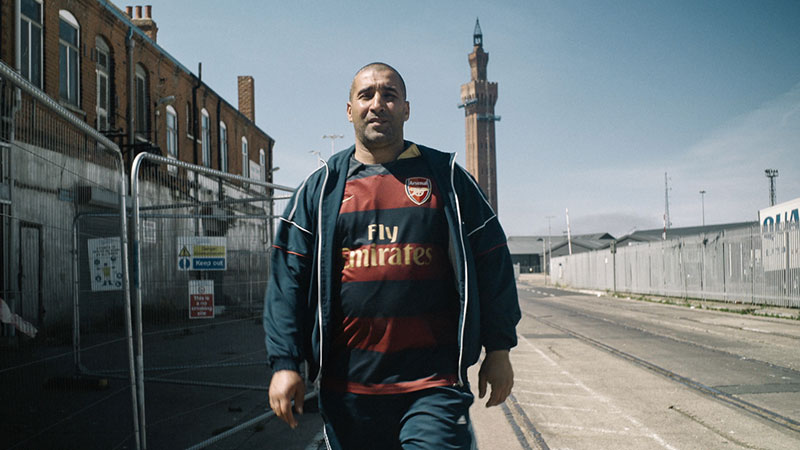
Like every immigrant throughout history, Fahed is destined to exist between two worlds, not fully from one or the other. Sayad’s camera captures this dichotomy exquisitely – cutting from relatives dancing joyously to Algerian music to interviewing a ten-year-old cousin about his future, which he definitively states lies abroad. Family versus livelihood is the eternal question, the immigrant’s dilemma with no easy answer. Though the lively boy isn’t worried. He’ll just find a wife on Facebook.
Karim Sayad’s My English Cousin is a much-needed counterbalance to the slew of refugee-themed docs of recent years.
And like his split with the British girlfriend, the postponement of Fahed’s wedding (and his family’s fears that his bride-to-be is using him for his papers) plays as more inevitable fact than a plot twist. Cut to «The World Is Divided Into Two Parts» in red on black (which we soon poignantly learn refers to «those with friends» and «those who are lonely»). He’s back in England, back at Pizza Centro, reunited once again with his white working-class mates.
«Life Is Confusing At This Point,» the final chapter, similarly seems preordained. As demonstrations begin against the Algerian government, Fahed has returned not to participate in politics but to marry. Maybe. While indecisive wedding plans add to the family tension and protests mount in the streets, things take a more personal turn as Fahed and his aunt visit a cemetery to pay their respects to relatives, perhaps for the last time. For, in the end, Fahed is back where he started: Grimsby, England. Only this time set to a mournful Algerian tune lamenting the immigrant’s circular plight.