The more certain we are that the #climate crisis# is already here, the less we know what to do to prevent it from turning into a disaster. Take, for example, electric cars. We believe that by driving them, we can reduce #CO2 emissions. But what if we charge them with #electricity produced by mining and burning #coal? For the coal, at least we know it’s dark and dirty. What if the thing causing the pollution is crystal white and even has cleaning powers, such as bleach or #sodium bicarbonate# that can thoroughly remove dirt and dangerous substances from anything, be it a dishwasher or fresh fruits?
This is what happened to the community of #Rosignano Marittimo#. Etruscans and Romans were already living there. This coastal area by the #Tyrrhenian Sea# is not far from #Rome, and the antique Tuscan cities of #Pisa and #Siena are just behind the hill. But it was Belgians that marked their destiny there. The surrounding mountains were rich with raw materials such as limestone and halite. Farmers living in the surroundings provided a convenient source of cheap labour. Not far was the port of Livorno, easily accessible via the railway line that was just built at that time. All this attracted Belgian chemist and businessman #Ernest Solvay# to open a chemical plant to manufacture sodium carbonate in 1914. In the shortest time, the plant became so crucial for the community’s life that they decided to give to the newly built part of the Rosignano Marittimo the name of the factory, Rosignano Solvay.
Into the sea
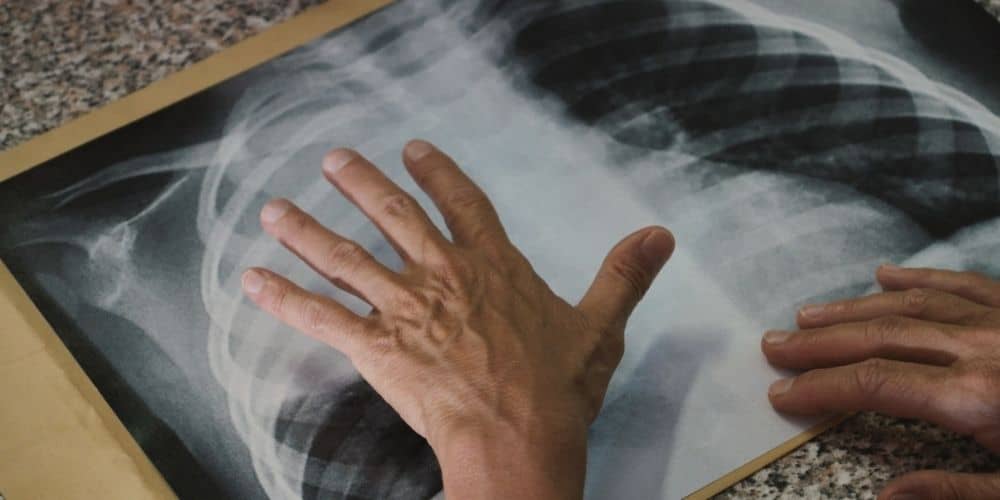
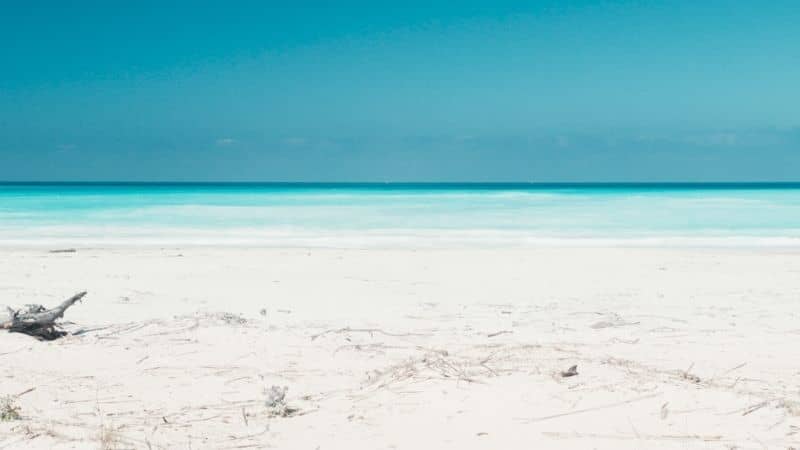
We hear several fantastic stories in the film, Medusa. A psychic medium will delicately touch an x-ray image of a chest and tell the name of a man who was sacrificed; his body left lying under the sand and preserved due to the chemicals that blocked the decay. A woman will remember the touch of the metal body and silicone lips of the lover she dated one hot summer during the 1960s. But no fantasy is more strange than the reality of this neat small town of rich palaces and well-cultivated parks, built by the Solvay for the people working in their chemical plant. And even stranger is the reality of the four kilometres of sandy beaches of the Rosignano Marittimo, by the Ligurian Sea, at the extreme north of the Maremma coast. They are called #Spiagge Bianche#, White Beaches because the sand is so white that they resemble tropical beaches. Many people, to this day, choose them as a location for their marriage – only that this colour is the result of years of discharges of calcium carbonate by the Solvay chemical plant, located about one kilometre from the coast.
…this colour is the result of years of discharges of calcium carbonate…
Today, the plant is the largest of its kind in Europe, and among their vast range of products are sodium carbonate and sodium bicarbonate, #calcium chloride#, #chlorine, #hydrochloric acid#, and #hydrogen peroxide#. They dump their discharges into the sea. These discharges might include various pollutants, even heavy metals such as mercury, but it seems that no one knows which exactly. The Solvay claims their discharges are harmless. Others, for example, the United Nations Environment Program, warn that this stretch of coast is among the most polluted in Italy. One thing is sure. The White Beaches are one of the most popular seaside destinations in Tuscany. As people say in the film, «there is a warning sign, but every year before the holiday season, it disappears».
Beyond perception
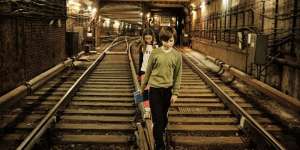
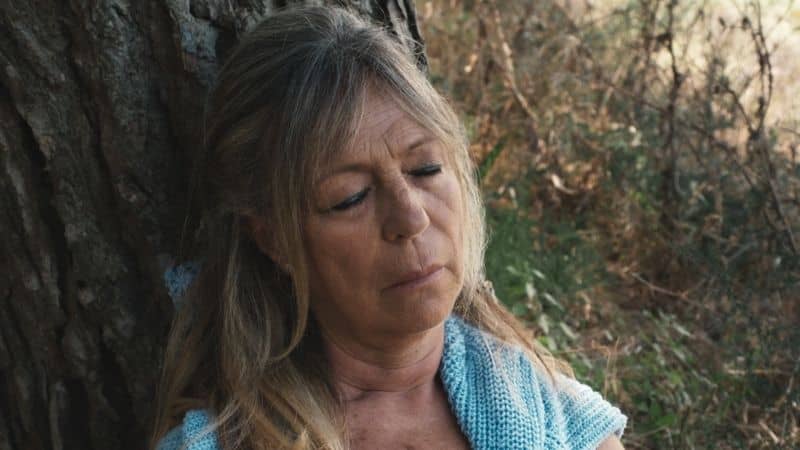
Medusa, the film dedicated to the story of this chemical plant and people living there, is not an ordinary documentary. It is more a hybrid between a film experiment and a visual essay. Its’ anti-realist form well represents the irrationality of Rosignano Solvay’s case and the general attitude towards the climate crisis. We see and hear diverse characters in the film – plant workers, beachgoers, citizens. They all somehow mechanically repeat the scripted dialogues. Their voices are of different warmth and colours, but one type prevails – light and open, slightly naive, with a high-pitched end. «Solvay brings us wealth, prosperity…» «We have various information…» «We can not be sure…»
Its’ anti-realist form well represents the irrationality of Rosignano Solvay’s case and the general attitude towards the climate crisis.
Gradually, one can recognise this sound with certainty. It is the voice of common sense, powered by logic that demands evidence verifiability. Rosignano Solvay and its’ White Beaches are a metaphor for what we are doing wrong with respect to the danger of climate disaster. We search for certainty, for tangible proof, while we should use our brain to imagine beyond what we perceive. Humanity seems stuck with the logic of common sense and its’ demand for practical evidence, unable to understand what, in the previous century already, the late French epistemologist #Gaston Bachelard# wrote about #science. Human knowledge reached beyond what can be verified in practice. We know more than what we can practically experience. It might seem complicated, but it is not. It might be too late if we wait to experience the climate disaster.