TOGETHER – Palestine: From Violence to Vision
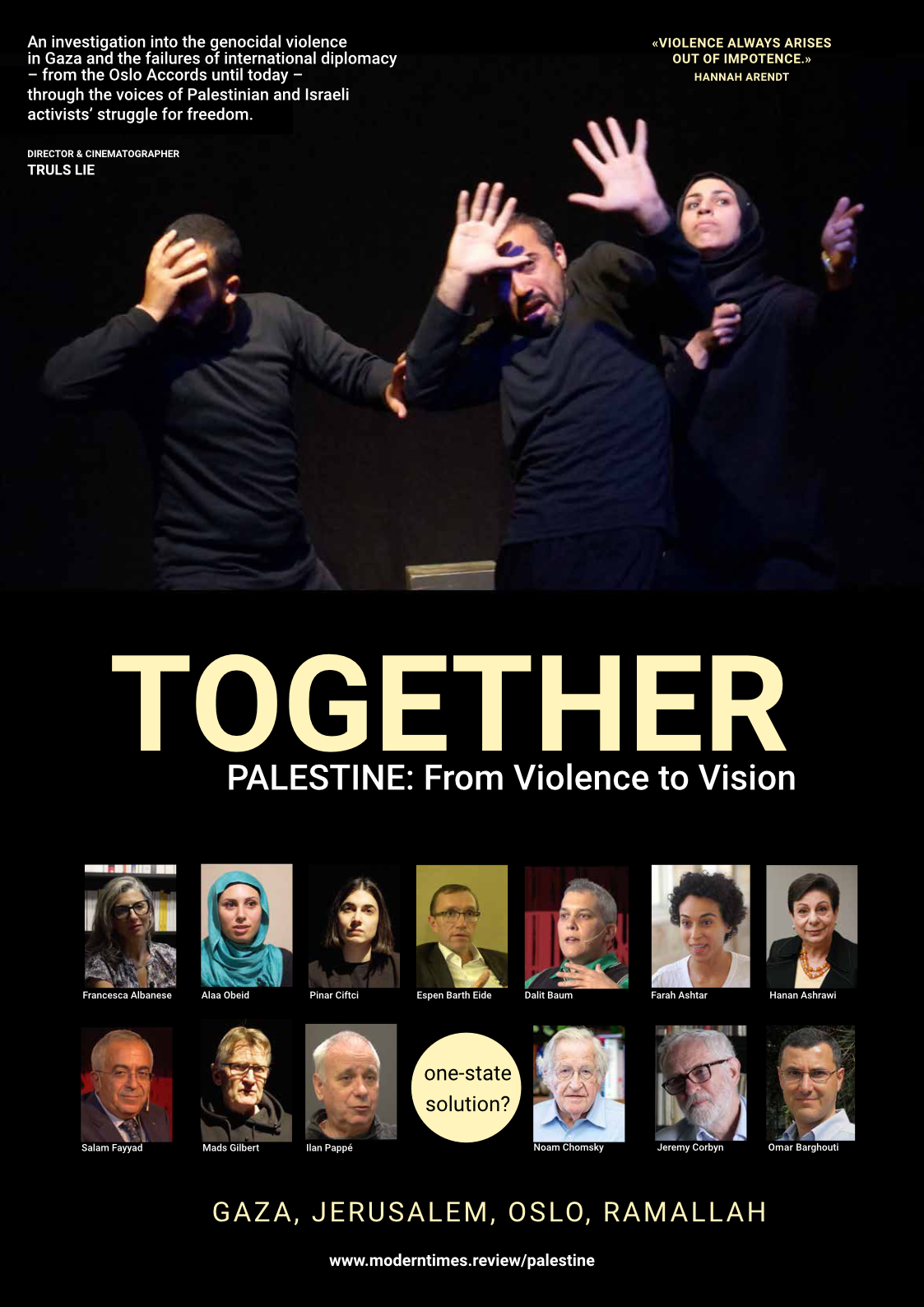
An unflinching 78 min. essay documentary probe into the heart of the Israel-Palestine conflict, led by Norwegian newspaper editor and film director Truls Lie. In Gaza, Tel Aviv, Ramallah, Jerusalem, and Oslo, he engages leading Palestinian, Israeli, and Norwegian politicians, activists, and thinkers – illuminating the struggle for freedom from violence, looking into a one-state vision.
The 78 min. documentary has subtitles in English (original language), Arabic, Norwegian, Italian, Spanish, French and Persian (choose by turning on CC and […]).
If you have discount code, you will have a reduced price or free screening. If you are in a Palestinian organisation, or have reduced means to see it, contact the film director by email to receive this code to see the film for free.
Read more about the film here:
LOGLINE:
Thirteen years, five cities, and twenty-nine voices — from a former Palestinian prime minister to an Israeli soldier who broke ranks, from Noam Chomsky to Jeremy Corbyn — TOGETHER follows one director’s long, unresolved attempt to ask a single question of everyone he meets: after a century of violence, what would it actually take for Israelis and Palestinians to live free and together?
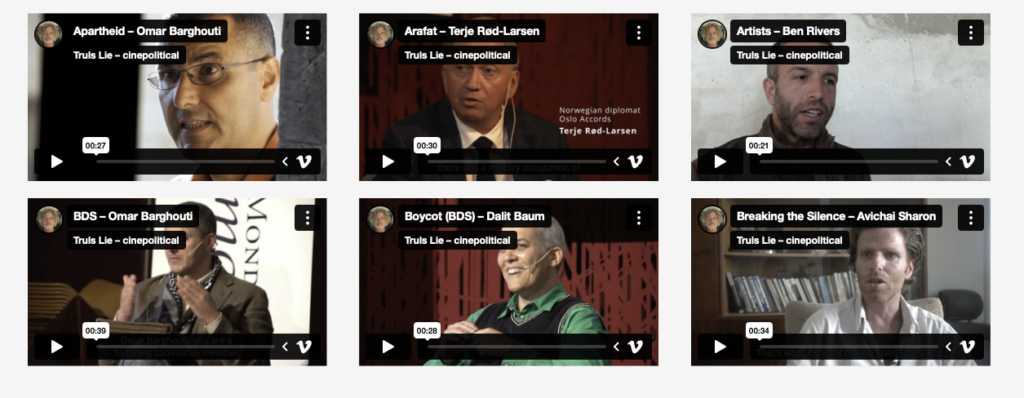
Clips from the film with statements (click keyword or all images):
APARTHEID, ARAFAT, ARTISTS, BDS, BOYCOT, Breaking the silence, DIGNITY, EXTERMINATE, Freedom flotilla, GAZA, Laboratory of war, One-state situation, One-state solution, Palestinian Authority, The peace process, State terrorism, The Oslo process, The Palestinian state, Time of monsters, EXISTENCE, Two-state solution, VIOLENCE, WAR.
Directors’ motivation:
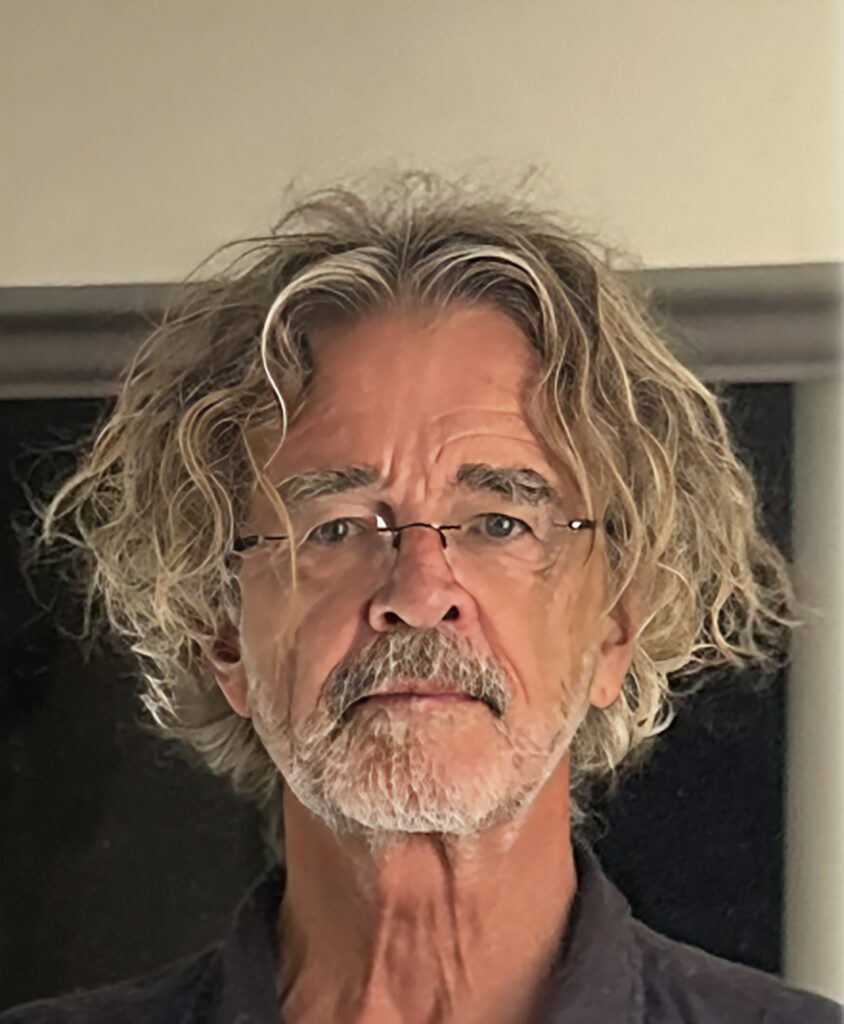
Truls Lie – Director, cinematographer, editor
I first travelled to Palestine and Israel thirteen years ago, and this film grew out of that return, conversation by conversation, with Palestinians, Israelis and Norwegians who see the situation from very different vantage points. My background in philosophy and journalism shapes the film’s register: it sits with the violence, the diplomacy – the Oslo Accords and what came after – the cultural and political activism on both sides, and the still-contested vision of a shared, binational future (one-state solution). I did not set out to make a film that tells the audience what to conclude. I set out to make one that makes the argument itself visible.
My motivation comes from two overlapping identities: as a humanist, and as a Norwegian who has always looked outward. I am trained in media and continental philosophy, and I’m drawn to a pragmatic anarchism – a belief in individual freedom bound to international solidarity, and a corresponding suspicion of suppressive power and militarism. Living for the past several years in Sicily has only deepened my attachment to the Mediterranean and to the more collectively minded East that borders it.

Ahmed Alkabariti – Co-director, cinematography (Gaza)
The scenes I gathered from Gaza offer an intimate view of a place reshaped by genocide – of daily life striving to continue amid destruction, displacement and loss. I wanted that the cameras held details that usually disappear behind the wider images of war: faces, places, movement, silence. These are the details that show how the war has changed people’s relationship to their surroundings and their memories – and how, despite everything that has transformed both the place and its people, a sense of life persists.
WHY THIS FILM
A decade of access, not a news cycle
Most Palestine-Israel documentaries reaching festivals now were shot in response to the last two years. TOGETHER was not. Filming began in 2013, which means the film’s twenty-nine interviewees speak across a long arc — several were recorded years before the current war and have not repeated themselves for the cameras since. That depth of access, built slowly and without urgency, is difficult to replicate and gives the film a different kind of authority than a reactive documentary can claim.
An inquiry, not an argument
The film is structured around a question the director puts to everyone he films, not a conclusion he asks them to confirm. Politicians’ formal explanations are cut directly against activists’ and artists’ emotional testimony; Israeli and Palestinian voices are given comparable space and comparable scrutiny. The intention, in the director’s words, is a film that is not political but ‘made politically’ – its method is the argument, before any single position is.
Two cameras, two vantage points
Truls Lie’s essayistic, philosophically inflected camera moves through Oslo, Tel Aviv, Ramallah and Jerusalem. Inside Gaza, co-director Ahmed Alkabariti shoots from within the war itself – his footage supplies the film’s ground truth against which every interview is heard. The two registers are cut together rather than kept apart, so testimony and lived consequence sit in the same frame.
The cast, in brief
Salam Fayyad, Hanan Ashrawi, Omar and Mustafa Barghouti, and members of the Freedom Theatre on the Palestinian side; Ilan Pappe, Breaking the Silence veteran Avichai Sharon, filmmaker Eyal Sivan and former MK Stav Shaffir among the Israeli voices; and an international frame that includes Francesca Albanese, Noam Chomsky, Jeremy Corbyn, John Kerry, and the Norwegian architects of the Oslo Accords, Jan Egeland and Terje Røed-Larsen. A full list of the twenty-nine interviewees is here.
Positioned for the next step
The team includes Steve Rickinson, who has worked with international documentary festivals for six years via Modern Times Review, and Francesca Borri, a longtime war correspondent from the Middle East, both leading impact strategy alongside the festival and sales campaign. Norway’s Antipode Films – the team behind «No Other Land» – is consulting. Conversations with international sales agents are underway.
| Director | Truls Lie (director, cinematographer, editor) |
| Co-director | Ahmed Alkabariti (Gaza cinematography) |
| Runtime | 77 minutes (feature) — footage and access can also support a series edit |
| Language | English. Subtitles English, Italian, Arabic, French, Spanish, Norwegian and German |
| Status | Picture lock complete; final colour and sound mix finishing |
| Premiere | Palestine House Film & Arts Festival, London — September 2026 (Norway: november 2026) |
| Sound/Color | Terje Paasche |
| Music | Chosen from Soundstripe and Epidemic Sound Hub |
| Producers | Truls Lie (producer); Steve Rickinson (impact producer / co-producer), Heidi Helgestad (impact producer) |
| Consultants | Francesca Borri, Antipode Films, Norway (No Other Land) |
| Sales | Film AS, Norway |
| Contact | Truls Lie ([email protected]) · Steve Rickinson, [email protected] (impact producer) |