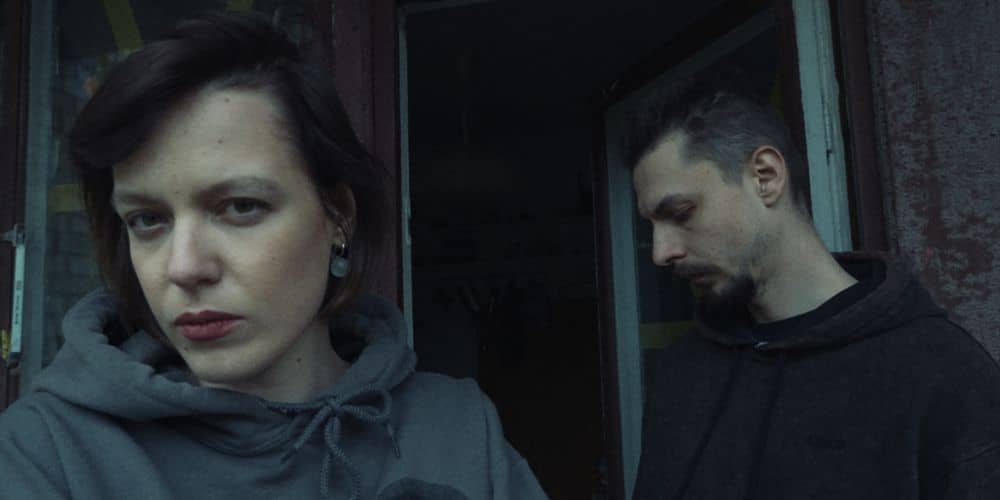
Culture is an «action and a product of a people,» stresses a character in Ukrainian-American writer-director David Gutnik’s #Tribeca-winning (Documentary Competition Special Jury Mention) and #Liev Schreiber# EP’d Rule of Two Walls, a rivetingly meta look at the war in Ukraine through the narratives of defiant artists that have chosen to stay in their country and fight – by continuing to make their art. And that includes not just painters and musicians but even a sound recorder and an editor, a producer and a director, all banding together to develop a documentary drama ultimately named after the directive to stay in a windowless space between two walls when the bombs start to fall.

Ida
Intriguingly, Gutnik, who shot the film alongside his Ukrainian DP #Volodymyr Ivanov#, has said that he «operated as though there are more similarities between narrative and doc than there are differences.» And it shows. The two actually bonded over their love of Paweł Pawlikowski’s Ida – specifically, the use of headroom to represent Ida’s seeking guidance from above. This led to the duo’s notable decision to frame participants in a manner that physically provides for that solemn space to search and the breathing room to question: How can I make art that matters in a world that no longer makes sense?
Indeed, it’s a high-stakes query because Ukrainian culture itself is an existential threat to #Putin – an inconvenient truth that must be extinguished if he’s to conquer a nation he claims doesn’t even exist. But the work is also a life preserver to those creative souls that unbudgingly remain on the ground. Or, as a woman in charge of a cultural centre puts it, «It’s important to find something to latch onto so you don’t become a burden to yourself.» Making art in a time of war is a way of «regaining control.»
«How can I make art that matters in a world that no longer makes sense?»
Not a dream
A crafter of gothic masks and prosthetics offers that he’s a «convinced materialist who believes in miracles.» But when the director tries to prod the weary mystic into discussing his last dream, he comes up empty. «I wake up and think, ‘Fuck, this is not a dream.’» Since art is his life, he explains that he will just have to keep creating, then adds that his choice to «be Ukrainian» is likewise a decision to live «in civilisation.»
«Where did you learn to speak Russian so well?» another character playfully jibes his companion. «Brooklyn!» is the retort. A female artist recounts the saga of Stepan, the cat from #Kharkiv, saved by nine lives and his #Instagram account (and a boost from some influencers in #Luxembourg. Welcome to civilisation). A tour of Stalin-era housing reveals beautiful Ukrainian frescos peeking through paint chipped away on ceilings and walls. The conservator notes that when the Soviets came, they immediately «whitewashed» apartments so they’d all be the same. The need to destroy identity goes hand in hand with the colonialist drive.
«There is a war, and there is a war for truth,» posits a Christian woman when asked about faith. She also wonders if «hatred will replace the pain» and ponders historical memory and «landscapes shaped by war.» A musician discusses The Terminator, a blockbuster that transformed for him over time, its meaning depending on the age he was when he watched (and re-watched) it. As for the film’s guarded cinematographer, «I don’t feel anything. I’m senseless,» is all he’ll reveal about his emotional state. It seems he’s witnessed far too much horror for one human being to process. «There’s no story behind it… Or I don’t see it,» the traumatised cameraman reflects. That’s «what war is. An absence of everything.» A void that perhaps only art can fill.
«There is a war, and there is a war for truth»
rules for some
And yet the most revelatory aspect above all, at least for this liberal, worldly American who lived through both the trauma of #9/11 and the Bush administration’s subsequent «war on terror» madness, is how intertwined #nationalism, art, and culture can become – to unsettlingly positive ends. Admittedly, the very notion of nationalism as a force for good leaves me equal parts queasy and skeptical – a sentiment I actually was roundly criticized for when I last visited Kyiv to attend #Docudays UA# 2018. Back then, the blowback from a cinephile audience member was swift after I publicly voiced concern during a critics panel about the Ukrainian government’s policy of only funding «patriotic» filmmaking. Would not my view be different if #Canada had invaded and annexed US territory on its border? At the time, I thought it was a rather dubious argument (not to mention silly. If those peacenik Canucks want Idaho, I say go for it!) Post full-scale invasion, I can now see that my POV is a luxury that only those born on world-power soil can so dismissively afford. Some have to obey the rule of two walls, others none at all.