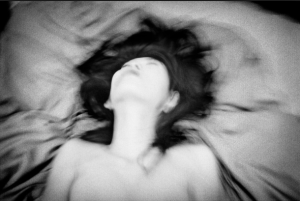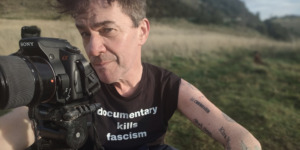
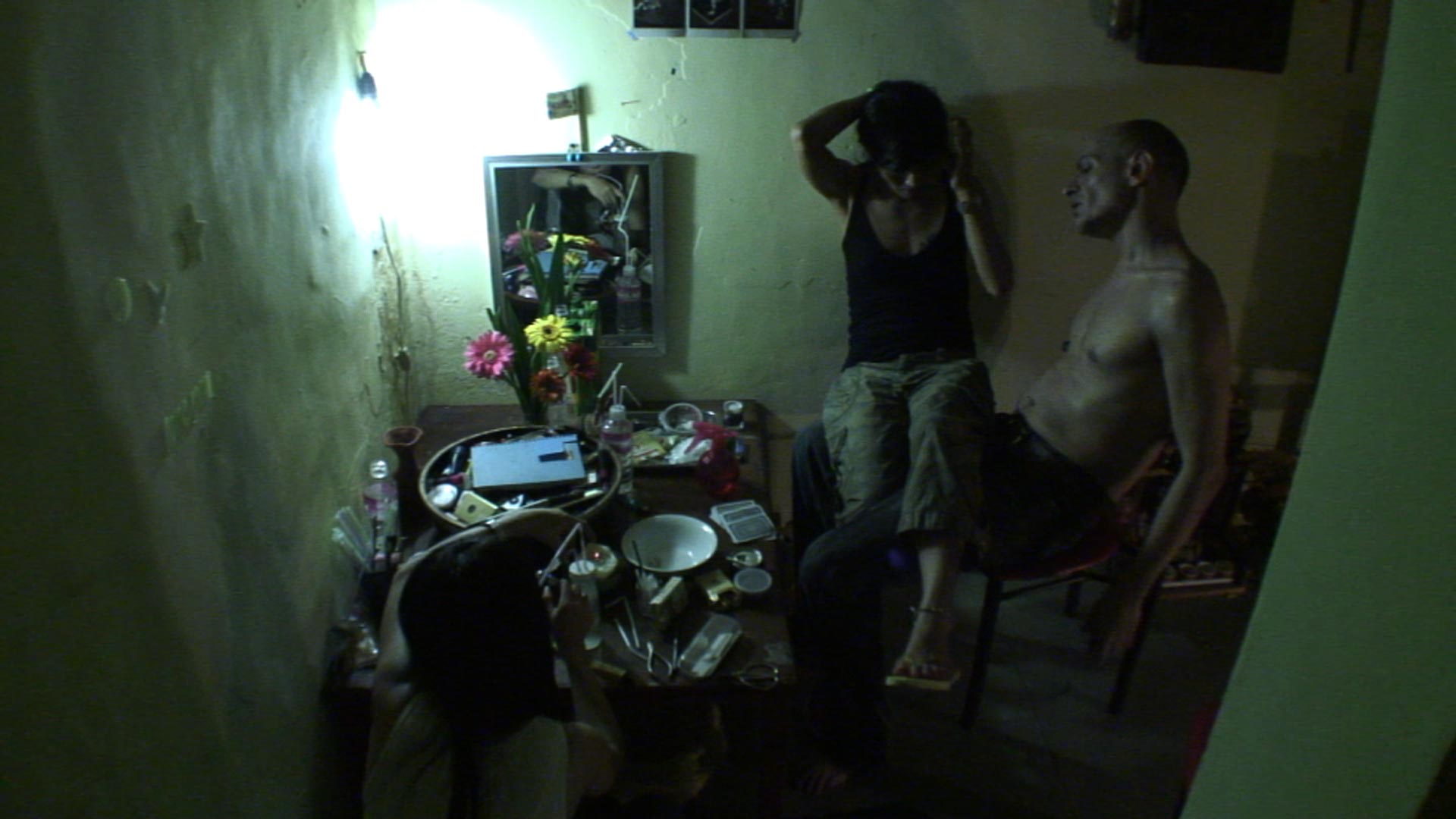
Magnum photographer Antoine D’Agata has gotten a little too intimate with the subject of his photo series. In order to get to know the seamy side of Cambodia, he goes to “the end of the end.” In Phnom Penh, he moves in with a drug-addicted prostitute named Lee, who does not only allow D’Agata to photograph her, but shares her crack pipe and her bed with him as well. When she asks him what he really wants from her, he admits that he hopes the pictures will earn him money. D’Agata has been throwing himself into projects like this for 20 years now. The claustrophobic atmosphere of this documentary is interspersed with gruesome street shots and uncompromising photos by D’Agata, who has increasing doubts about his profession as photographer. Journalist Philippe Azoury is concerned and visits D’Agata, forcing him to question his unorthodox working method.
THE MAGNUM PHOTOGRAPHER Antoine D’Agata needs to be in what he calls “a primal state of being” to be able to take his pictures. He needs to travel far from morality. Cambodia.
Somewhere between a portrait, an extended interview and travel documentary, The Cambodian Room presents a critical ethical study – that investigates the relationship between being an artist and simultaneously affirming a particular mode of existence. As D’Agata says: ”it’s not only to take pictures, but it‘s how I see the world and how I live it.” The Cambodian Room is the name of a place where he can investigate his own limits, to see if he can bear it. The room is also the name of a small apartment in which he spends his time with a Cambodian prostitute. Both of them take refuge in smoking. This refuge is D’Agata’s attempt to avoid oblivion, his attempt not to forget about reality.
D’Agata wishes to discover a new method, a method to go further into the unknown. As he says: “to find more perverse ways to know the other. […] This will go through sex, but only at the beginning, then we arrive to violence, pain, sorrow and indifference.”
THIS DARING VOYAGE of a famous magnum-photographer bring to mind – not only his own film Aka Ana about a group of Cambodian prostitutes and an unknown man’s voyage into his hell – but certainly also The Heart of Darkness: a director’s nightmare, the portrait made of Francis Ford Coppola’s journey while making Apocalypse Now.
He didn’t care that this would end up being an intimate portrait of D’Agata himself and his intense struggle to continue his work and his mode of living. Hence, the title of the last part: “The end of the end is here.” In this section, D’Agata investigates what appears to be an endless conversation with a Frenchman who knows his work and admires him as a photographer. Together they sit in the Cambodian room. The Frenchman asks only few questions, and, as the conversation progresses, D’Agata seems to penetrate deeper into the heart of his own darkness. He says: “I am tired, tired of being locked in all the time. I have locked myself into this space increasingly smaller, because you’ve removed … all the details, no more context.” We are literally face to face with D’Agata’s struggle, confronted with his meditation.
When he was sixteen or seventeen he was a punk, an angry young man in a capitalist society. Now he searches for a primal state to convert his anger into a more sensible proximity to reality. Taking drugs is not ideal, he admits, but the compromise of lives further removed from the intensity of reality. He knows that his present journey and associated lifestyle can destroy parts of himself, but it’s a necessary journey if he wants to learn how to see.
 He says he has to remain in this room, to get rid of all pretense, to no longer play any role. The true search of the heart of darkness is proximity, proximity to the other being, not simply a human being, but a prayer for the future being, the one that can approach suffering – as from an ethical point of view: D’Agata’s voyage is the most difficult one; it’s about becoming a true ethical being, not so much through morality (moral codes) but by being ready to accept, create and affirm this world irrespective of its devastation and misery.
The film itself is more a portrait of the very state of becoming – D’Agata struggles to become worthy of this event. As the French philosopher Gilles Deleuze writes: “either ethics makes no sense at all, or this is what it means and has nothing else to say.” That is what D’Agata is doing, trying to become worthy of this situation of reality, to face it directly. The film is about facing up to this world and being able to continue. Like Joseph Conrad’s colonel Kurtz, D’Agata has emptied himself to intensify his material existence, to affirm it by forgetting his earlier self – to be oneself as another as Rimbaud says, a struggle that continues …
LIKE THE FILM Aka Ana, The Cambodian Room involves existential solitariness and vulnerability. It is this exposure to being that we share as the philosopher Jean-Luc Nancy writes.
The Cambodian Room is a fascinating experiment with our own mortality. D’Agata and The Cambodian Room is remininscent of the difficulty of capturing the trauma of life, the tragedy and hopelessness of living in an image, in a photograph. D’Agata is a photographer but he is not taking photos. D’Agata is trying to capture what we have in common – the wound, the trauma. As an artist and photographer, he attempts to go back and capture the impossible – how our mortality makes us truly human. It is the experience of this mortality that takes us out of ourselves. So the conclusion must be that all we can do is try to live and function in relation to the Other in ourselves.