«Falling Sky» was already the title of a book by shamans Davi Kopenawa and Bruce Albert. It’s a testimony of the #Yanomami culture in Brazil’s #Amazon, a culture threaded by death in different ways, by miner and gold prospector militia, virus contamination through physical contacts, pollution of their natural resources, and the huge reduction of their territories caused by forest erosion and other industrial sabotage.
Trustworthy relations
In 29024, Cannes «Fortnight» Section presented the Brazilian directors Eryk Rocha (*Brasilia 1978) and Gabriela Carneiro da Cunha (*Rio de Janeiro 1982) inside-looking work. They spent some weeks with the Yanomami in a very small team, partly constituted by Yanomami members. In recent years, both directors have, as producers, already established trustworthy relations with the locals, encouraging and supporting films directed by them. This ongoing cooperation is the base to overpass the well-grounded images of the «whites,» referred to by the Yanomamias merely «as merchandise people.» It may come as a surprise how well informed the Yanomami are about the different wages of occupation by the United States, Spain, Portugal, Japan and France, as also about the destructive politicos of their of own government, including all failed promises of protection, starting on a big scale in 1973 with the territory destructions to build highways. The Falling Sky even documents their global awareness of market realities and trail business. The film’s significance is to allow us to observe our realities from their perspectives, which are deeply grounded in nature’s realities and limitations.
The human existence here is not considered the top of creation, degrading everything to resources, but just a fragile part of an overwhelmingly powerful and transcendental reality. For the Yanomami, the actual industrial activities are not only the end of their culture but of human culture in general. Consequently, Eryk Rocha and Gabriela Carneiro da Cunha don’t hesitate to infiltrate images of destructions, «natural» accidents and disasters of all kinds through short sequences of grey-scaled images to prologue the local visions into worldwide perspectives.
Spending weeks with the Yanomami allowed the directors to gain an inside view of their rituals and songs, rhythmic music and dancing, daily lives, food preparation, face painting, and, more specifically, their dreams, stimulated by plants, which set them in a trance during which they imagined, facing the future, exclusively apocalyptic visions.
For the Yanomami, the actual industrial activities are not only the end of their culture but of human culture in general.
Prophecies
The team struggled to capture this entire life panorama. Events are normally unannounced, and rituals and celebrations often happen at night.
Another surprise, which can perturb the familiar imagery of wilderness, is to see the different tribes communicating by VHF radios. They alarm themselves about #malaria and #pneumonia spreading caused by air #pollution, as well as about childbirths and hospitalisations.
The Falling Sky is a visual metaphor for an undergoing culture, as the indigenous old seers had already prophesied. Rocha’s and Carneiro da Cunha’s work can be seen as the last chance to document a disappearing culture made for and partly by the indigenous.
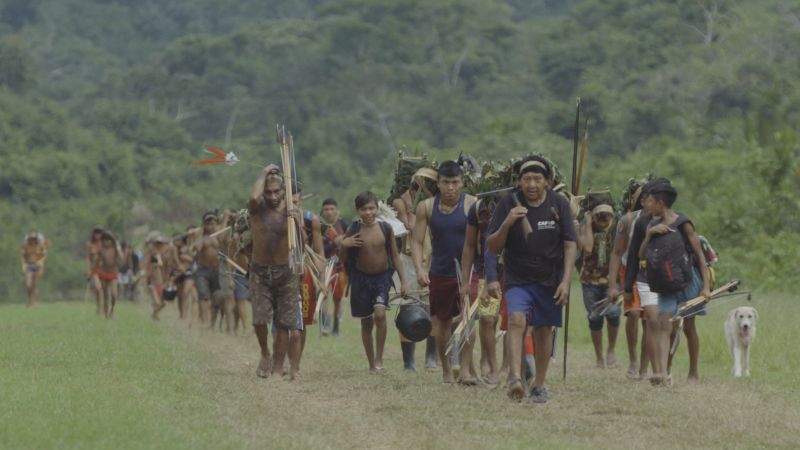
Editor Renato Vallon’s work often uses quick changes from distant to detailed viewpoints, and long takes characterise it. The longest seven-minute take is set right at the beginning, capturing a huge group of Yanomami coming back from a hunt, nearly invisible in the background, slowly coming towards and then passing the frame of the camera.

Another worldview
This initial take already changed the time concept and usual expectation settings. This documentary doesn’t want to deliver information quickly, as it is partly well-known, but to offer the possibility of being part of another worldview. Carneiro da Cunha adds that the walking pass of this scene is a landing strip for planes, again a metaphor for the beginning of the Indigenous genocide starting in the 1980s.
The soundtrack is focused on the ingenious rhythms, shoutings and singings, accompanied by atmospheric compositions. Giving space to observe and be present without didactical shortcuts is the predominant impact of The Falling Sky, again a warning message of what our way of life is leading to.