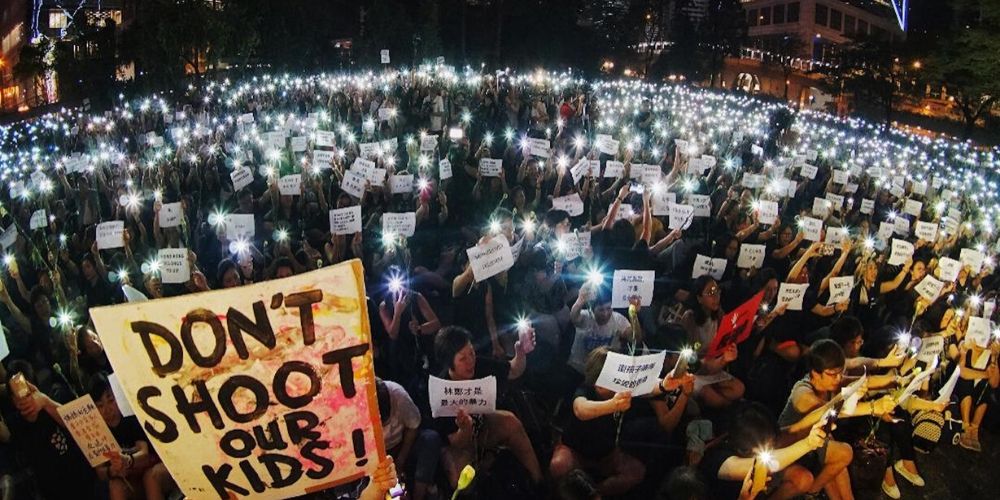
What brings 2 million people from a population of 7,3 million to the streets, fighting for democratic elections? What leads students to kill themselves as a symbolic act for their desire for #sovereignty? What makes Hong Kong’s inhabitants so special in sending out a global message on the worth of #democracy, while other society’s democracies fall into #recession, often even unnoted?
The 2020 International Film Festival Rotterdam (IFFR) offered a large «Focus» program with over 40 historical and actual works, to reconstruct the phenomena of Hong Kong. One of them, We Have Boots by Evans Chan, offers a huge quantity of information from an inside view, bringing key figures, who – this needs to be pointed out – don’t want to be leaders, in front of the camera.
Inequality
First, let’s remember that #Hong Kong# is the most populated territory in the world with 6763 hab./km2 (2017). It’s also the 9th most unequal «country» in the world having the most expensive housing market nine years in a row. In 2018, a 4-bedroom house became the most expensive such home in the world, sold for $446 million.
Tens of thousands of families live in cramped rooms about the size of a parking space, with lower-class people managing different jobs simultaneously, adding time needed to study for some of them. With this, Hong Kong is confronted with a politic praxis of non-sustainability.
On the other side, China’s propaganda already starts to alarm against «universal» western values, calling them a time bomb. Hong Kong’s relative sovereignty starts to, even for China’s mainland intellectuals, be a model to follow. China’s strategy over the last years was not to answer any political liberation request through simultaneously rising political and social pressures. The candidates for Chief Executive started to not be freely elected anymore, as guaranteed to the British government during its passing over the administration power to #China in 1997. Since 2014, only preselected candidates got access to the elections. The «One Country Two Systems» concept, which includes a «high degree of autonomy» and an independent judiciary, started to fade away.
Hong Kong is the most populated territory in the world
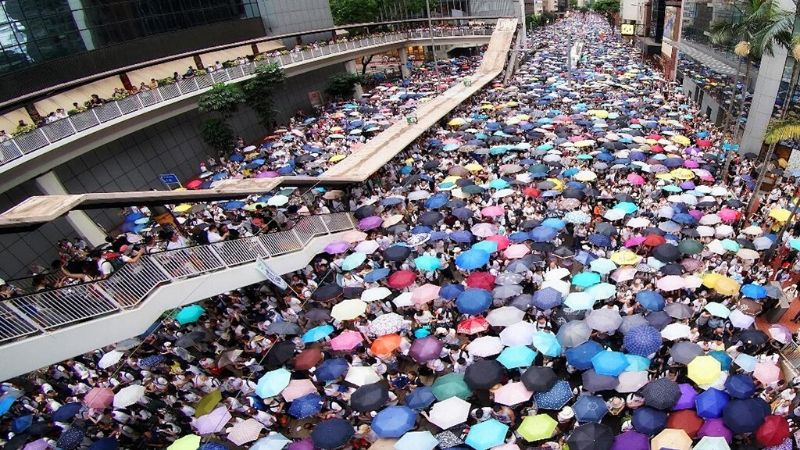
The first large outbreak of resistance against the growing Chinese occupation was the «Occupy», or «Umbrella Movement», which across 79 days, demanded real voting rights in vain. This movement followed the rules of non-violence/non-collaboration. #Alex Chow#, one of the activists of its first hours, confessed to the failing of intern democratic practice. The speaker’s podium was then accused of being a command centre. The protesters started to split up based on their approach to utilising physical violence: one side against radical strategies, the other as clear Hong Kong independence fighters, against those who still count on a dialog. Others surrender and choose Buddhism for a new mental frame.
Defeated by not destroyed
Still, the «Umbrella Movement» had been defeated but not destroyed. Facing the discussion of other independent legislators and the disappearance of five people from a bookshop that featured «critical works» – one reappeared after imprisonment in China’s mainland; another, as we got know over the few last days, is still in prison. Ai Weiwei‘s captivity, as well as the death of Chinese Nobel Prize-winning writer and freedom fighter #Liu Xiaobo#, further alarmed protesters as attacks against freedom of artistic expression increased.
New campaigns appeared, like young student Agnes Chow’s «Demosisto», declaring resistance against the national education program and defending democratic voting. This movement was disqualified, accused of supporting Hong Kong’s self-determination. The «Reclaim Neighbourhood» campaign reacted to the 40 million Chinese visitors by infiltrating Chinese traditions on small Hong Kong.
Making the rounds
Reflections about the legitimation of violence in resistance then grew. Martin Luther King Jr’s letter from Birmingham Jail declaring the fights for justice against written law makes the rounds.
During the «Fishball Revolution», a protection of the street vendors, police got attacked and many protesters were imprisoned. Some of them fled, like Ray Wong, to Germany where he became the first-ever political refugee from Hong Kong. Others decided to face their trials as part of their resistance, even if this meant the loss of their positions and employment possibilities.
Finally, the government declared, after the «Umbrella Movement», to deliver some actors accused of «conspiracy to incite others to incite others to commit public nuisance» to China’s mainland in November 2018. The last defense line against China’s influence broke down. This intention first brought one million, and soon later two million protesters demanding the dismissal of the country’s leader, #Carrie Lam#. This was followed by violent confrontations on the streets. On August 7 and 8, 2019, two subway attacks on neutral civilians took place. The police not only let it happen but also closed the station for 24 hours refusing any possibility of medical help. Further mysterious deaths caused additional doubts about the police’s conduct. Videos document gangs attacking known figures from the protests with hammers – a pointless action given that the, now known as, «Be Water Occupy Movement» was factually leaderless. The young generation started to break out street stones for their fight. These youth don’t expect to have money anymore or have children in their future.
Violence on both sides
On November 11, 2019, police laid siege to the Chinese and Polytechnic Universities. 1000 tear gas canisters were thrown. Masks and eye goggles became useless. A painful video showed protesters set a man on fire. The tragic point here is, the resistance can’t stop as, in this case, terrible reprisals would happen to the protesters.
perpetual resistance seems necessary to reform this world.
Chan confronts us is with the uncomfortable truth, that perpetual resistance seems necessary to reform this world. Of course, unionising and actively running for elections also play a major part in acquiring such change.
A referendum
November 24, 2019, on the District Council Election Day, the pro-democracy candidates received a large majority. Even if only minor functions are concerned there, the vote could be read as a referendum on the government.
Finally, in September 2019, Carrie Lam withdrew the extradition bill but still hasn’t investigated the police brutality. New confrontations take place on Christmas and New-Year nights. The «Be Water Movement» was then blamed to be under China’s foreign influence. To resume: between 2014 and 2019 some 8,000 demonstrators were arrested, the youngest one is twelve years old.
Chan remarkably balances the scenes of high tension in the streets with reflective and (self-) critical statements about recent memories. He even followed some protagonists on their roads to exile in creating this full spectrum of Hong Kong’s people today.