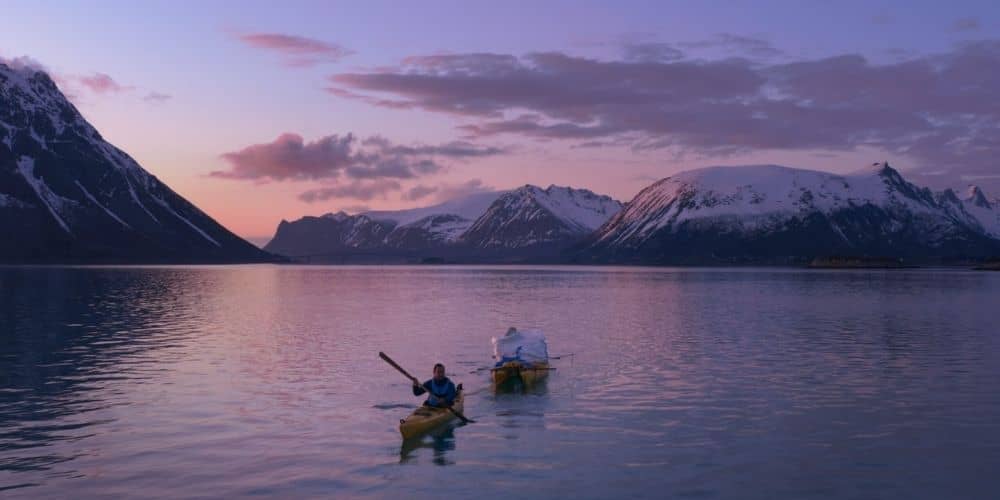
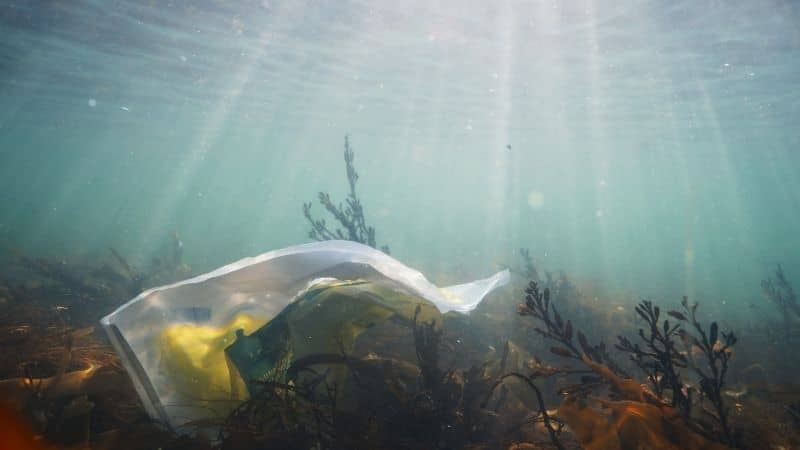
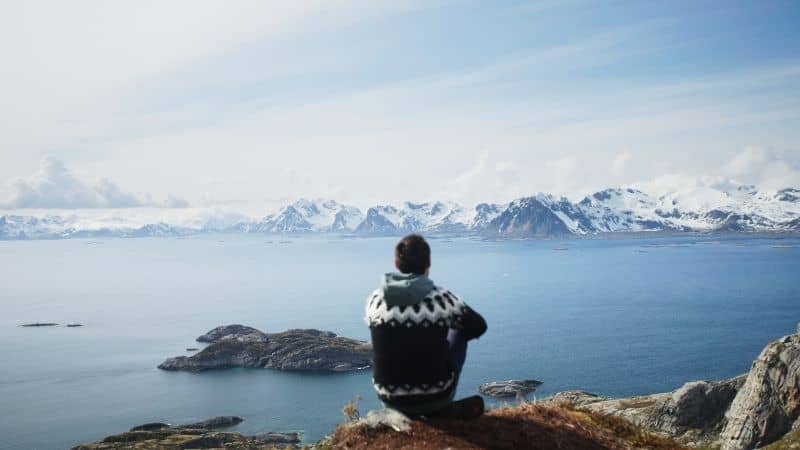
Countless fish heads are drying out on racks. A figure of a lone man with his back turned toward the viewer is silhouetted against the sky. It is a scenic landscape, some 68°13’ north of the #Polar Circle#. And it is graced with a washed ashore plastic grocery bag, an unsettling sight spotted at the remote reaches of our planet.
«Let’s check today’s catch», we hear an Inuit Kris Jensen say to his friend Steffen Krones as they drag a sizeable white bag. Inside is an assortment of plastic litter – a high-density #polyethylene (HDPE) chemical container, #styrofoam, and even a worn-out Ralph Lauren cap crown. Steffen, a Dresden native, retrieves another found object, a commonplace item in any German supermarket or household – a bottle of Bavarian Erdinger wheat beer. Now it has come ashore on the #Lofoten Islands# in #Norway, one of the world’s northernmost populated areas. But how did it get there, and did it travel all the way from Germany?
Paths of plastic
In the documentary The North Drift, German filmmaker Steffen Krones sets out on a quest to follow the paths of plastic waste with GPS, starting from Germany’s Elbe River, drifting downstream into the #North Sea#, then moving on into the Atlantic, and finally making its way into the #Arctic region. Together with his neighbour and design engineer Paul Weiß, Steffen builds various GPS buoys, dubbed «drifters». Through trial and error, the men are able to remodel and revamp different prototypes before casting them into the waters and bidding Bon Voyage. Catching rides on the currents and wind, the GPS buoys travel up north, revealing massive «hotspots» of rubbish as a sort of «a garbage finder». In Norway’s #Mausund, strewn plastic bottles, various packing materials, and fishing nets litter a stretch of the coastline, producing disconcerting crackling sounds when one rummages through seaweed and moss, enmeshed in marine debris. «This is the most horrible thing I have ever seen», says Kris, who works as a tour guide in the North Polar Sea and studies environmental protection. Beneath the organic layer, chunks of plastic are further mixed up within the topsoil. When it rains, the ground folds and new fragments of plastic surface, explains a young man, who, alongside over a dozen others, has been employed since 2017 full-time to clean up plastic waste drifted ashore on the islands in the area. «Every time we come back, it’s always something new. And right now, it doesn’t look good again».
Many improperly discarded plastics come to the ocean from land sources, carried by rivers and ocean currents. Larger plastic objects then continue to crumble and degrade in the ocean waters due to temperature shifts, waves, and exposure to heat and wind, with motes of plastic permeating seafloor sediment. Deep-sea researchers at Germany’s Alfred Wegener Institute for Polar and Marine Research have observed staggering increases in the amount of plastic on the seafloor, as much as sevenfold between 2004 and 2017, according to marine biologist Dr. Melanie Bergmann. «At one station, it was 13,000 particles per kilogram of sediment». Sea ice also seems laden with #microplastics, with over 10,000 particles detected per litre of melted sea ice. As Bergmann argues, it shows that «microplastics can get anywhere on our planet via the air».
In just six decades, what humankind has brought about is «an atrocity».
Atrocities
The presence of plastic particles in the Arctic water column, sea ice, and the air arouses grave environmental concerns over marine litter and its potential effects on #ecosystems. In just six decades, what humankind has brought about is «an atrocity». «Everywhere we go, from the deepest trenches down in the #Pacific Ocean# to sea ice in the Antarctic and the Arctic, we find plastic», stresses climate physicist and oceanographer at the Utrecht University, Dr. Erik van Sebille. However, the movement of plastics in the Arctic is particularly worrisome as it hosts «one of the most unique ecosystems» globally, which makes it «much more vulnerable» than the Great Garbage Patch in the North Pacific Ocean.
«That makes me utterly angry because you and I, we, didn’t create this problem. We were born into a system where we cannot live without using plastics», Kris says in anguish. The (micro)plastics circulating now in the oceans will largely remain there, but what will be the consequences for nature, society, and man? The ubiquitousness of plastics in our environment is bound to have repercussions for humans too. While the long-term impact on human health is unknown, scientists are concerned. A new study, published in the Environment International journal and reported by the media this week, has found microplastics in human blood «for the first time». Last year, another study showed evidence of microplastics present in human placentas, which could potentially harm fetal development.
Words into action
The advent of the #COVID-19 pandemic only aggravated global plastic pollution due to copious amounts of biomedical waste produced and disposed of, including single-use face masks. When the world was brought to a standstill and locked down, plastics continued moving between the borders while domestic waste rose. «You know, Dresden, the Elbe, the North Sea – it’s just a symbol of all the other places. It shows us that you have a big impact on the Arctic wherever you live», voices Steffen at the end of the film. Despite the grim outlook, the documentary draws to a close with a tinge of hope that «it is not over yet» and «there is a lot worth fighting for». Scientists and climate change campaigners may not share that optimism, but hope does transpire as we see young activists take to the streets in thousands, urging leaders to turn words into action on the climate crisis.