Werner Herzog’s latest exploration of an area of #brain science# – the monumental Theater of Thought – brings a few fascinating stories about other species and a brief introduction to a multitude of topics arising in the field, which is by now similarly multidimensional, complex, rich, and still shredded in the unknown as the object of its study. By necessity, then, we get only a glimpse of the plenitude of issues tackled by scientists working behind tightly sealed doors of the biggest US laboratories and institutions. Progressively, Werner Herzog not only opens up a world of people and places only a few can normally access but also playfully puts himself in as a filter of #consciousness through which we perceive a current state of rapidly evolving science that changes and questions almost everything we thought we know.
Navigating the labyrinth of consciousness
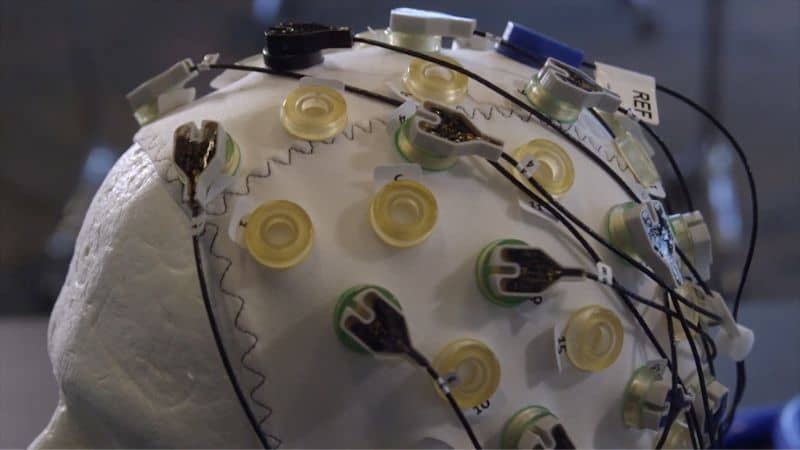
There are various players here. #Big tech# corporations like #Facebook and #IBM, individual investors are vividly interested in certain types of research, universities, foundations, Nobel prize winners, hospitals, brain surgeons, mathematicians, physicists, philosophers, and lawyers. They all justify their work with a common good or the medical issues resulting from brain damage. All of them also hope to influence the future of humankind, although each in a different way. The selection of guests and the topics they work on leads us from the commercial use of collecting and analysing brain data, hence shaping human understanding of things (in accordance with the goals of whoever pays for it), through reading brain signals on a cellular level; enhancing coordination between brain and a body parts, to various means of reading thoughts, and methods of precise, intrusive and non-intrusive manipulation of the most complex behaviours of living organisms.
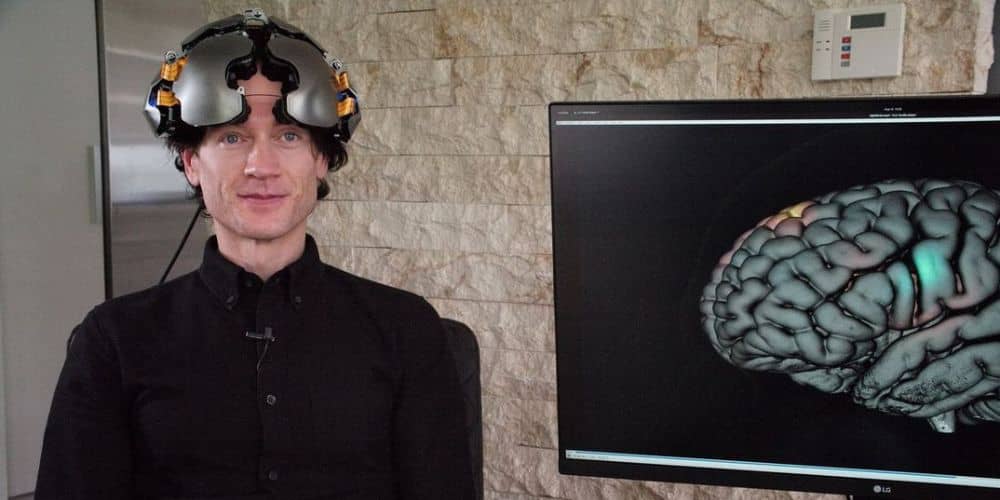
The methods developed and for years researched in the major laboratories vary and span a vast area from already advanced brain scans through now dawning quantum computers, brain chips, brain-machine interfaces, #AI, and virtual technologies to the groundbreaking novel ways of accessing a nervous system based on nanotechnologies, neurotechnologies, or optogenetics – light injections influencing certain areas of a brain and shaping complex behaviours, emotions, attitudes, or preferences. Reading minds, telepathy, virtual smell and virtual taste, brain-to-brain communication, or communication with other species seem to be within our reach. Dr. Rafael Yuste, a neuroscientist at Columbia University, who invited Herzog to do the film together and serves as the chief scientific advisor, presents his research on hydras as a way of discovering – among many others fascinating aspects – the rules of organic self-assembly of animals.
Werner Herzog not only opens up a world of people and places only a few can normally access but also playfully puts himself in as a filter of consciousness…
From neural pathways to social implications
How does consciousness arise from neurons? What is consciousness? At which point in evolution did it appear? The answers to these basic questions are still unknown. Many scientists describe consciousness as an effect of a sum of past experiences, determining one’s perception, cognition, sensation, and action. Yet, the fact that we still struggle to find fundamental answers doesn’t stop the successive progress in more detailed applications of technological developments that imperceptibly penetrate and affect the very core of our existence. It is a point at which ethicists’ and philosophers’ advice on the necessity of securing the privacy of an individual’s thoughts becomes crucially important. The questions of who, how, and when can access our thoughts (and how to use these data afterward), and what, who, and how can input certain words or ideas into our minds are not #science fiction# anymore but have just become a current reality that our societies have to face practically and legally. The concluding remarks of Jared Genser – a #human rights# lawyer, on to what extent the international community is unprepared, or – perhaps – unconscious?, of how fast the brain technologies will stir our lived experiences brings to mind the shock waves going through the world after the public introduction of the AI systems last year. The useful solutions in one field can bring disastrous effects in another. Does it mean we should stop trying, as one of the ethicists fears? Hopefully not. It also doesn’t mean we should allow anyone to uncontrollably interfere with an individual’s thinking process.
Perhaps the problem is that the current science is so vast, sophisticated, specialised, and imbued in its own language that it rarely actually realises the far-reaching social consequences of particular technologies. Herzog makes an effort to lighten the heavy technicalities and tight discourse with his jokingly naive questions and his own individual remembrances of artistic meta-experiences, like the marvelous indeed 1930 Earth by #Oleksandr Dovzhenko#, or meetings with extraordinary friends, like #Philippe Petit#, who crossed on a high-wire the space between New York’s World Trade Center’s twin towers in 1974. As in Herzog’s previous films, here the voice-over guides us through fundamental brain science questions to a recurring motive of the world as delusion or phantom, the «theater of thought» of individual’s making.
Unveiling the mind’s mysteries
Today, thanks to #quantum physics#, we know that the one objective reality does not exist. Yet, still, there are forces, external and internal, deeply determining the shape of our lived experiences. Even this fragmentary and introductory excursion into the brain research area the «Theater of Thought» in its popular film form – reveals the magnitude and gravity of questions emanating from the neurotechnologies in their current, still initial stage. The film becomes a panoramic overview of a fragment of a vast research field and its basic philosophical and social implications and leaves us with much to think about. The questions of consciousness are still far from a definite resolution, but they allow us to form much more precise and sophisticated answers than ever before. And it is still only the beginning of what this scientific field will lead us, the human race, to…