
– What makes Human different from other festivals?
– The number of talks and debates. Beside the Q&As, we also have debates going into the content of documentaries. But we also have separate panel debates just connected to the Human Rights topic of our international program. We are actually sponsored by Amnesty and The Norwegian Helsinki Committee.
– In your program there is a lot on the Middle East and Palestine. Why?
– Yes, #Palestine is in focus. We have two theatre plays about Palestinians and relevant films. And also an exhibition by #Mohamed Jabaly#, who is a filmmaker and refugee in Norway. We have talks about prisons in #Israel – where we have both Israelis and Palestinians in the panel.
– So, did you invite the ambassador from Israel here in Norway to the prison discussion?
– No. From earlier experiences here, I am not sure what he can contribute to the discussion, or if he has knowledge of the topic.
– Why do you have theatre in a documentary festival?
– We have done this before, including documentary #theatre as a part. It is about trying to communicate reality. And in our theatre plays, some of the actors have actually experienced the content they are communicating.
– Do you think the festival films have a possible impact for change?
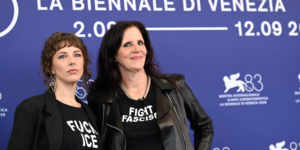
– To create change, films can have a part – by sharing light on complex issues. Like Advocate, showing how the lawyer Lea Tsemel works. Or Behind the Blood, which comes inside hard violence in #Honduras. They bring knowledge that is impossible to get from a text.
– Any Norwegian Example?
– #iHuman by #Tonje Hessen Schei#. It is about #Artificial Intelligence#. About the consequences for our society – like what face recognition can do or when decision making is taken away from humans. It is very dystopic, but informative on what is happening.
– Do you see festivals changing for the future?
– Yes, this is complex. People get more home cinemas, and they like to travel less. We have to think more about the online scene – but still most important is to be a meeting place – where people can talk about films with others in the audience.
– Any film early on that inspired you into documentaries?
– I started the festival in 2003, but before Sagolandet (Land of Dreams,1988) by #Jan Troell#, and Michael Moore’s Roger and Me (1989), inspired me in the 80s. They had a huge impact on me.
Listen to our podcast with Magnussen on more political matters and European critical thinking.