China is not really the place for journalistic freedom or public research, especially if the investigations want to offer a view behind the coulisses. Already, for this reason, we can only be surprised by Meng Han’s Smog Town, which offers a deep look into the working conditions of Langfang´s «Environment Office», in the town known as the most air polluted place in #China. Maybe more than usual, its people have had the chance to see the film online, something offered as a generous initiative by Nyon´s Vision du Réel for this year’s online edition.
Yellow smog
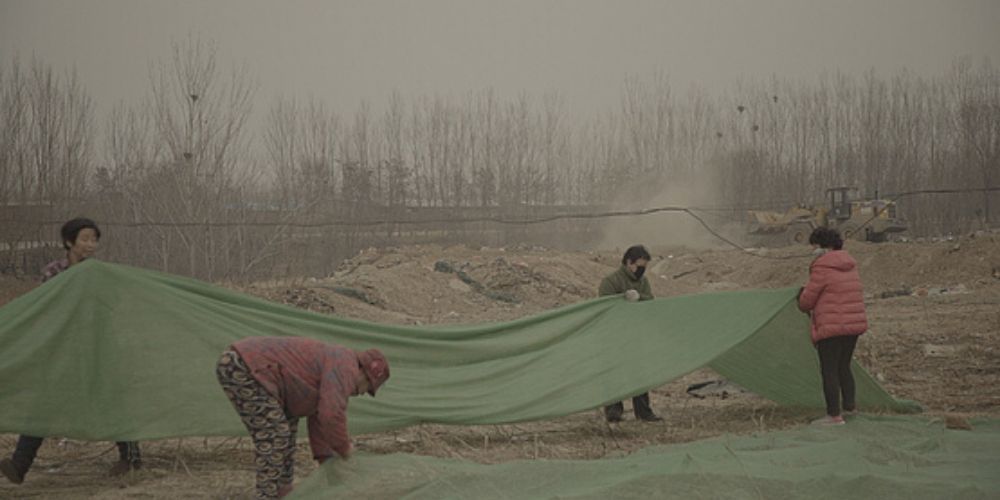
This part of China is regularly alarmed by «yellow smog», which turns the environment opaque and strictly reduces visibility, mostly caused by particles smaller than 2.5 micrometres. These pollution excesses can endure for days.
Speaking about pandemics these days, the question can arise more effectively, why the #Coronavirus gets so much attention, but air pollution, which caused a yearly death rate of 7 to 9 million, passes by with incompatibly less awareness and consequences. Of course, the main reason is that the recent Coronavirus has had higher visibility in hospital services and rest homes. Therefore, commerce, which generally isn’t interested in death numbers (besides the pharmaceuticals industry, etc.), but only in political decisions and their economic consequences, is immediately felt.
At the beginning of Han´s documentary, a Chinese off-voice in the form of a news report remembers the 30% rise in respiratory diseases. Li Chunyuan is the director of the inspection team inside the local environmental protection office. His task should be to discover and reduce or deactivate the pollution sources. But practically, his actions are limited mainly to smaller local shops, which use, for example, car colour sprays, or to give out warnings and fines, not to use #coal stoves. Han also gives voice to all these threatened isolated workers, who are confronted with social regression as a consequence of this policy. Even one member of the environment team itself declares the secret use of coal for heating because gas would be too expensive for him.
These pollution excesses can endure for days.
The real challenge is, even if the publicity department of the environment office declares the days of uncontrolled pollution as passed, the reality remains that construction companies, farmers burning their fields, truck transports and the steel industry are barely targeted, while other enterprises still operate «as they want».
This has become a mission impossible for the environment team, which sometimes hosts official guests inside their spaces with air purifiers and «smoke blocking screens». But as one insider in a meeting declared with astonishing frankness: «We’ve ruined the air outside. What’s the point of cleaning the air here?»

Tears
Li Chunyuan isn’t a cold functionary. During a school visit, a question from a child of how we can develop economic growth and, at the same time, protect the environment, brings him to tears. He is part of the generation coming from pureness into an economically growing society, which has brought a much higher living standard for most of the population. So he is not in the position to take growth by itself into question.
«We’ve ruined the air outside. What’s the point of cleaning the air here?»
His problem is that the steel industry in his town alone consists of around 50,000 workers and their families. Closing them would cause the loss of «billions of Yuan», even if the coal consumption could be reduced by millions of tons.
So, politicians are going on advising people to use loudspeakers in their villages to denounce neighbours who burn fields or use coal stoves, or to confiscate materials in private houses and small enterprises, which will only be easily replaced by the same products bought on the black market. Other actions take the form of covering construction seats with plastic sheets or smashing the water on the ground with jet sweepers to reduce the dust emission, which again, of course, means useless carbon consumption. In these «red alert» times, streets are barricaded and air traffic is limited…for some days, hoping for a change in the wind direction. Langfang is, after all, situated only 40 km from #Beijing.

One factory opportunity
Not only in Chunyuan’s, but also the worldwide capitalistic argument is: a steel factory makes 10 Million Yuan (1.4 Million US Dollars) profit every day (!) and 10,000 people are dependent on just one factory. Nobody can risk the loss of these jobs. We know this argument only too well. But there isn’t even a trace of a reflection, that the «profit» could be used to create other non-polluting factories and production centres, which would surely offer plenty of job opportunities, even if during the transformation time the profit scale will be lower. During investigations for such transformations on a large scale, not one participant in Han´s documentary addressed this concept.
Ultimately, Li Chunyuan only can observe while his assistant Hu brings his weakened daughter to the hospital with fever and aspiration problems. Han´s camera intimately captures the stress in the environment team, because the political logic is, to make them, and their local mayor, responsible for the disaster. They will be penalized. And indeed, Han´s documentary – not needing any voice-over commentary – finishes with the demission and dislocation of the local mayor to another town in July 2019. Problem settled!