The film starts with a countdown. It gets clear that it’s the necessary time for a contamination check of a #nuclear reactor. The sign for danger is set.
The German town of Greifswald holds one of the disconnected reactors in #Germany. Its decomposition process will take 33 years and will cost around 5 billion euros. Greifswald is only one of 17 reactors to be decomposed after Angela Merkel’s 2011 decision to turn away from #nuclear energy#. So we are talking about 85 billion euros just in Germany. Unfortunately, Carsten Rau does not ask who will pay this bill in his documentary Atomkraft Forever. 600,000 barrels of radioactive material will be the result of the deconstruction and still not one final storage zone has been determined worldwide. Reactors in Germany had received the construction permission by just signing the sentence as «removal proof»: «It needs progress for the research of final storage». This was the reason why the repository Gorleben had been kept as a possible solution for so long, even facing massive population protests and scientific declarations about its ineptitude.
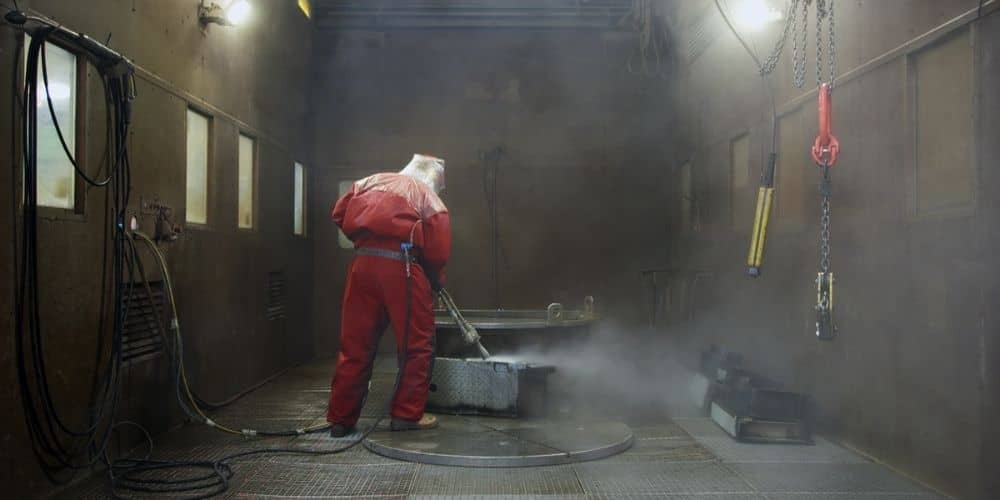
During this deconstruction, radioactive liquids are set free and the polluted cement must be decomposed with hand machines. The evaporating dust constitutes a heavy risk of entering worker’s bodies.

Facts & numbers
It’s not easy to illustrate these often-abstract facts and numbers with pictures. Carsten Rau slides the camera over the depots, tubes, corridors, protective suits, waste barrels, mechanical movements, and working processes inside the different reactors and intermediate stores. He uses early #propaganda films from East and #West Germany# promising a cheap and clean unlimited energy source for the future. He also shows the usual strategies of how nuclear energy companies convinced modest yet sustained communities to settle down on their territories. Sports centers were built, jobs offered, and much money flowed into this local cash box. Rau captured the people who got even emotionally involved, feeling like «part of the family», appreciating the reactor and all the workers and businessmen showing up.
Rau resumes the usual arguments and doubts from the population. What sense does it make for security, if Germany stops nuclear production, but the neighbors do not? Today, in #coronavirus times, on a local level we observe the same argumentation: why should we wear masks if our neighbors don’t? We also see the results.
600,000 barrels of radioactive material will be the result of the deconstruction and still not one final storage zone is determined worldwide.
Furthermore, all those who make the most #profit from nuclear production, interpret Germany’s withdrawal as just a voting strategy, as if the huge number of #anti-nuclear voters don’t have arguments for their choice. The economic loss was announced by the inevitable import of fossil fuels as if an economic win still is the decisive parameter. Different forms of energy production that create their own economic benefit weren’t taken into consideration. Instead of working with the forces in Germany’s neighborhoods, which also refuse nuclear energy, a huge part of the population prefers profit-making compromise with the risks. These people’s voices rest unchallenged in Atomkraft Forever.
Here, doubts start to arise about what Rau´s up to this point critical approach by describing all the destructive potential of nuclear production, ridiculing the propaganda, showing images from #Fukushima. However, in the second part of this documentary, he falls into the ideological trap, and allows the most efficient strategy for nuclear management to come back into the game again. He gives an uncommented on voice to German and French nuclear management protagonists, who declare nuclear production as the only solution against the threats of #climate change#.

Questions unanswered
It starts with the remark that two weeks after Merkel´s decision, nuclear enterprises was invited into the ministry to discuss if a pullout planned for 2022 is possible. Joachim Vanzetti, director of German’s «Netzführung» (Electric net direction) «Amaron» declares that even if there are some days when renewable energy can cover 95% of the necessities, there are others when this capacity goes down to 1% due to no sun and wind. Today, the energy storage capacities couldn’t even guarantee the needed energy for one day in Germany so carbon energy would be processed again. This is the reason why shut down reactors are even held in a standstill position to be reactivated in time.
At this moment we would have liked to hear just one specialist on renewable energy and one political scientist. Stored energy is not dependant on a centralisation. In fact, it should,
and is, stored in smaller units, like enterprises and households (ie. solar energy). This is just the positive capacity of alternative energy production. Another missing point in Atomkraft Forever is a reflection on the political consequences of energy control and distribution. Democracies would profit much more from decentralised energy production and local distribution than from centralized and technological highly security controlled management of a few distribution companies. All the realities of bio, heat, water energy, biomass, combined heat, power stations, hydrodynamic power, and ocean energy are not even mentioned. Neither is the fact of the still missing investments for the development of all those new technologies, besides other – waiting to be implemented – technologies reducing energy consumption.
Unmentioned stays the fact that there are already energy autonomic communities like the German town Feldheim, which had been forbidden to supply their overcapacity to the public energy net. Also absent in Rau´s documentary is information about investment facts, their profits, and strategies.
Instead, we find nuclear managers from France, the country with the highest number of rectors (58), producing 75% of the national energy, like Guy Brunel, director of communication in the Nuclear Research center Cardarache, presenting his unchallenged viewpoint that nuclear energy is «absolutely necessary for the energy mix», assuring furthermore that everything is under control to avoid accidents and if they happen, they will not have heavy consequences. No word again about France’s top-secret evacuations plans for nuclear catastrophes.
At this moment viewers ask themselves if the stylistic element in Rau´s documentary to end a sequence by a visible hand-clapping indicates an ironical alienation. But unfortunately, this option rests problematically discreet.
The word is given to the leader of the «EDF-Project» «Neue Atomkraft» (new nuclear force) Xavier Usat, who announced a rising energy necessity of 30% for 2040, of course without clarification on which social and technological realities he is talking about, calling Merkel´s 2011 withdrawal ridiculous and not possible to be repeated today because of drastic uprising of CO2 emissions and their costs. Again, he is unchallenged with the fact that after 40 years of run-time, France will have to decompose 30 reactors in the next 10 years.
Concerns abound
All this nuclear management agrees that, worldwide, precisely 434 reactors guarantee a «certain living style and life». Besides, they like to remark that gas, oil, and carbon also cause victims and death. It does not even enter these schizophrenic professional minds that we cannot go on consuming this amount of energy. We don’t want it and we don’t need it. The fact is, as Rau mentioned as pure information that even in Japan, 9 of 50 reactors had been reactivated and 18 are waiting for their permission. From 27 EU-States, 13 have a nuclear production.
Again, the voice we hear is, for example, French nuclear scientist Isabelle Zaccherie explaining that chemical production also has its risks, showing workers behind walls as an example of guaranteed security.
worldwide, precisely 434 reactors guarantee a «certain living style and life».
Jochen Stay, the speaker of «ausgestrahlt e.V.», one of the rare critical voices, reminds us that after the decomposition process in Germany, 1900 radioactive castor containers need to be stored in a final depot. We don’t even know how long a container sustains. The store should be secured for 1 million years, which means, statistically, during ten glacial periods. Besides the humorous optimism about the survival of flora and fauna on our planet, Stay already doubts that in 30 years, when the storage will get urgent, there will still be the know-how, the understanding, and acceptance to face this problem. Today civilians are invited for hearings and discussions, but without any decision, not even a veto right. The decision about the final depot will be a political one.
Again we see not challenged the young French nuclear physicist Lucas David hallucinating about the «poetry of fusion» and the beautiful water evaporation in the turbines.
We have no time for errors, he declared. This time he is right.