Perhaps you have no idea what ZAD stands for. In the French language, this acronym is a neologism that stands for ‘zone to defend’. It refers to a militant occupation – activists taking over an area so to block a development project. In France, there are several such zones, mainly in rural areas, all with an ecological or agricultural dimension, though they can be in urban areas as well. One of the most notable ones is ZAD de Notre-Dame-des-Landes, north of #Nantes, which supported a broader effort to block the development of Aeroport du Grand Ouest that was to be built over the area. With a history starting back in the ‘60s, the airport project was officially cancelled in 2018. But the area had been inhabited since 2009 by this diverse community that solidified over the years, from a community opposing the airport project to an autonomous zone of alternative living. Curious and fascinated by it, Valeria Mazzucchi and Antoine Harari set to understand it. Their film is a dive into the history of #resistance in this place and a portrait of what life was like there until a massive police operation was deployed in April 2018 to evict everybody and put an end to it.
In the 60s, as the Paris region was developing and getting more and more capital, the French government decided to find new areas that could be attractive for investors. In what is called the Grand Ouest – the area including Nantes and Saint-Nazaire, the infrastructure was lacking. The airport in Nantes was dilapidated, and so in 1965, it was decided to start looking for a site for an additional airport. Located between Rennes and Nantes, in 1968, Notre-Dame-Des-Landes was chosen as the ideal spot. But local farmers opposed the project. And though an official decree put in place in 1974 allowed the government to purchase land in the area progressively, the 1970s oil crisis and the opening of a new high-speed railway line in 1989 delayed the project.
Autonomy
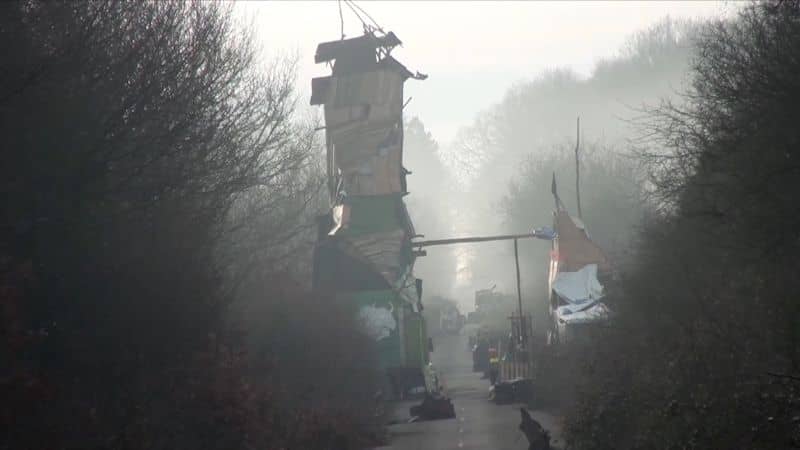
In 2000 the project was revived again. An official report stated that the project promoted public utility and interest. Despite the newly adopted Grenelle de l’Environnement, a multi-party debate aimed to unify policy on development and the #environment, stating that no new airports should be built, a decree was signed for this project to advance. Opponents of the project protested. And in 2009, local activists and residents organized a camp on the site. They didn’t want those beautiful fields and the historical farms gone. The project would have destroyed 2000 hectares of forests and wetlands, with a massive impact on #biodiversity, including hundreds of animal species and water sources that were officially protected. It would have taken away the farmers’ means of living, and anyway, living near an airport would raise health concerns. They didn’t see a reason anyway not to rebuild the old airport. So, they squatted the buildings and the empty farms and built their own houses and shacks. This is how ZAD started.
That moment also marks the decades-long effort to stop the airport project split into two overlapping stories. One was about the effort to resist and eventually stop the airport development project. The other was about experimenting with a different kind of living. But once the airport project got cancelled, and so those decades-long efforts won, the downfall of the second story started. In the authorities’ eyes, the community had no more basis for existing. It had no generosity for autonomous living experimentation. The state gave into the civic action to preserve the land but stepped in to reclaim that very land.
Through interviews with some of the residents and following them in their daily lives, Mazzucchi gives insight into what life within ZAD was like. Perhaps you’ve dreamed of it, perhaps you heard of it, but living in a community driven by what they called a ‘non-market economy’, in which members discuss things openly, live close to nature and put their skills together to build what is needed depicts a dream life, at least for some.
The idea of autonomy lies at its core, growing their own vegetables – for themselves but also supporting ZAD communities in other places, cooking together, building their own library, singing songs, and generally living a life of belonging. And belonging didn’t mean #homogeneity. The inhabitants took pride in the community’s diversity – a varied mix of farmers, anarchists, anti-globalization activists, liberals, and leftists. Some holding high degrees, some not. Some driven by political convictions, some just wanting to break up with conventional life. All united and inspired by the power that comes with being able to contribute to building a collective dream.
The inhabitants took pride in the community’s diversity
Let the people speak
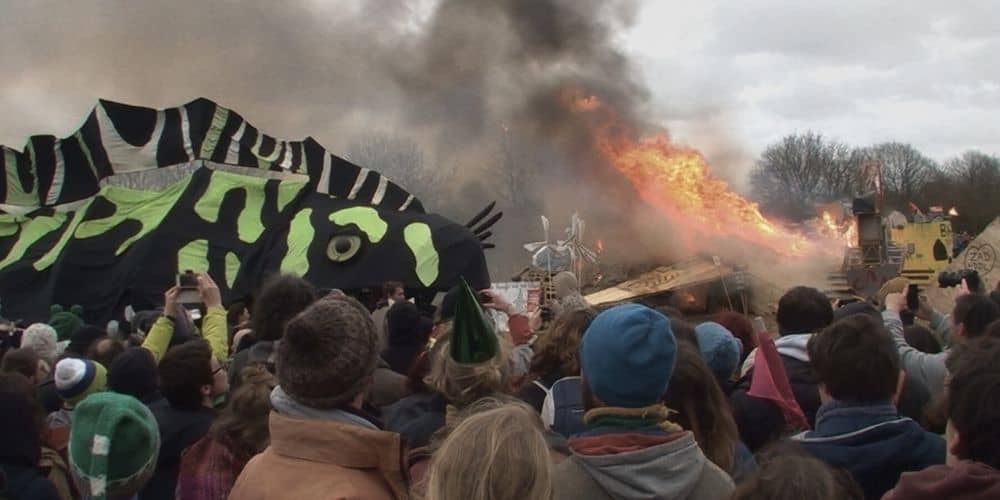
The depth of the film comes from capturing the simplicity of such a life, its natural slow pace combined with footage and narratives on the history of struggle in the area, all culminating with ZAD’s downfall and the mix of active and symbolic resistance in front of the 2018 eviction. One powerful recurring symbol is a huge man-powered salamander puppet, requiring tens of people inside it, moving in unison to propel it forward. It is a double symbol: of a protected species in the area, and of creative peaceful resistance that appears at protests and eventually at the end, moving towards armed authorities there to destroy the ZAD community, its members clearly not standing a chance in front of them.
And there is something in the film’s take on this community to life that makes one wonder – what would it be like to live that way? Are there things the camera does not show or see? There’s a divide coming from seeing no harm in this lifestyle and wondering, how would things be if anyone could just start a community?
Mazzucchi does well not to romanticise that life but rather let the people speak, and the camera captures the place’s dynamics. It is a different life it finds, yet it’s a normal life. This normality is a true positive revolt against the pitfalls of current life – in France but not only. It’s an example of people not only advocating for what they believe in declaratively or describing what they think life should be like, but instead truly being it, living and embodying an alternative that is close to their values. And by that, proves that an alternative is possible and not so scary and not so out of reach. Nevertheless, within the states we have created, the freedom to pursue it requires such an act of defiance that might be out of reach for many.