Sally Jacobson and Tuva Björk’s Unanimal is not a conventional animal-rights documentary. Rather than piling up statistics or shocking images, the film asks viewers to pause, to imagine, and to redefine. What does it mean to be an animal? And how different are we really from the beings we have categorised, commodified, and controlled?
Narrated by Isabella Rossellini’s calm, hypnotic voice, Unanimal invites us into observation. A snail stretches out of its shell in an artificial white studio. «Perhaps we are a snail,» Rossellini suggests. The scene sets the tone: the film resists lecturing, instead guiding us into a thought experiment where the line between human and nonhuman dissolves.
The film reminds us that in ancient cave paintings, animals were the central motif. Early humans revered them for their strength and instincts. When did that reverence shift into domination? How did we reduce animals to slaves of our needs?

The Fragile Line Between Us and Them
Anthropologists have long asked: What makes humans unique? Language? Tool use? Memory? Planning? Each supposed dividing line has blurred. Crows warn each other about dangers. Monkeys use sticks to capture ants for a snack. Elephants mourn their dead. Creativity, empathy, and strategic thinking are not exclusive to humans.
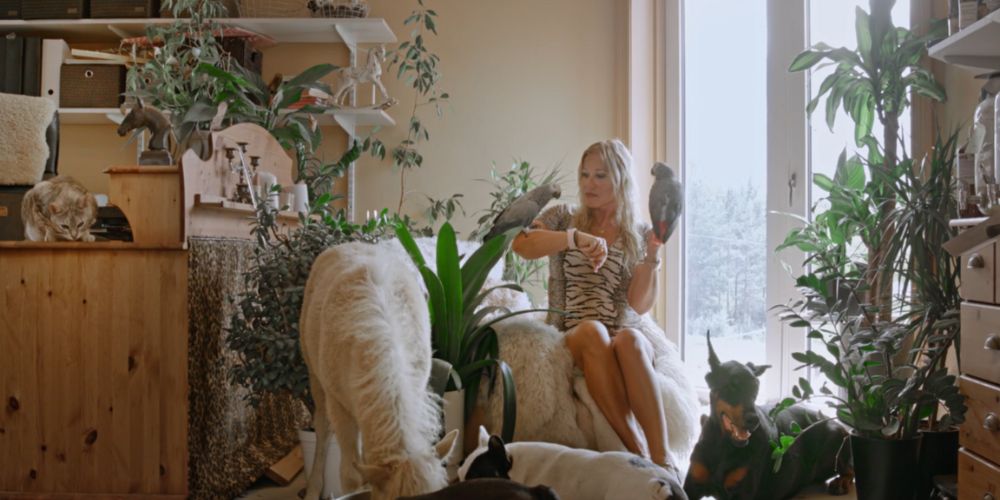
Yet despite the evidence, we persist in defining animals by their usefulness to us. The film avoids scientists and polemics, instead showing animals trapped in human systems: horses on treadmills, dogs in beauty contests, lions in cages. Through these juxtapositions, Jacobson and Björk expose the absurdity of our categories—«pets,» «livestock,» «wildlife,» «vermin.» These labels determine which animals are cherished, which are exploited, and which are hunted to the brink of extinction.
Creativity, empathy, and strategic thinking are not exclusive to humans.
Animals as Commodities
One of the most striking sequences follows racehorses. Instead of galloping freely, they are confined to mechanical treadmills, their bodies reduced to gambling machines for ageing men in smoke-filled halls. The film captures the quiet absurdity: horses tied in stalls, pampered against their will, and transported on planes, yet never free.
The directors resist sensationalism. There are no images of the pistol shots that kill many racehorses, as revealed in Aftenposten’s 2024–25 investigation of 25,000 registered deaths of racing horses. While horses can live to thirty, Norwegian racehorses are most often euthanised at just five.
Other examples emerge: we see fish farms, but there is no discussion on how millions of salmon endure a painful death long before harvest; the film also chooses not to show how breeding industries alter bodies for efficiency or aesthetics. By not showing the worst, Unanimal avoids numbing us with horror. Instead, it reveals the everyday systems of control we rarely question—zoos, pet ownership, domestication itself.
Pets, the film suggests, are a particularly insidious category. Dogs share our beds, eat our food, and comfort us, while pigs—equally intelligent and playful—are denied such privileges because their «role» is to be eaten. What defines a pet is not intelligence or emotion but human convenience. And even the pampered pet is not free: dogs on treadmills, dogs paraded in shows, dogs bred to suffer. Love and exploitation collapse into one another.

The Politics of Dehumanisation
What mechanisms must be in place for us to be able to treat other creatures this way? I can help myself from thinking of parallels in history. #Nazi #propaganda in the 1930s gradually recast Jewish people as subhuman, which led to their separation from other humans. Being isolated from the others enabled their extermination. European settlers defined #Native Americans# as lesser beings, justifying land theft. In both cases, redefining the other makes cruelty acceptable.
Today, animals are «meat,» «product,» or «pest.» Once separated from human qualities, they can be raised in factories, slaughtered in efficient systems of transport and liquidation. Efficiency becomes justification. We breed animals who will never see the sky or step on grass, who will never play freely or make their joyful discoveries. A few generations ago, most families kept chickens, rabbits, pigs and horses and knew them as individuals. Daily encounters created respect and reminded us of our mutual interdependence. Industrial farming severs that relationship, reducing animals to a product.
Today, animals are «meat,» «product,» or «pest.»
The Disappearing Habitat
Beneath this lies an even deeper threat: the destruction of natural habitat. Like colonial pioneers displacing #Indigenous peoples, humans expand by displacing every other species. What we call progress is, for others, the obliteration of home.
Archival footage of elephants chased by planes recalls this violence. Today, wild animals are pushed into shrinking reserves or the margins of cities. Since 1975, the world has lost over 70% of its wild animals. Can we imagine a sadder world than one where only humans remain?
A Subtle but Urgent Film
Unanimal works through suggestion, not shock. It refuses to become another exposé of factory farms, images that risk overwhelming or desensitising viewers. Instead, it creates a reflective space where we can no longer take our categories for granted.
The film’s strength lies in its balance of gentleness and urgency. Rossellini’s voice soothes even as the content unsettles. The cinematography lingers, refusing to rush. The message, however, is stark: humans are not superior to animals. We are animals too. And our ignorance is not a right but a choice—with devastating consequences for all species, including our own.