DocLisboa’s international competition entry Cinema Kawakeb is a timely, poetic, and metaphorical commentary on the political and social situation in the #Middle East# as it presents the picture of a small cinema run by Palestinian refugees in Jordan. The film’s postmodernist and auto-thematic form lightens its subject’s density by putting the region’s modern politics in a historical framework shaped from the beginning of the 20th century. Passing before our eyes, the archival chronicles of past conflicts and discussions, decisions and speeches, peace conferences and treatises, UN declarations and statements, evoke the bloody reality on the ground, leading to the current state of #Palestine. This is symbolised by the dilapidated walls and interiors of the eponymous Cinema Kawakeb, which is days before being demolished.

Closuers
An auto-thematic framing of slow observation brings a witty, slightly self-depreciating distance, balancing the gravity of the political situation, while revealing the pain, disillusionment, and helplessness of the people living in the region, here hidden behind the layered narrative form. So many opinions and arguments throughout over 100 years of history, which have only resulted in a reality far from any expected peace and decent living conditions—the reality of forced emigration, and longing for one’s homeland. The film’s form musters ironic distance as a means of psychological protection against the unbearable; a distance of the irony resulting from despair, disillusionment, and disbelief in words and lofty declarations.
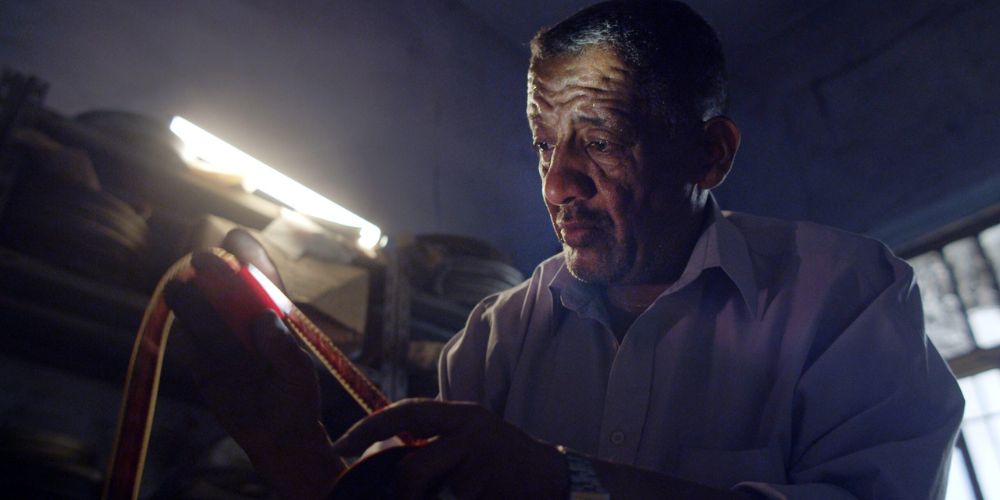
Shot mostly during the Covid closures, the Cinema Kawakeb shows a theatre which cannot reopen due to a dispute between the owners’ brothers. It is run by two operators, refugees from the #West Bank#, and is visited by only one «sponsor» – Hussein, a local, lonely, scrap collector, who comes after work to watch his favourite Indian films. The family of one of the employees, Hamza, used to operate a cinema theatre in the West Bank, and this is where he learnt details of the craft. Another one of the employees – Abu Ragheb – introduces Hussein to the perilous situation that the Cinema Kawakeb is about to be sold and demolished, and expresses fears of what happens next: «We will not have a place to meet.» For two years, both the operators were downgraded to cinema guards, while the owners were benefiting from the governmental subsidiary programs, but now they are about to be relocated; no one knows where. Hussein reacts to this news with peaceful resignation as he leads a lonely life, without family support, on the outskirts of society.
The film’s form musters ironic distance as a means of psychological protection against the unbearable; a distance of the irony resulting from despair, disillusionment, and disbelief in words and lofty declarations.
Old film posters
The archival newsreels illustrate the points of film’s construction. They span from the beginning of WW1, the establishment of the British colony, President Wilson’s 13 Points, the League of Nations’ special meetings, WW2 Peace Conferences, and so on, throughout the major political events of the 20th century, up until Benjamin Netanyahu’s speech following 7 October. From a Middle Eastern perspective, the oldest archival reels covering European world wars seem abstract and alien if not for their terrifying significance on the lives of their people. Falling bombs, including the atomic, killing and wounding every living creature, are a grim and constantly reappearing reality of the region, symbolised by starved, wounded, and disfigured cats living in the theatre. The film’s closing song expressing longing for #Jerusalem: «Twenty years have been searching for a land and identity, searching for my home that is there,» is followed by a street demonstration marching by the theatre, demanding to «open the borders”.
The camera is set still inside the cinema, only sometimes observing what is happening on an adjacent street, as if rooted in the ground. It ventures to the neighbouring street outside, rarely, as its main point of focus is the collapsing state of the building. Operating since 1945, the Cinema Kawakeb has long lost its glory. All the attempts at renovation have brought sorrowful results: broken pipes cause water leaks into the building, and only shattered, old film posters recall the cinema’s better days. But still, the «cinema has its charm», as one tourist puts it, which surprises its operators.
Poetic metaphors
The Cinema Kawakeb postmodernist narrative tools, irony and scepticism in summarising the region’s last 100 years of history present a case of the role of irony, on which #Soren Kierkegaard# in his The Concept of Irony wrote that: «when irony has been put under control, its function is extremely important in enabling personal life to gain health and truth. Irony as a controlled element manifests itself in its truth precisely by teaching how to actualise actuality, by placing the appropriate emphasis on actuality.» Irony helps to attain a distinct picture out of numerous, differentiated sources and layers of discussing and experiencing the subject. In a poetic metaphor, the film captures a cognitive stance of many people anxiously observing the development of current events. Which of the two films’ alternative ends (idealistic/wishful or realistic/pragmatic) will come to pass, we will all see in the future.