
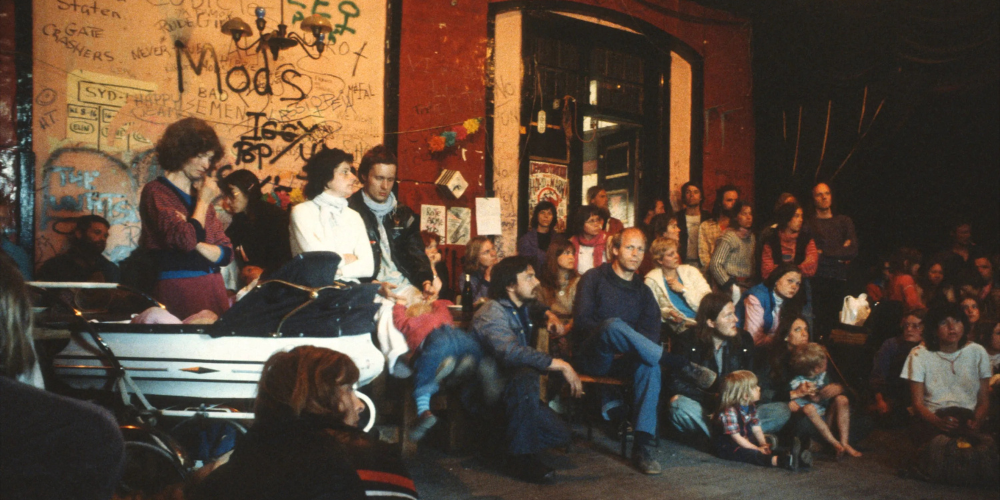
Fifty-five years on, Christiania persists in the European imagination as a place of permanent provocation. It is so mythologised that it often exists in the collective consciousness more vividly as a symbol than as a simple settlement. The colourful murals, the quaint, hand-built houses, the winding bike paths, the smoke, the stubborn aura of tolerated refusal all circulate in advance of any actual encounter. Karl Friis Forchhammer’s ode to the freetown, Christiania, which world premiered in the 2026 CPH:DOX DOX AWARD competition, begins from that burden of overrecognition and does something difficult with it. Instead of clearing away its myth in pursuit of some corrective realism, it restores an ideological depth flattened by tourism, scandal, nostalgia, and easy political shorthand.
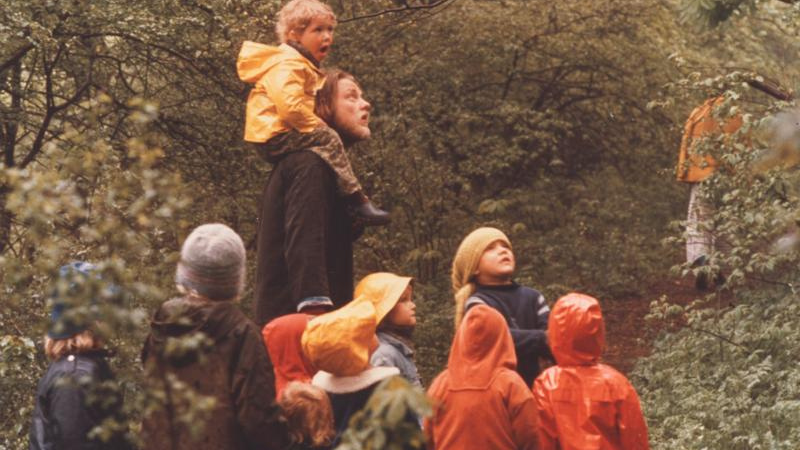
Blurred into legend
Forchhammer is well-positioned to tell this story. He was born in Christiania, and his parents made their lives there. That procity shapes the film’s credibility. Forchhammer knows that affection for a place deepens the obligation to think clearly about what has been lost, compromised, defended, and inherited within it. The result is a documentary that is warm and affectionate without pretending the whole thing has been something it hasn’t.
The founding of Christiania has, by now, blurred into legend. In 1971, hundreds of young people occupied the decommissioned military barracks at Bådsmandsstræde, entering an area that future residents had already been using informally by breaching the perimeter fence. The occupation gave a form to pressures that had been building for years, above all Copenhagen’s housing crisis, but also a broader desire to test another way of urban living. When the Danish state called Christiania a «social experiment,» it probably meant the label as a temporary bureaucratic fix, and maybe as a polite way of writing the whole thing off. But that throwaway phrase ended up serving as a kind of founding document for one of the longest-running countercultural communities Europe has ever produced.
The occupation gave a form to pressures that had been building for years
Lived textures
Forchhammer’s film is strongest when history appears as a lived texture. The archival material is superb. Its grainy footage of early settlement, construction, domestic improvisation, assemblies, costumes, children, workshops, and collective labour creates a clear sense of place. The film’s animated passages work in the same register, preserving its half-remembered roughness. Together, archive and animation produce a documentary form appropriate to Christiania itself, patched together and full of fingerprints.
Just as important, the film understands that Christiania’s inherent creativity was never a decorative supplement to its politics. The craft workshops, repair culture, salvaged materials, painted surfaces, and building experiments are all part of its political form. Forchhammer clearly sees this without reducing Christiania’s aesthetic life to mere bohemian charm. In this sense, Christiania belongs to a wider geography of self-fashioned enclaves that have tried to prise open space inside the managed city or at its edges. One thinks of Exarcheia in Athens, or of Amsterdam’s long squat tradition, from Vrankrijk to the now-evicted ADM and the legalised cultural free haven of Ruigoord. Further afield, Slab City in the California desert offers a harsher image of autonomy, with a less communal philosophy than by a survivalist refusal, yet still animated by a desire to live outside administered norms. Christiania differs from all of them in scale, longevity, and symbolic density, but suggests that it belongs to this larger atlas of places where alternative social forms are built under pressure and never without contradiction.
The documentary becomes more searching when it turns toward the contradictions that emerged from that founding openness. Pusher Street, now inseparable from Christiania’s global image, is focused here with all seriousness. The hash market had long existed as one expression of the freetown’s permissive ethos, tolerated in part because internal policing seemed to betray the spirit of the place more deeply than the market itself. Yet what began as local accommodation eventually fell under the control of organised criminal networks, with catastrophic consequences. Violence altered both the atmosphere of Christiania and the philosophical terms by which it imagined itself. Worse, the street developed a clear capitalist, market-driven ethos, as underground economies tend to do. The community’s efforts to reclaim or dismantle that area, driven largely by women, is among the film’s most morally acute and up-to-date material. To his credit, Forchhammer refuses the comforting script in which external corruption descends upon an otherwise innocent enclave, instead showing a community confronting the long afterlife of its own convictions.
The exposed borders of self-governance
Here, Christiania turns into an observational meditation on self-governance’s exposed borders—in essence, asking how a community can refuse the state’s coercive logics without leaving itself undefended against other forms of coercion. Consensus democracy, often romanticised from afar, appears here in its actual grain as labour, repetition, frustration, endurance, and an almost spiritual commitment to procedure.
The film has its limitations, however, which primarily lie in its very closeness to the subject. There are moments when its formal language remains overly dutiful, and one occasionally wishes it would employ greater risks to match the radicalism of the history it recounts. Yet even in this restraint, Forchhammer seems less interested in innovation than in making modern Christiania legible to itself.
Christiania, as a place, is still being worked on from within. Its eponymous film shows its wear, contradictions, continuities, (recurring) arguments, and the countercultural energy that has allowed it to persist across a half-century. Forchhammer understands that history here moves through the present, through people still deciding how to inhabit a working project they did not begin for themselves. The freetown emerges as a place still full of memory, still marked by conflict, still asking more of its residents than nostalgia can provide.






