«Don’t you think everything looks strangely normal?» Artsiv asks Comes in a voiceover, while unveiling to him, through his mobile phone camera, the deserted streets of Stepanakert, with only occasional lone figures strolling by. The former capital of Nagorno-Karabakh has now been renamed Khankendi following Azerbaijan’s appropriation of the territory, but in Here, Elsewhere this is not even mentioned. Winner of the Jury Prize for Best Medium-Length Film at the Visions du Réel Film Festival earlier in April and currently screening in a native context at the Golden Apricot International Film Festival (12–20 July), this captivating documentary is more of a memory vessel, yearning to preserve the last drops of authentic native life on this soil, than a chronicle of the actual events.
As Comes Chahbazian was not allowed to film in the region himself, he asked his local friend Artsiv to shoot under his instructions – both in terms of content and form – and guided him throughout the whole process. The result is a powerful and quite unique piece of cinema, primarily because it documents a firsthand experience by showing from inside the ethnic cleansing in Artsakh – the Armenian name for the Nagorno-Karabakh territory, a sacred land, being one of three ancient provinces of Armenia located at the eastern end of the Armenian Plateau. Its political autonomy endured continuously from antiquity until the 18th century, serving as a stronghold of Armenian identity and Christianity, where the country’s culture and civilisation withstood centuries of external domination; thus, its annexation by Azerbaijan represents not only a territorial loss but also a profound symbolic one, disrupting a fundamental sense of belonging. However, the Artsakh conflict has now fallen silent and largely disappeared from media attention, even as the displacement continues, while the notions of «international community», «right to self-determination», and «justice» have been profoundly shaken.
the Artsakh conflict has now fallen silent and largely disappeared from media attention
Secondly, the amateur footage in Here, Elsewhere is remarkably cinematic, unlike that of many other documentaries employing a similar approach. Concise in duration and precise in framing, the film creates poetry out of the everyday without resorting to the intensely dramatic and, in doing so, conveys a mood and a rich emotional palette, allowing us to step into the characters’ shoes.

Poetry under siege
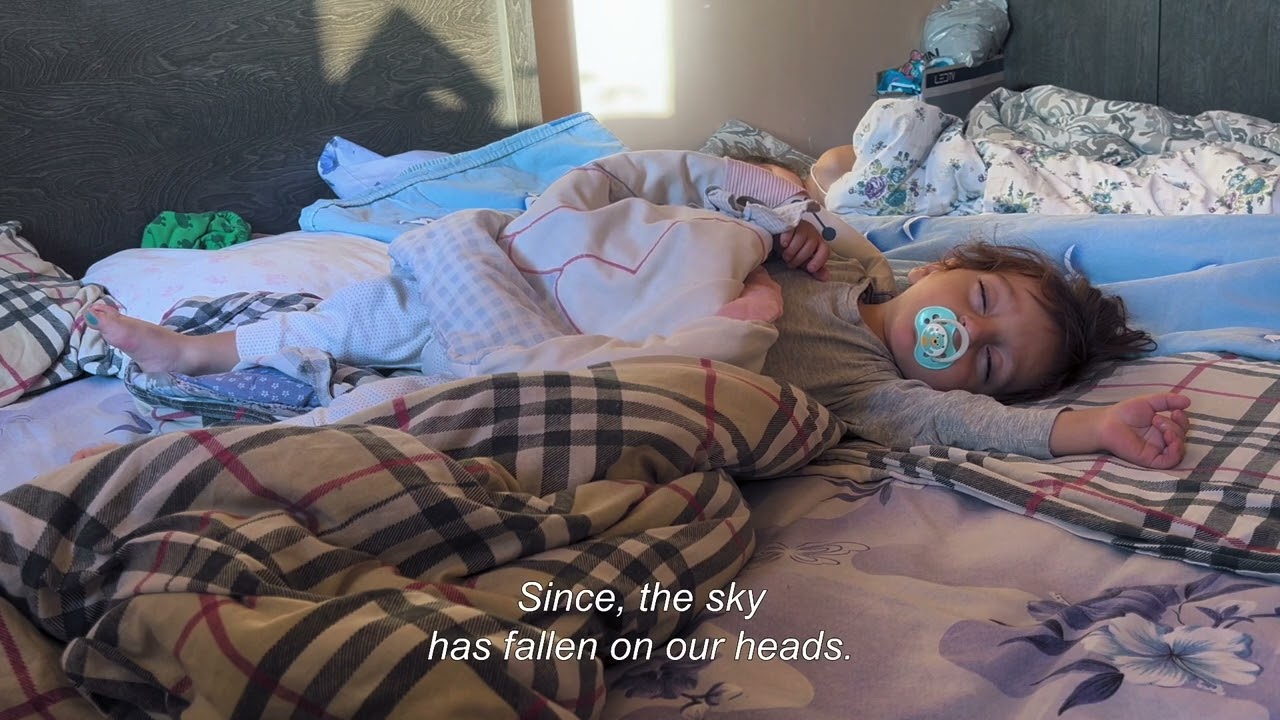
Artsiv, his wife Tatev, and their five children have been under siege for 217 days as the documentary embarks in 2023. Lethargy is overwhelming and all-consuming: queuing for bread for two hours only to leave empty-handed, with almost no cars on the road. Stepanakert has become an «eco-friendly capital,» Artsiv notes with bitter humour. Yet people still share their scarce food with one another – a solidarity that restores faith in humanity.
As an amateur cameraman, Artsiv proves to be far more ethical than many professionals who might seek sensationalism – he focuses on meditative moments rather than showing people in distress, noting that he does not film queues for food because no one wants to be shown in a state of deprivation. Instead, he captures a colourful table, reminiscent of a Martiros Saryan still life, covered with modest yet beautiful vegetable dishes made from pumpkins, peppers, tomatoes, and cucumbers, typical for the fertile Armenian soil. He admits that he does not know what to film, as time seems to stand still, yet out of this mundanity emerge picturesque études: reused plastic bags hanging out to dry, ants moving in and out of a hole in the ground, and children playing basketball, all of them forming captivating compositions; evening scenes lit by candles due to the electricity shortage, playing with shadows; the simple act of making bread depicted as a prayer ritual; the pouring of soil from the lost homeland into a glass jar. Tatev is also tempted to film, and that is how Artsiv becomes a character as well – a pensive, furrow-browed man before the camera. «As we cannot paint, we film… the way of hanging in there.»
Last traces of belonging
Artsakh is a painful and persistently present topic for Chahbazian: his previous documentary Notre village was a portrait of volunteer soldiers who took the initiative to protect their homeland, while Here, Elsewhere captures the final moments in the ancestral territory of the last people standing – the same heroes from the previous film. And it also unfolds into two parts: the first half absorbs us within the limbo of uncertainty, implying feelings of remorse, despair, and finality, while the second part, in which the family moves to Armenia, is more of a reflection on what is left behind, as if a current life here and now is not possible anymore. Tatev will even nostalgically arrange another still life out of fruit and vegetable coupons, mirroring the first part.
Here, Elsewhere undoubtedly echoes Jean-Luc Godard and Anne-Marie Miéville’s mid-length documentary of almost the same title, Here and Elsewhere (1976), which is both a chronicle of the Palestinian resistance movement and an analysis of contemporary social and political crises. Chahbazian’s contemporary take on displacement avoids direct polemics, leaving the political context as an inevitable surrounding aura, thus creating a profoundly humanist depiction of forced exile in which even hope is not denied. And as the film approaches its ending, Tatev replaces the urge for self-expression through filming with the quiet act of picking up a paintbrush.