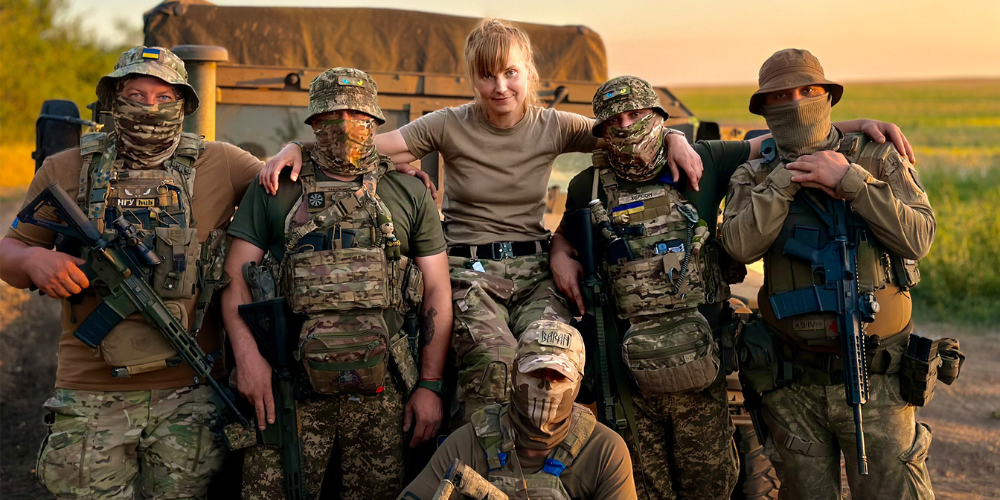
Some documentaries are already a testament of history as they are filmed. Don’t Ask Me if I Killed is a brilliant historical document and an extraordinary watch. Selected for the Documentary Competition at this year’s Sarajevo Film Festival, the 104-minute feature reflects on endurance and moral responsibility through director Helena Maksyom’s perspective. Her personal diary, filmed over more than a thousand days (starting in 2022 and finishing in 2025), follows her transformation from an inexperienced filmmaker into a volunteer, fighter, and eventually an officer. The narration is raw and unfiltered, striking the viewer directly. This effect comes from the director’s decision to show reality as it is: not only the consequences of war and its daily atrocities, but also, above all, the psychological difficulties the people involved experience.
The Russian-Ukrainian conflict is one of the worst wars of our time, and there is undoubtedly a need to bear witness to it. In this case, we are presented with an extraordinary record of the conflict that lets us reflect on events still unfolding as we watch the film. The reality depicted on screen is not confined to the past; it continues in the present, making the experience immediate and deeply unsettling.
The paralysis of people in the face of war
This is perhaps one of the most remarkable aspects of the contemporary world: although spectators are constantly made aware of atrocities around the world, especially through social media, we often feel completely powerless. Perhaps the only thing we can do is keep people aware of what is happening, make audiences more sensitive to these issues, and, above all, let them see the reality of these events with their own eyes. This allows them to form clearer, more informed judgments and, most importantly, to understand the circumstances before forming an opinion.
What is particularly remarkable about this documentary is its composure and the way it is edited. The film alternates between intimate moments involving the protagonist and the people she chooses to interview, and moments that concern the nation as a whole—events much larger than the individuals themselves, which they try to understand and grasp as human beings. As a result, the film conveys a broad spectrum of emotions about life’s fragility and ordinary people’s inability to make decisions about a conflict whose most important decisions are made by those in positions of power.
One of the most moving aspects of the film is probably the reflections shared by the protagonist and her companions about the importance of family and the importance of ensuring a future for their children. At a certain point, the film suggests that the conflict may not end in the short term, and that the soldiers sometimes begin to lose sight of the reason why they are fighting. They fear that their efforts may not lead to a meaningful outcome in the near future, but instead become merely a drop in the ocean of a much longer, bloodier, and potentially intergenerational conflict.
The fact that Helena Maksyom has a background in filmmaking but has also chosen to take part in the war gives the documentary a particularly strong structure and direction. As a result, its technical aspects are extremely successful. An entirely amateur recording might have preserved the same transparency and authenticity we find here, but it probably wouldn’t have had the same cinematic power or narrative strength. The director’s professional background lets her turn her direct experience into a coherent cinematic narrative without sacrificing authenticity.
Intimate moments
There is also the aspect of her being a woman within a predominantly male environment. However, the film does not constantly exploit this for narrative purposes. Instead, the film creates a remarkable atmosphere in which she is not presented as fundamentally different from the men around her, despite the obvious differences in gender and experience. At the same time, aspects of her identity as a woman emerge naturally in her reflections—for example, when she speaks about the possibility of becoming a mother, or when the men around her call their wives and children while she remains alone, filming herself.
These moments are, in many ways, the film’s beating heart. They offer a necessary pause from the violent images of war and let the viewer connect with the protagonist on a deeply personal level. The contrast between the scale of the conflict and these quiet, intimate moments makes the documentary particularly powerful: war is presented not only through destruction and violence, but also through the personal lives, fears, relationships, and hopes of the people forced to live through it. The scenes Maksyom shares with her mother are among the most moving in the film: a daughter visiting her parent, knowing that each visit could be the last—not because of her mother’s old age, but because of the risk of death she faces in a war zone. It is a tragic paradox that should never exist.
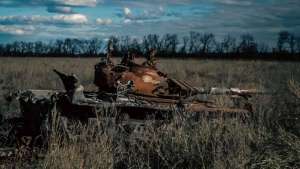
Nonetheless, Don’t Ask Me If I Killed also does not restrict itself when it comes to showing the raw realities of the conflict: a captive Russian who has to undergo an interrogation, a small group of dead Russians starting to decompose on the ground, a Ukrainian soldier who shows the camera his wound, with skin coming off his hip. Is there a space for hope? Maybe cinema does not always have the answer, but it can pose the questions.