Teboho Edkins’ 38-minute documentary An Open Field offers an exclusively intimate excursion to the crash site of #Boeing 737 MAX in Ethiopia, turning to collective grief as a guiding focus. A corporate negligence, driven by financial priorities, claimed the life of his brother, whose memory is now held by the people of Bishoftu. An Open Field, which premiered at #IDFA, where it received the award for Best Short Film, affirms the universality and complexity of the language of mourning, set in stark contrast to the impersonal rhetoric of the company. By absorbing the charged presence of the place itself as both a personal and cinematic resource, Teboho Edkins underscores how vital and rare physical access to sites of catastrophe can be.
The notorious Boeing 737 Max
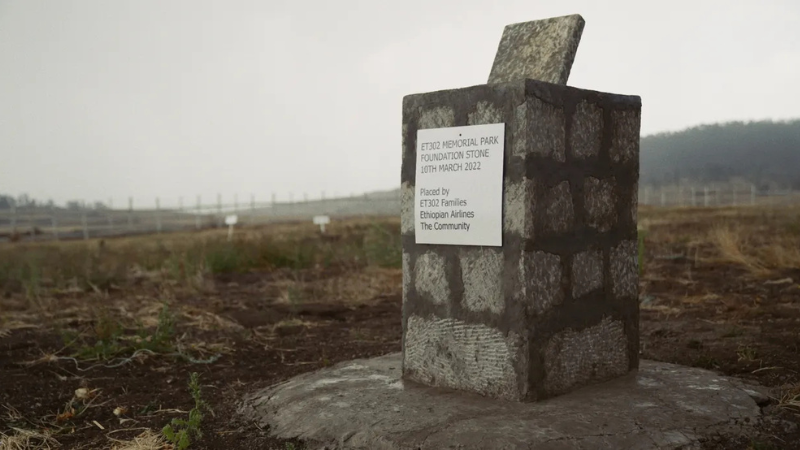
In just seven years of service, the Boeing 737 Max—introduced initially as a more efficient version of the iconic American airliner—caused two catastrophic crashes that killed a total of 346 people, eventually turning the model into a new reference point for aviation fear and distrust. In October 2018, flight 610 fell into the sea off the coast of Indonesia just minutes after takeoff, killing all 189 people on board. Although that crash raised concerns about a new Boeing flight-control system known as MCAS, this scrutiny was not rigorous enough to prevent the next disaster, which claimed the lives of 157 passengers and crew. On March 10, 2019, flight 302 departed Addis Ababa, Ethiopia, and crashed within six minutes of takeoff into an open field near #Bishoftu. Subsequent investigations unsurprisingly revealed that Boeing’s precarious implementation of the flight-control system reflected a prioritisation of profit over basic safety. For several years up to date, the company has been locked in legal battles with governments and the families of the victims, revealing weaknesses and violations surrounding a demonstrably unsafe aircraft and, as stated during the trial, «senselessly took many lives.»
On that plane was Teboho Edkins’ brother, Thabiso. Teboho, together with his father, Don, who served as the film’s director and producer, respectively, travelled to Bishoftu to confront their emotions at the epicentre of the crash. They find something more enduring when being accepted as «brothers and sisters» by the locals, for whom mourning is the crucial cultural element and who now carry the burden of grieving the victims of the flight. Capturing the intimacy of the community’s processions, the camera gives equal attention to the natural fragility of Edkinses, immersed in prayer as in the shared, lucid language of grief.
Teboho Edkins underscores how vital and rare physical access to sites of catastrophe can be.
The familiar contrasts
Teboho Edkins has long distinguished himself through over a dozen shorts and features marked by his illumination of post-apartheid South African stories and landscapes. Attentive to the volatile conjunctions of cultures and the seismic shifts in places unmoored from the front pages of the Western news cycle, Edkin’s acclaimed feature-length documentary, Days of Cannibalism (2020), tells a story from #Lesotho, where he once lived. It chronicles economic migrants from China as another victim of modern #capitalism, and the shifting balances of power and societal morality they brought. But in An Open Field, he adopts a participatory mode as an intuitive directorial method. By observing the community, its rituals, and the piercing experience of tragedy that has befallen them, such an obligation to a culture of mourning has a contagiously calming effect.
Avoiding the emotional linearity, An Open Field unfolds through a layered, multimedial structure that often comes as an aid for a reflective documentary about #trauma. From the outset, Edkins interweaves news, telecommercial fragments, and the nervous rhythm of a dialling telephone with images of the field, until eventually he leaves himself alone in the frame, listening to the surrounding wind next to the memorial. Out of this convergence of media and dispositions emerges a vivid contrast between the community’s compassion and constrained corporate posture. These widely familiar oppositions of altruistic vs negligent, metaphorically echo the processions of mourning set against the superficial rhetorics of Western news coverage. What ensues is a deeper inquiry into what it means to become the resting ground for a stranger’s soul, a question whose sacred weight cannot be genuinely imbued from afar.
The place and the proximity
There is a scene where two men sit in the field recalling the day they helped collect human remains from the 28-meter-wide crater left by the plane. As a man turns a stone in his hand, over a scene, it is revealed to be a fragment of a human skull, something the ground still yields with ease.
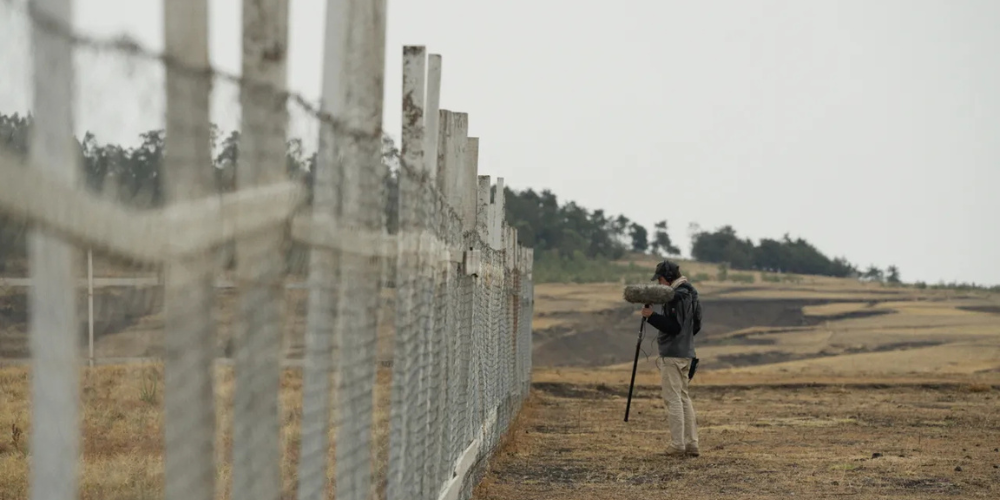
Highlighting the importance of physical presence and palpable evidence, An Open Field avoids the familiar didacticism of films about loss, which often reduce mourning to communal consolation. Film also has the power to demonstrate how much solace can be drawn from physical proximity to the site of catastrophe — a place haunted by an ineffable phenomenological presence, by ghosts, by evidence, and by energetic charge above all — are valuable resources long coveted by documentary cinema. This is why Edkins so often appears in frame holding a boom, listening, recording, as if attempting to reach his brother’s presence—a gesture that carries a hint of healing in the end. This is also where the film’s universality lies—in an unspoken invitation to think about those who cannot reach such places, thinking alone of those who lost families on a Malaysian flight, buried in the occupied #Donbas. At least the victims of Flight 302 have their invaluable guardians.