Lesotho-born filmmaker Lemohang Jeremiah Mosese guides us through his childhood memories in a firm and verbose monologue. An ode to #cinema and an «eternal nod» to his mother, Ancestral Visions of the Future explores the dualities of exile, leaving and returning, disillusionment and longing, mother tongues lost and others gained. In its fragmented form, however, Mosese’s #docufiction transcends the perennial question of «what is home?» and attempts to penetrate the interconnectedness of the individual being with the being of humanity – #Ubuntu, the ancient African humanist philosophy.
Deconstructing the form
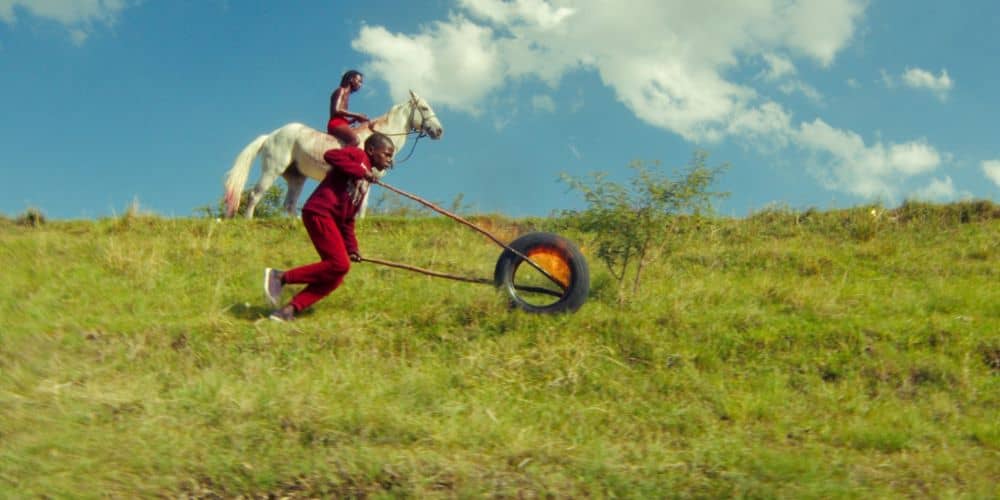
Mosese is known for his experimental approach to cinema. His most notable films, Mother, I Am Suffocating. This Is My Last Film About You (2019) and This Is Not a Burial, It’s a Resurrection (2019), grapple with the themes of #memory, exile, #colonialism, and belonging. His films are as much visual and sonic experiences as they are narratives, often resisting conventional cinematic structures. Ancestral Visions follows a similar trajectory. The film shares many traits with a quintessential essay film: Mosese’s voice guides the narrative, highlighting key visual elements, reflecting on the past, ascertaining the present, and mythologising the future. However, juxtaposed with theatre-like performances and staged compositions, the complexity of symbolism and myth-making goes beyond the conventional tradition of the essay film. He takes us into his imagination.
Mosese is interested in the revival of ancestral knowledge as a blueprint for the future. Rather than seeing tradition as something static and outdated, Mosese perceives it as dynamic and malleable. Yet this is not pure #Afrofuturism, like the work of #Kodwo Eshun#, #Octavia Butler#, or #Wangechi Mutu#. Mosese’s oeuvre suggests that imagining the future—especially for marginalised and colonised peoples—requires looking backwards. Like Sylvia Wynter’s New Man, which envisions a counterfigure to the Eurocentric idea of «Man» shaped by colonialism and #capitalism, Mosese reimagines what it means to be human, disrupting the Western ontological ideas of being, time, and human. In his vision, time is circular, not linear; so is the land, brimming with memory, knowledge, and healing power; so are people, bound to one another across generations and geographies.
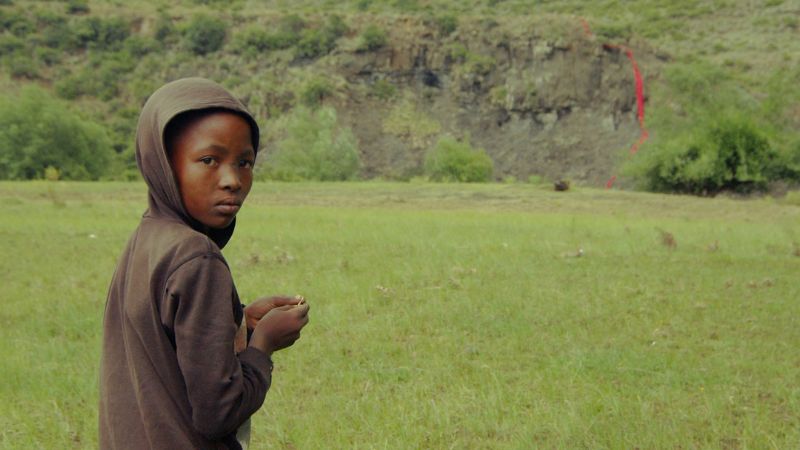
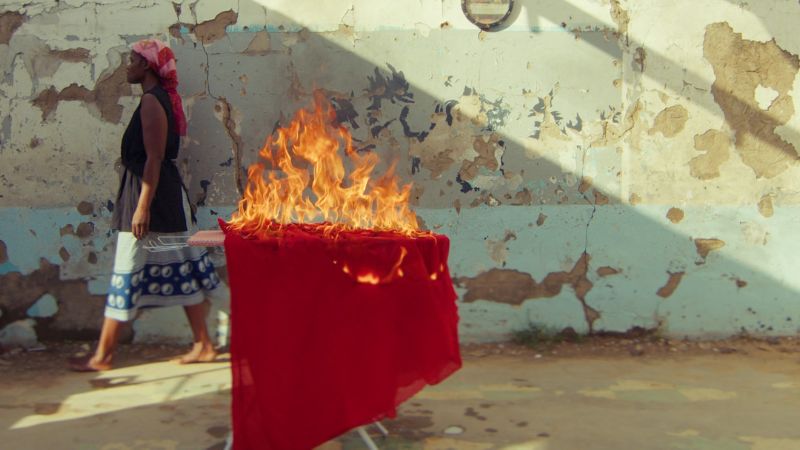
Formally, however, this makes it challenging for the viewer to piece everything together. From the outset, Ancestral Visions offers an image of a strikingly long red ribbon that looks like a bloody, meandering river. Scattered across the Lesotho soil, it serves as a visual metaphor akin to an umbilical cord, a connection to the land that is vital but, like the navel string, can be discarded. Told loosely through the eyes of a small cast of characters, the old man and the young boy toiling away on the land, ploughing the stubborn soil with a pair of oxen, Ancestral Visions weaves together the personal and the collective: the stories of Mosese’s childhood and the colonial history of his land. As he recounts his mother working as a cleaner for the British government, scrubbing the very rooms where Africa’s borders were carved out, the camera lingers on #Basotho women washing clothes in the river.
He takes us into his imagination.
But who are these people? Are they a testament to intergenerational survival against all odds? Do they represent Wynter’s New Man? Are they living embodiments of Ubuntu’s philosophy of interconnectedness? The director’s voiceover evades these questions and, at times, is interrupted by a jarring soundscape that slows down the narrative, making the bodies on screen rather mythical and universal. While the old man and the boy exist within the pastoral landscapes of Lesotho, the city—perhaps Maseru—is presented with a contrasting rhythm and atmosphere. Other enigmatic characters appear. Here is a mad woman who howls like a wounded she-wolf; here is the herbalist, Sobo, who dances, transfixing and hypnotic. Meanwhile, Mosese keeps musing on the circularity of time and the mundanity and omnipresence of violence within the walls of his home and in the annals of history.
At times, I was jolted out of the film’s rhythm, perplexed by the dissonance between the narration and the imagery—especially in tableaux shots like a young boy with his face covered in flies or Sobo walking with knives protruding from his back. Although visually stunning, these shots forced me to search—in vain—for a deceptive sense of wisdom they were meant to impart.
Exile
«Exile is strangely compelling to think about but terrible to experience,» wrote Edward Said in his landmark essay Reflections on Exile. It seems to me that this is what Mosese has conveyed – translating the terrible experience of exile onto the screen while doing away with the typical culprits: the subject of the exile, the financial hardships, the red tape, the distance, the long #WhatsApp calls. Instead, the filmmaker opts for evoking what exile feels like. «I am suspended between worlds, neither rooted nor free, wholly here nor there,» the director says in the prologue.
Mosese left Lesotho of his own free will. He was neither a refugee nor a #genocide survivor. Nonetheless, the painful realisation of losing home dawned on him much later, matching the intensity of forced exile. In one of the film’s most memorable scenes, Mosese describes a profound encounter with an African man in Berlin, where he resides. The scene shifts abruptly from the sun-baked landscapes of #Africa to the cold, towering marble statues, signifying European wealth. The man, wrapped in dirty rags, shouts in his mother tongue, forcing Mosese to see himself in the man. The sight of the man stirred the ancient call of Ubuntu in Mosese’s heart —«I am because you are.» It was then that he realised it was time to go home. But home had become a mythical place.
Ultimately, in seeking to capture both the tangible reality of his homeland and the spiritual essence of Africa, Mosese grapples with the conflicting emotions familiar to all who have experienced exile. His homeland is at once near and far, but Mosese does not tell us what home is—he asks us to feel its absence. The filmmaker’s decolonial approach is commendable. Fusing African storytelling traditions with avant-garde cinema, Mosese creates films that are more like rituals or dreams, reminiscent of the work of Djibril Diop Mambéty and Apichatpong Weerasethakul.