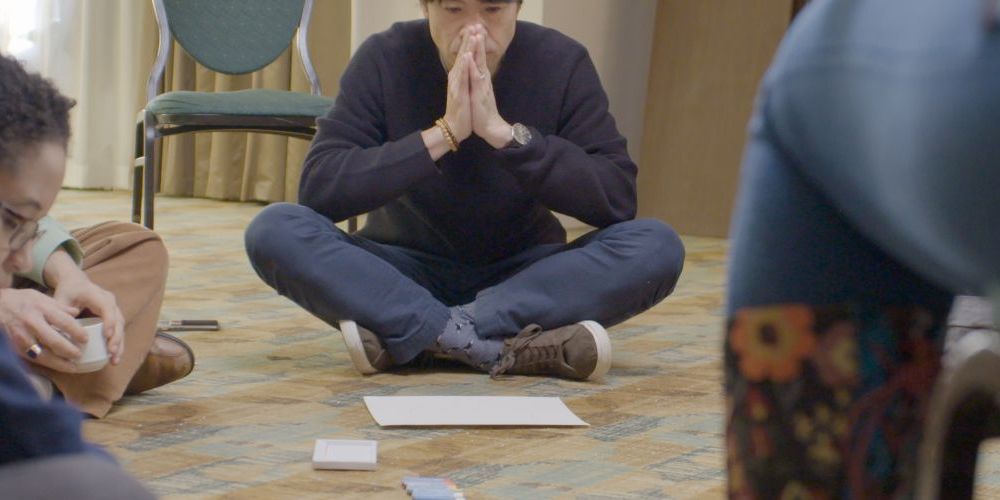
In the expanding field of environmental documentary cinema, cameras most often turn their gaze toward the aftermath of disaster, framing it as a terrifying warning and an urgent call to act. Far more rarely do they linger on those who devote their lives to understanding and preventing such crises. The filmography of Swedish director Nathan Grossman belongs firmly to this latter tradition. Following his documentary portrait I Am Greta, Grossman’s new film Climate in Therapy, part of the «Testimonies» section at #Ji.hlava IDFF#, offers a strikingly simple yet profoundly revealing idea: documenting a group therapy session for climate scientists. It emerges as a wise and humane invitation to engage with those whose climate anxiety is chillingly convincing, as they view the future through the cold clarity of pessimistic statistics and graphs that most people are reluctant to confront, let alone understand.
Gestalt-inspired approach
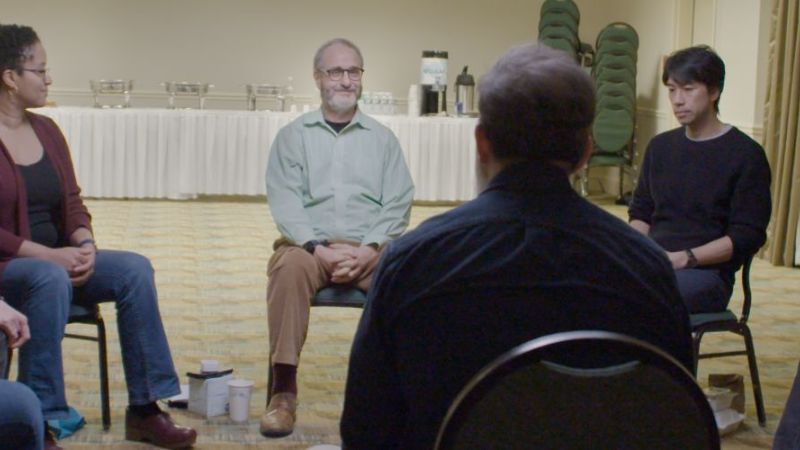
«There are 20,000 climate scientists on the planet, and many of them have never spoken about their climate emotions. We invited seven of them to group therapy,» reads the opening credit. The film begins with busy preparations for the first day of therapy — the film crew setting up the lighting, bagels in the catering corner warming up, the therapist pacing the room. Through the voice-over, he is amidst the fear for the day, as the patients are «very f*cking smart.»
It is a scientifically proven fact that humanity must reach #carbon neutrality# by 2050 to prevent the catastrophe. Yet another scientifically proven fact is that constant professional interaction with heavy content without any type of psychological support inevitably erodes one’s #mental health#. Much like those who work in OSINT and must review footage of war crimes, for scientists, this graphic «content» is the endless charts and figures that quantify the grim future for the planet. From the very first minutes of the session, the therapist seeks to ease tension and establish a connection. Through his perspective, we might start to check boxes of warning psychological conditions among the participants: many cannot step out of their professional mindset, immediately demanding structure and measurable results from therapy; one scientist describes emotions as ‘something irrational’ if they are not directed toward action; another confesses in impatience that strains his relationships with family and relatives; yet another often hides his profession in public altogether. What unites them, which is almost palpably present in the air, is the shared burden of living in a state of chronic suppression, trapped in cycles of anxiety over a looming environmental catastrophe, surrounded by a system impotent to support them.
The proposed group therapy follows a Gestalt-inspired approach, designed to address deep #trauma — to give form to anger, release suppressed emotions, and confront inner conflict, and also to identify the limits of one’s capabilities. Beyond drawing their biggest fears for the Earth, the therapist introduces a powerful exercise: he places a chair in the middle of the room and asks them to imagine a child from the year 2050. What would you say to them? Through the waves of denial and self-doubt, tears come, along with an admission that they have done everything they could.
many cannot step out of their professional mindset
A therapeutic setting
Climate in Therapy also provokes an approach-connected reflection, regarding the camera’s presence inside an actual therapeutic setting. Here, the guiding principles are privacy and openness, and the awareness of being filmed inevitably shapes the latter. This ethical paradox has long haunted documentary cinema, yet in this case, it seems resolved through the filmmaker’s own identity: Nathan Grossman has dedicated his career to environmental storytelling, and perhaps his presence, or even his indirect participation in the therapy, might feel as necessary for him as it does for his subjects.
Although officially described as an «observational» documentary, the film rather resists such a strict label. Grossman’s direction is generous with music and editing, both of which amplify the already heightened emotional atmosphere in the room. Between sessions, the handheld camera drifts into hallways, eavesdropping on private moments — the scientists’ solitary pacing, the therapist’s silent preparation. But perhaps the most aesthetically precise decision lies in the film’s structure as a whole: at 64 minutes, it mirrors the average length of a real and successful therapy session — beginning with nervous tension, going through painful openness and release, and ending with an exhale of relief.
How don’t you lose hope?
«How don’t you lose hope?» — at the end, the therapist asks a question that echoes through the film’s beginning. He compares scientists to the rescue dogs of #9/11, who fell into #depression, finding only lifeless bodies. It is not a question seeking an answer, but rather a fragile encouragement to scientists whose love of knowledge has become entangled with despair. Beneath this exchange lies a deeper critique of an institutional system that not only fails to act on the impending catastrophe but also lacks any structure for psychological support for those who have dedicated their lives to warning us about it.
In keeping with its therapeutic form, Climate in Therapy could not end without a touch of cautious optimism, though it arrives with purpose and by pleasant surprise. The closing credits reveal, quite literally, an academic report titled ‘Safe Spaces’ and Community Building for Climate Scientists, Exploring Emotions Through a Case Study — the scientific outcome of this group session, and consequently, of the film itself. If world governments continue to ignore the verified reality of an approaching disaster, then at least one can offer help to those who did everything they could.