The rhetoric of public political discourse strategically and systematically conflates «Israeli interests» with the interests of the Netanyahu government. This shamefully applies even to a country like Germany, which supplies and purchases weapons (!), allied with Israel. Consequently, pro-Palestinian statements are immediately branded as «anti-Semitic.» The latest victim of these strategies to come into the spotlight is Berlinale´s festival director Tricia Tuttle.
For days, rumours circulated that the festival director should leave because the Palestinian director of the award-winning film Chronicles From the Siege, in his closing speech, had alluded to Germany’s complicity in an ongoing genocide, and because she appeared in a photograph with Palestinian filmmakers waving their flags.
Now she can stay, but an oversight committee will supervise her and must require filmmakers and other Berlinale participants — including the press (?) — to sign a «code of conduct.» We would have liked to learn more about this code. For over a year now, artists and filmmakers in Germany have been forced to refrain by signing a document from making antisemitic statements if they wish to participate in public events and discussions. And, as mentioned, in Germany, what is considered antisemitic also serves as a platform for attacking pro-Palestinian statements. Many cultural figures have already left the country, and it is now foreseeable that a plethora of films from the Arab world will no longer be submitted to the Berlinale. Also (covert) self-censorship in the film selection process is anticipable. This significantly weakens the festival’s traditional cultural significance as the most politically recognised A-list film festival worldwide.
These new restrictions are a more effective way than a simple dismissal of political influence in the cultural space, where freedom of speech, expression, and reflection is needed and essential. Now, the cultural responsible figures themselves are being instrumentalised and manipulated.
Cultural repression
Such rhetorically defamatory distortions and anti-Zionist constructs certainly do not represent the interests of a segment of the Israeli population that demands an immediate end to the genocide, peace negotiations, and aid for the Palestinian people. Israeli filmmaker Anat Even is one of them. She lost her teacher and friend, Yonatan Carol, as well as his family and many other friends. They all got murdered by Hamas at the Gaza border, in Kibbutz Nir Oz, on 24 October 2023. Only one person survived. The filmmaker herself had spent her early years there.
In an admirable and, by today’s standards, «courageous» way, she speaks simple truths. In her documentary Collapse (Effondrement), she quotes, in the very first minutes, the words of the Hungarian-Jewish writer, Holocaust survivor, and Nobel laureate in Literature, Imre Kertész:
«We were fully aware of the destructive ignorance, stupidity, barbarism, and wickedness spreading through our country like a plague, and of the approval given to them by the authorities. Yet we regarded all this with indifference, mole people who had long since given up any attempt to improve the state of public affairs in general, or to bring about any change whatsoever.»
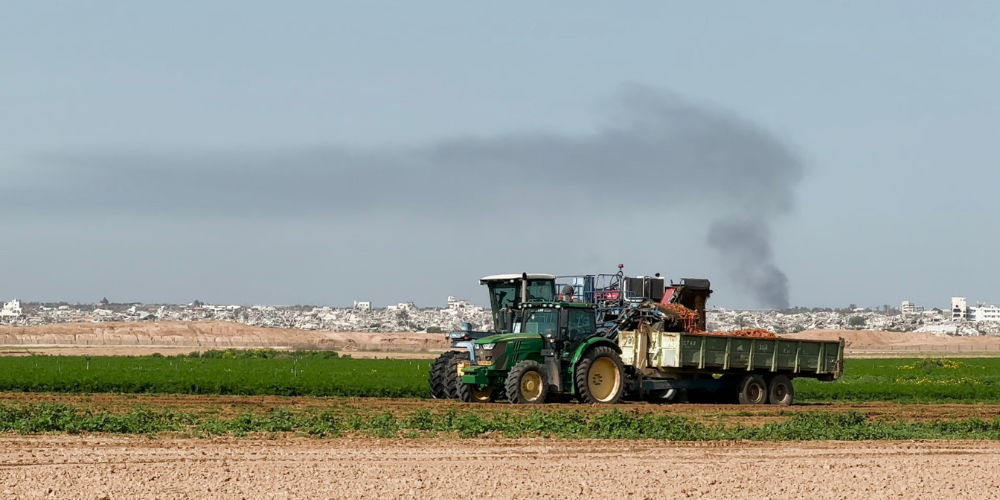
She even drives her car along the border with the Gaza Strip, ignoring military obstacles, and presents her observations in photographs and very personal commentary that doesn’t hide her feelings. The first photos were taken in Nir Oz. She observes peaceful agriculture on the Israeli side, a stark contrast to the neighbouring towns in the Gaza Strip, which are subjected to constant bombardment. Nir Oz is systematically used as a memorial site to stimulate patriotic, if not vengeful, feelings. Yet, Nir Oz was home to residents who dreamed of peaceful coexistence and spoke out against the occupation. Now, the residents of many neighbouring houses have been evacuated, and part of the fields has been declared a military zone.
She maintains constant contact with her friend Ariel, who lives in Paris. This deeply disillusioned man reminds her that massacres have always served organised armies as a pretext for committing crimes against humanity, such as the Sétif and Guelma massacre, a slaughter of tens of thousands of Algerians by the French army after a riot of French settlers on 8 May 1945.
The same rhetoric of violence and racism is resurfacing once again. It is even causing formerly left-leaning, government-critical Israelis to switch to the right-wing camp and agree with claims that «Arabs» always want war. Facts such as the presence of Palestinians in the Gaza Strip since 1946 are ignored.
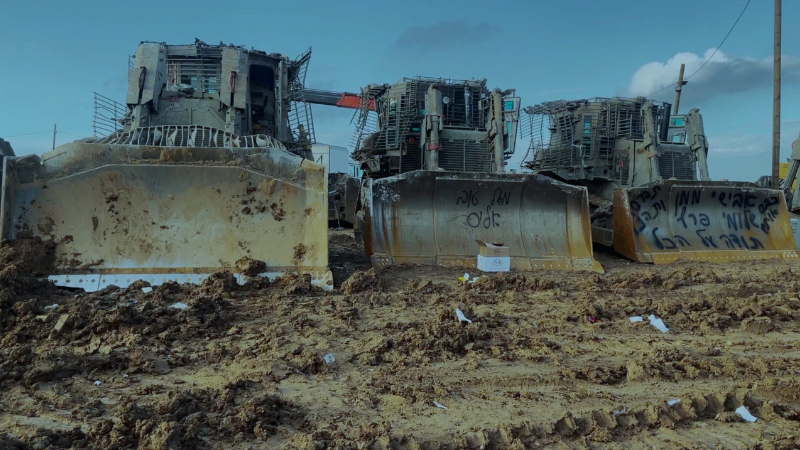
While Ariel predicts the destruction of the villages ahead of Even, her camera captures precisely that. Ariel doesn’t hesitate to accuse the filmmaker, just as Even doesn’t hesitate to include this in her film, that her work, while courageous, is insignificant in the face of the incredible destructive fury. Only films from Gaza, not rumours and commentary, are appropriate anymore. For a while, it even sensitively documents the birds’ panic at the constant noise of bombs and shows idle, seemingly peaceful soldiers at kiosks. Since the end of November 2025, 100,000 grenades, along with bombs containing up to 400 kg of explosive material, have been dropped—a greater quantity than US forces fired in Afghanistan in 2019. People in the Gaza Strip are buried under their rubble-strewn homes. Added to this are rocket and drone strikes in what are termed «surgical operations.» Troops are clearing entire neighbourhoods and then levelling the devastated terrain with 60-ton bulldozers.
Nevertheless, the accusation against Even cannot go unchallenged. Images of the destruction and barbarity are essential, but it also makes perfect sense to document the behaviour, rituals, and statements of the attackers. This is precisely what Anat Even does.
the accusation against Even cannot go unchallenged.
Witnessing ruin
She reminds us equally of the 27-year-old poet and doctor Ezzideen Shehab, who returned to Gaza in October 2023 and succinctly captures the logic of the powerful and their cold arithmetic of geopolitics. People are treated deliberately and emotionlessly as vermin. He observes a father picking dirty food scraps from a grave and giving them to his daughter, who gratefully devours them. 60,000 dead and 150,000 wounded are condoned by millions of Israelis demanding revenge. Soldiers dance in a frenzy of power on the ruins of Gaza. Even captures the voice of a soldier who, seeing the convoy of aid trucks blocked at the border, comments: «It’s shameful what we’re giving them.»
This «asymmetric war» and disproportionate attacks by an organised army against a civilian population are always rhetorically legitimised as retaliation for damages suffered. Since the first day of the Israeli military offensive, there has been growing interest in the total annihilation of the Palestinian population in the Gaza Strip and the West Bank.
Even wonders whether it was really a good idea to hold a dance party on the border of people who have been brutally oppressed for decades. This indifference, too, is a form of dehumanisation.
No one benefits more from Hamas’s attacks than the Israeli army under Netanyahu and the orthodox right-wing extremists allied with him
Rituals of erasure
The filmmaker manages to infiltrate a new party on the border, reserved for «authorised guests.» There she encounters Israelis from all over the country wearing T-shirts emblazoned with «Love Gaza, my Homeland» and propagating their motto «Occupy, expel, settle,» as well as «We take back what we gave them.» It also witnesses the small-scale protests against these settlers, who require military protection. At some intersections, other protesters linger with their placards demanding immediate peace. They all know that to claim there are no innocents in the Gaza Strip is to claim there are no innocents anywhere.
With its attempted extermination of the Gaza population, the current Israeli state power is making even the Hamas murders of 7 October appear as an anecdotal event and using them as a justification for unpunished killing. This commentary is also heard in Collapse. It continues: only a public indictment and reckoning with the crimes, as occurred with the Germans, Serbian, and Hutus, could break the widespread feelings of immunity and superiority of large parts of the Israeli population.
No one benefits more from Hamas’s attacks than the Israeli army under Netanyahu and the orthodox right-wing extremists allied with him, who chant their slogan «Occupy – Expel – Exterminate.» The question of the extent to which decades of Israeli settlement and displacement policies bear responsibility for the formation and strength of Hamas is also completely taboo.
But Anat Even and many like-minded individuals will not give up hope for peaceful coexistence. And no one contributes more to combating all forms of antisemitism through their actions and declarations than this group of Israeli citizens.
Unsurprisingly, Even was immediately accused in the ensuing discussion of airing dirty laundry in public. While these voices also acknowledge that something is indeed dirty here, they overlook that dirt must always be brought to light for purification within an open, democratic, and dialogue-based process.