This is not a film about Iran.
Or rather, it is not just a film about Iran.
The main character, yes, fights for emancipation and change in a remote area of the north of the country that is a world apart from our own Europe. But is the Persian saying with which she is silenced, at some point, «Give girls shoes, not paths », really Persian? Or is it perhaps the pressure on all of us? The pressure to confine us to beaten paths?
To conform? All the same? All innocuous?
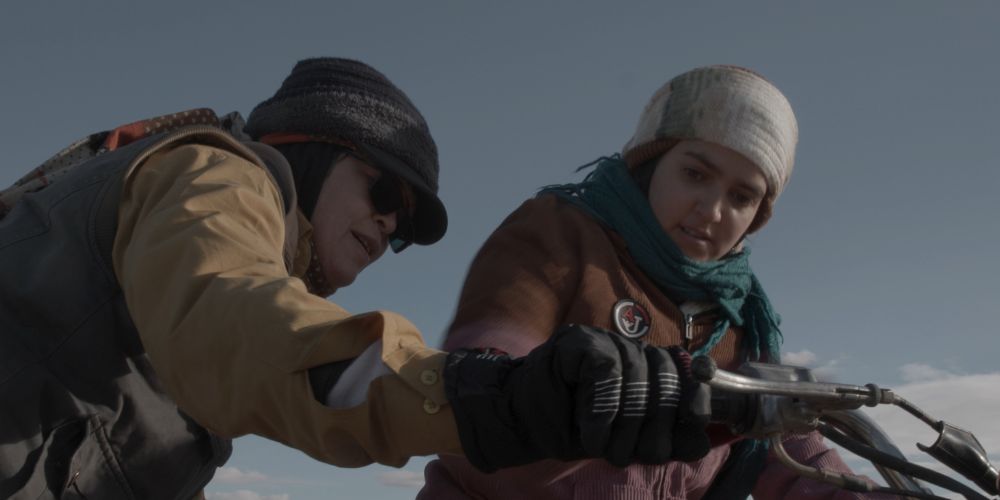
Sara Shahverdi is 43 years old, has no children, and wears no makeup. A divorce behind her. And also a motorcycle. The motorcycle of her father. Who passed away when she was 16. But despite being so different, so unconventional, she works as a midwife, she is at home in every home, and she is elected, top of the poll, to the municipal council. She is like a mayor. And she starts by going into the classrooms to talk to the 11- and 12-year-olds who will soon be finishing compulsory schooling, encouraging them to continue studying. To not just imagine themselves as wives and mothers, for that, she says, there is time, but also as doctors, as engineers, as entrepreneurs. Then, she decides to connect the houses to the gas grid. No one, obviously, objects. But in reality, it is just a pretext to register the houses, and co-register them with the wives, who otherwise, if they get separated, or become widows, have nothing: as happened to her sisters, stripped of their share of inheritance by their brothers, even though when their father died, it was the sisters who were the breadwinners. They would be nothing now, without their sisters, and instead, it is the sisters who are nothing.
After a while, all girls want to learn to ride a motorcycle.
All girls want to be Sara Shahverdi.
To be themselves.
The truest, and deepest, change is not the gas grid: it is the admiring gaze of Fereshteh, who married a 35-year-old man at 12, and after being denied a divorce by a judge, who orders her to rather focus on improving her marriage, and accepting fate, moves into the house of Sara Shahverdi and immediately learns a trade, learns to weave carpets, and, of course, to ride a motorcycle. And she follows in her footsteps. But it is not easy. At all. With every clash, with every obstacle, Sara Shahverdi is told not to stir up trouble. Not to question everything, not to always be so nervous, to smooth the rough edges. To be open to compromise. As if she were the problem. The doctor she sees for a painful ankle tells her it’s stress-related to her work. The cure is to resign from the council.
And maybe it really is stress. But ultimately, it is just an attempt to stop her.
And it will end badly. Sara Shahverdi will be brought to court, accused of dishonour, accused of living alone and childless: of living like a man. Without skirts. With a cap over her hijab. Could she be a transvestite? She won’t be convicted, but she will be dismissed from the council. While Fereshteh returns to her family. And the girls, one by one, get married too soon at these wedding parties where there is not a single smile.
But she keeps riding her old Honda. And to teach how to ride it. Out in the fields now, rather than near houses, to avoid the girls being identified and punished, but she keeps repeating: «Go! Go! Hit the gas! Don’t be afraid! » – she keeps pointing the way.
Showing a way.
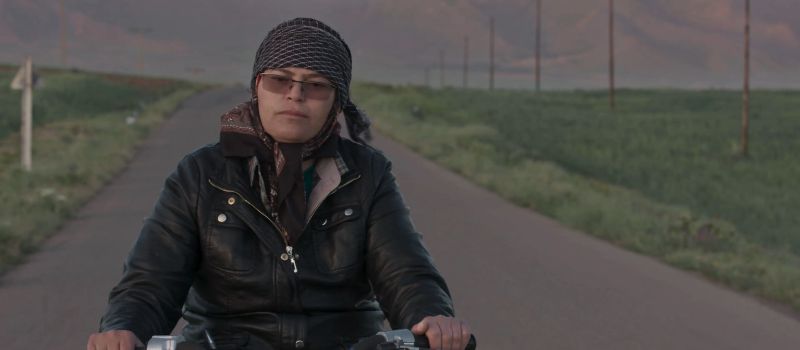
Of course, this is a film about Iran. If we were not debating whether to bomb it to overthrow the Ayatollahs, to change it, the story of Sarah Shahverdi probably would not be running for an Oscar. And it is an anti-war film. Because aside from a poster of Khomeini on a wall, the Ayatollahs never appear: in rural Iran, life would be like this even with a different government. Traditions govern. And change comes from the courage and tenacity of those who swim against the tide: not from the hit-and-run of a Trump arresting a Maduro, and then moving on to the next crisis. The next airstrikes. But it is a film that is much more than a story about Iran, because its main character is not a heroine, nor a revolutionary: she is simply doing her part. She is marked out as different her whole life, she is marked out as an exception, but no: she knows she is normal. And she carries on.
And she starts alone, she ends up with many.
Another saying goes: Water is stronger than rock.
And you? Are you the doctor, are you the judge? Or are you the one who hits the gas?