Dear Beautiful Beloved, directed by Juri Rechinsky, is an observational documentary about the tragedy of evacuation, which is explicitly divided into two binary lines: the evacuation of elderly civilians from the front lines to the calmer areas of Ukraine and the evacuation of soldiers’ corpses back to their families for burial.
On 18 November, during #IDFA, where the film was screened, the invasion of Ukraine counted down to a thousand days. The duration of the war had an irreversible effect on society’s habituation to war, and this phenomenon is beginning to interest documentary filmmakers more. Increasingly, they are moving away from documenting direct military action and concentrating on the home front to explore the consequences. In his film, Rechinsky is responding to the effect of the normalisation of war in society by showing the tragic scale of the humanitarian catastrophe on both sides of the front.
Approximation
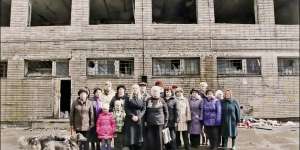
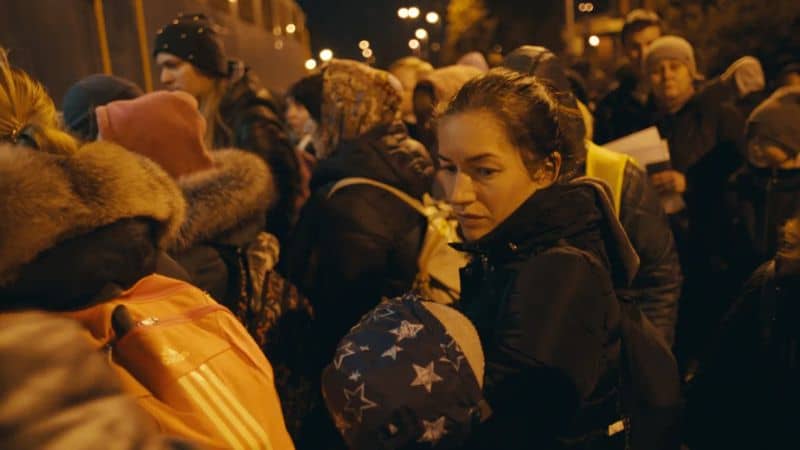
The war forced the evacuation of almost a third of Ukraine’s total population, but the director focuses on the elderly. The film opens with a sequence of the onset of the evacuation of the most vulnerable ones in this war: immobile and sick elderly people are evacuated from their homes in eastern Ukraine by foreign volunteers. They are forced to embark on a deeply disturbing journey with no end in sight. The evacuation train takes them to a medical facility, where they are told their stay is temporary. ‘No one is asking you,’ says one of the staff at the centre, with lists of names in her hands.
The anxiety of being away from home is heightened by the fear of the unknown, as no one can tell these people where they will be evacuated next. Focusing on a multitude of characters on this journey without a final destination, the film portrays a vast picture of physical and moral suffering. Rechinsky makes a wilful decision to film the suffering in close-up, following his characters with a handheld camera, deliberately staying with them as long as possible until they start to speak up. The director is also interested in the moments of interaction between the evacuees, shooting long dialogues in which people often find it very difficult to explain themselves. Or, on the contrary, simply see each other – there is an arresting moment in the film when two women confess they are blind.
Nevertheless, the evacuation plot in the film is full of life, its manifestations expressed through an instinctive fear of death. It is a struggle for survival in a system that cannot withstand the strain, overwhelmed by the tragedy of a catastrophe whose entire sentimentality is conveyed in micro-detail. Shooting these moments from such an intimate distance, the director leaves no chance of not eliciting an emotional response.
Nevertheless, the evacuation plot in the film is full of life, its manifestations expressed through an instinctive fear of death.
Stabilisation
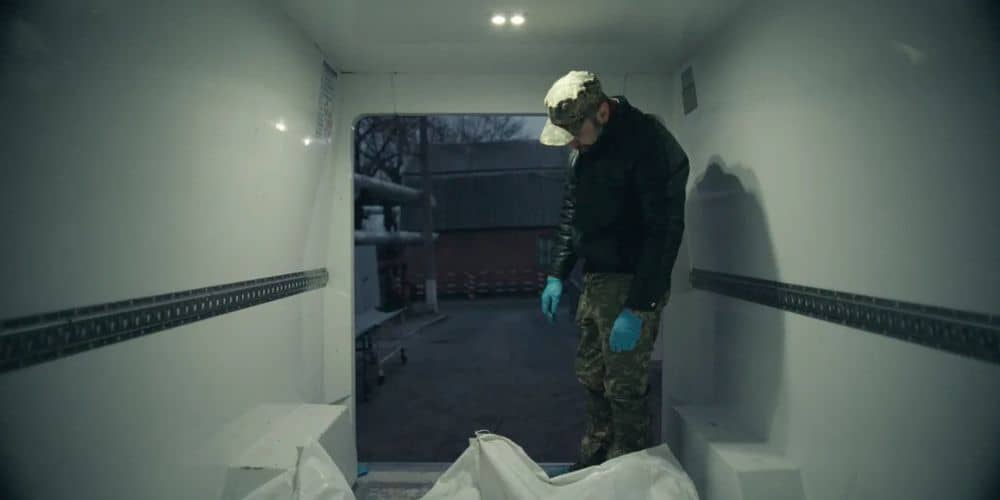
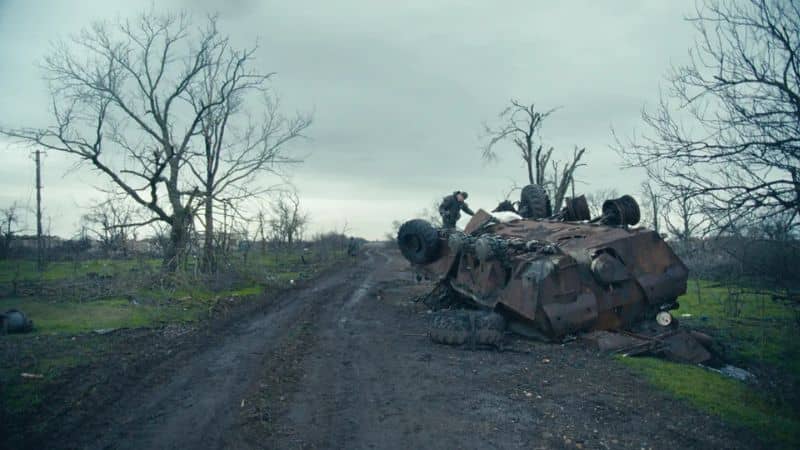
The remarkable thing about the film, however, is that the director uses a second, radically different narrative line to convey the globality of the tragedy, transparently showing the system of exhumation, evacuation and burial of a large number of soldiers’ corpses. In fact, the director begins this narrative thread with shots of a car with the sign “Cargo200” driving over the scorched earth towards the area where specialists will begin to search for the bodies. The main characters in this storyline are two volunteer transporters, a young woman and a man, who transport dozens of corpses across a large territory of Ukraine together.
Rechinsky clearly establishes a different kind of cinematic language in this narrative. He frames his shots intelligently and keeps his distance from the bodies from the beginning. While filming the volunteers at work, he keeps the camera as uninvolved and static as possible, shooting the entire narrative exclusively from a tripod. The stabilisation provided by the tripod allows him to balance the emotional tone of the film—an essential element that walks on the edge of ethical boundaries.
The director does not approach the corpses immediately, even though the process of transporting them contains valuable and spectacular material in the most gruesome sense. The approximation of the dead bodies in this narrative line will develop synchronously to the whole path of the soldier’s body shown here – from the field to the coffin. Thus, towards the end, Rechinsky dared to show a rather ethically discursive moment – the preparation of the soldier’s body for burial. He places the camera in the middle of the room and shows the whole procedure, with the ringing silence of the room until the mother of the soldier arrives.
Constant movement
These two narrative lines, the evacuation of the living and the dead, are intercut throughout the film and together create an image of suffering that attempts to describe the magnitude of the pain of this war. Overwhelmed by the binary emotion of fear in the first line and cold alienation in the second, the director montages his main thesis, which lies in the film’s title. Dear Beautiful Beloved is addressed to the victims of both sides. By juxtaposing two narratives shot with different documentary approaches, the director equates the tragedies of the dead, who no longer care about their representation on the screen and the living elderly of one of the most vulnerable units.
There is, however, one strong element in the film that definitively links these two evacuation journeys, and that is the state of endless movement. Its cruelty and magnitude are reflected in the displacement of the living and the dead. This message is, in a way, a response to the phenomenon of the normalisation of war in society and, therefore, speaks out against this process. Globally, Dear Beautiful Beloved reminds us that war is a constant movement, and even when it seems to have stopped, it leaves its mark on those who must first be evacuated.
This text was published thanks to the support of EEA and Norway grants