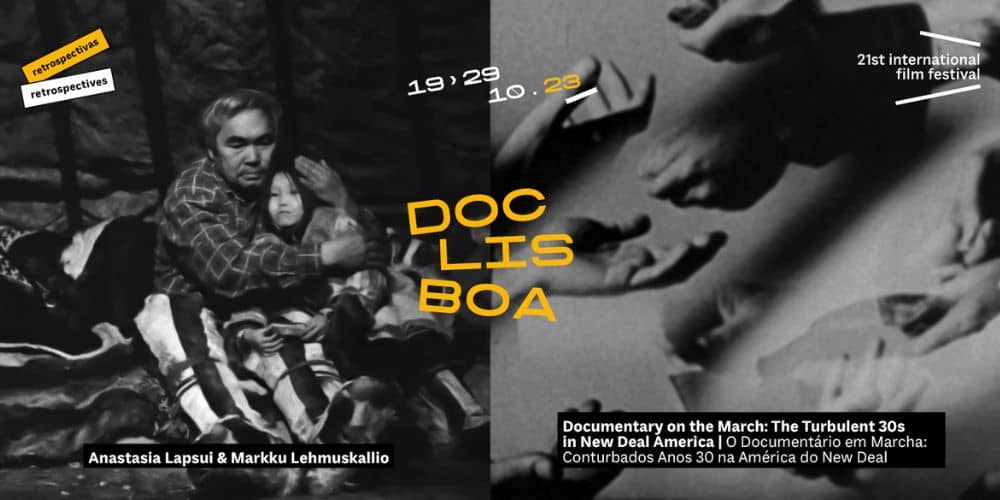
The 2023 #Doclisboa 19 – 24 October) retrospectives introduce us to America’s socio-cinematic experiments during the #New Deal# period, and to visions of the tundra, the forests, and life in the North, as discovered in the cinema of #Anastasia Lapsui# and #Markku Lehmuskallio#.
In partnership with Cinemateca Portuguesa, Documentary on the March: The Turbulent 30s in New Deal America dedicates its thematic retrospective to the delicate coalition of radical filmmakers who, in the midst of the #Great Depression#, fought to birth the new genre of Social Documentary as a tool for socio-political change in the #USA. In parallel to President Franklin Delano Roosevelt’s commitment to social justice through the policies of his government’s New Deal in the 1930s, a generation of filmmakers sought to infuse facts with feelings, art with agitprop and propaganda, through a cinema of reality that sought to communicate, and perhaps even help resolve, the significant social issues of turbulent, troubled times.
From the self-proclaimed ‘revolutionary’ output and weaponised cameras of independent groups such as the Film and Photo League and Frontier Films, to epic ‘musical documentaries’ financed and produced by the US Government itself, the retrospective will focus on the affinities and conflicts between a core group of filmmakers – including #Ralph Steiner#, #Irving Lerner#, #Willard Van Dyke#, #Paul Strand#, #Leo Hurwitz#, #Herbert Kline#, #Pare Lorentz# and #Joris Ivans#.
With the support of the Finnish Film Foundation, the cinema of Anastasia Lapsui and Markku Lehmuskalliowill be the first complete retrospective dedicated to the directors.
Anastasia Lapsui, director and screenwriter, born in 1944 in the Yamalo-Nenets Autonomous Okrug, then territory of the Soviet Union, and Markku Lehmuskallio, director and director of photography, born in 1938 in Finland, have dedicated their lives and their work together to the indigenous peoples of the North: the #Sami, #Inuit, #Nenets, #Chukchi and #Selkup, among others. In attempting to convey the ways of seeing and the culture of these peoples, whom they film through a wide variety of cinematic approaches, they have documented their lives and created a unique body of work.