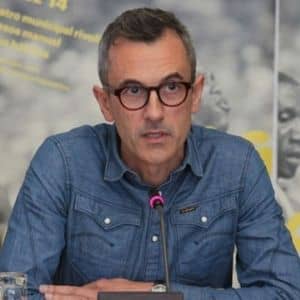
Amir Labaki founder and director of It’s All True, celebrating it’s 25th edition this year.
Anna Glogowski as moderator and festival director, she is an international advisor and jury member for many documentary festivals.
With guests:
Petra Costa premiered The Edge of Democracy at Sundance Film Festival 2019 and has since gained some popularity as the documentary is published by #Netflix getting to even a nomination to the Oscar’s, but her previous work is no less interesting. She has been a member of the Academy of Motion Picture Arts and Sciences and is known for her films on the edge of fiction, like Olmo and the Seagull (2015). Her work has won quite a plethora of awards, at Rio de Janeiro Film Festival, London International Documentary Festival, and Cine Las Americas International Film Festival, DOCSDF, and Cinema Eye Honors, to name a few.
Andrés Di Tella Founder of the Buenos Aires Festival Internacional de Cine Independiente# and one of the investigative journalists alive during the military period in Argentina. His work as a journalist sets him in a unique position as one of the most outstanding documentary cinematographers in #Latin America# today, particularly with his endeavor at portraying major history. He has numerous films for tv and has written extensively about film-making. Visiting professor at multiple universities, he directs the Princeton Documentary Festival at Princeton University.
It’s All True is a long-standing documentary festival from #Brazil that has been a lighthouse of documentary filmmaking and social-political discussion for Latin America for a quarter of a century. Since #COVID-19, they’ve become really active online, with debates and roundtables, collaborating at this time with Cannes Festival’s section Cannes Docs – Marché du Film.
Amir gives an introduction to these outstanding guests and, right away, Andrés talks to us about success and the importance of failure. Going forth to discuss the difficulties of introducing the director as a window to the story being in play, Petra follows up with the issue of colonialism and the stain in the view of everything that is portrayed as an heir of a white family with a colonialist past.
Going in-depth into the subject of #colonialism and the considerations to be had when looking through the window to tell a story, subjectivity, and the necessity of understanding the role of the director as creator of a narrative.
Andrés walks us into understanding the nature of the first person speaking in a documentary as a conglomerate of views of a team working in a documentary and also going into autobiographical film-making about a mixed-race family.
Furthermore, Petra gives us a glimpse of the emotional journey of #trauma, vertigo and betrayal felt as the Brazilian democracy crumbled, as viewed from a wealthy white family – her grandparents – confronting the understanding of a family that already changed to oppose colonial views – her parents.
Both go into stories about the strains, connections, and revelations brought forth by inquiring into the family’s history and the process it involves as a documentary director. Andrés explains how he approaches filming documentary trying to not know what he is doing, showing weakness, and allowing fragility, in a process of exploration. Just like Petra agrees that the generosity of exposing oneself while doing non-fiction.
Interesting experiences with 360 technologies and VR are discussed together with the more in-depth importance of narrative, and the possibility to test the feeling of social pressures, like racism, from these immersive technologies.
With the new online format at Cannes Docs – Marché du Film, talks are dynamic and surprisingly engaging. Maybe because hosts are comfortable in their homes and us, as attendees, get to see them up close and intimate. The whole experience being integrated with an efficient Q&A system that allows for the audience to participate extensively.