Director Radu Jude’s experimental documentary Eight Postcards from Utopia is comprised entirely of Romanian commercials over the past 3 ½ decades. Co-directed by philosopher Christian Ferencz-Flatz, the documentary seeks, through the medium of #advertising, to detail Romania’s turbulent ascent into #capitalism in a post-communist landscape. Adverts that span the unimaginably wider gamut of products and services (including public service announcements) are sequenced back-to-back in a non-chronological order resulting in a chaotically steered documentary which offers acerbic critique about rampant consumerism.
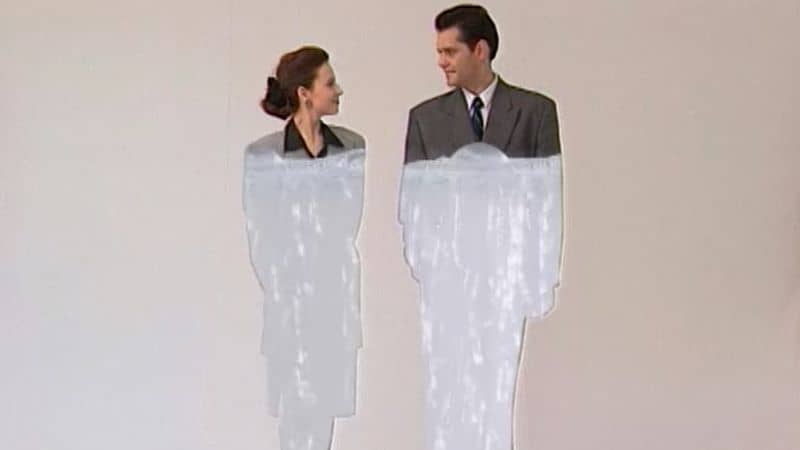
Jude and Ferecencz-Flatz provide no commentary or context, par the allocation of the ‘found footage’ into eight loose chapters. Clips appear to be queued up in continuous juxtaposition; some connections are obvious, and others are vague. Some clips are cut before their punchline, while others have their sound omitted. There is little regard for any visual cohesiveness, flow, or pace. The viewing is a frenzied experience, which, on a visceral level, compares to the barrage of marketing messaging of daily modern life. The documentary’s unusual format is not so much a departure for Jude but an accentuation of a directorial style, which sees him frequently insert visually disparate, if thematically relevant, footage to compare and contrast, providing a sharper perspective.
Chapters
The first chapter, ‘The History of Romanians,’ zooms in on historical themes promoting anything from vodka to deodorants to photocopy machines. The Middle Ages appear as a popular backdrop, a pivotal geographical moment in Romanian history where the country’s main three principalities came together. Adverts feature repeated images of brutish, long-haired men with capes on horses charging ahead. The very first advert is for #Pepsi. A famous local footballer in a gladiator’s outfit is drinking the cola in its new plastic configuration. It’s an exact replica of a David Beckham advert for the same brand in the early noughties. American #imperialism and hypermasculinity are also a recurring theme throughout.
There are countless clumsy and questionable aesthetical choices. A joyful Colgate family advert is bizarrely accompanied by a melancholic rift from an Abba song. An advert for bottled water emulates the visuals and sound of a music video by the English band Massive Attack. The chapter titled ‘Masculin Feminin’ is a potent, if obvious, take on #gender politics#. Men are seen to engage in various forms of sports or drinking beer. Whilst for women, the focus is predictably on their face and body, more often unconnected to the product, women’s legs are the sole focus for selling chocolate croissants. Adverts for cheap sex phone lines appear to only feature topless women.
American imperialism and hypermasculinity are also a recurring theme throughout.
Jude and Ferencz-Flatz prove most coherent when they are intentional. The flagrant shameless marketing is accentuated in ‘The Anatomy of Consumption’ by zooming in on the exaggerated facial and bodily sensations. Heightening the supposed euphoria of eating a chocolate wafer, smelling a freshly washed jumper, or lathering one’s hair. Or their attempts to garner #nostalgia – an attribute lost on audiences not grown up in Romania – in ‘Magique Mirage’ where #magical realism# is conjured up by cringeworthy sparkly special effects offering a throwback to childhoods and bygone Christmas holidays. Romanians born before the 1990s will generally feel an affinity to all the grainy adverts of the decade. Their low-budget aesthetics are a source of humour but also indicative of a country in dire economic straits. The poor quality of the footage suggests minimal thought has gone into archiving or preservation.

Measuring the zeitgeist
Jude’s work over the past twenty years of filmmaking has purposefully provided biting commentary on topics varying from social and moral values, financial inequality, and loss of worker’s rights to the effects of outsourcing. Primarily focused on Romania, with Eight Postcards from Utopia he is following the same path of ideological exploration. Jude and Ferencz-Flatz believe adverts to be an overt symbol of #consumerism as well as an accurate measure of the zeitgeist, reflective of the ever-evolving needs and desires of the Romanian public. Even in the most American/westernised adverts, they appear it to merit it with cultural value. Retrospectively, one can see that the meticulous choice of commercials articulates the pervasiveness of individualism through purchasing, but it is also one that seeks to instil a sense of Romania to boost feelings of national pride. Succeeding to re-enforce the perceived correlation between free market capitalism and right-wing politics.
The anarchic choice and format to document does have its limits, as it proposes that capitalism can only be viewed through the lens of consumer behaviour. Largely it is, but there are also the effects on government institutions and healthcare services. This is slightly hinted at with one featured public service announcement from the mid-90s, which enthusiastically, if opaquely, announces «the biggest privatisation program in Romanian history».
The film’s epilogue is comprised of consecutive scenes of nature and wildlife, acting as a tranquil cleanser to the onslaught of consumer images. It is the weakest link of the chapters, appearing as a hurried conclusion. It gestures to the wider global environmental demise as well as human detachment from nature. Paradoxically, these images themselves derive from adverts.