In Colombia, the armed conflict that has gone on since 1964 has taken a huge human toll. With the prevalence of death, internal displacement, and forced disappearances many civilians continue to live in fear. Colombia’s National Centre for Historical Memory puts the figure of Colombians who are direct victims of this long, low-intensity war at 16.9%.
The fighting arose from high levels of inequality in the country as communist guerillas organised against the government in a struggle for the poor’s. Revolutionary armed group the National Liberation Army (ELN) was founded by Colombian rebels trained in Cuba and headed by Roman Catholic priests who embraced the radical ideas of Liberation Theology (a synthesis of Christianity and Marxism that sought to better the conditions of the oppressed). It has been countered not only by the state but by U.S. backed right-wing paramilitaries as part of its aggressive efforts to sabotage and snuff out communism. Levels of violence rocketed in the ‘80s as drug trafficking entered the mix (feeding a massive appetite in the U.S. via organised crime channels).
Torn apart by trauma
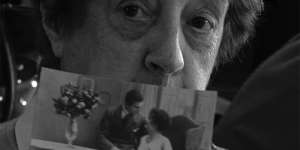
It helps to know this basic background going into Camila Rodriguez Triana’s In Ashes (En Cenizas) (screening at doclisboa 2019) as it is a film that, while wholly rooted in the local experience of this conflict, spends no time setting out contextualising facts. This is not really an oversight, because the business of this haunting, poetic oddity is in allowing viewers to inhabit the profound disorientation of an identity torn apart by trauma. Cues and anchors indicating «where and when» come in snippets, disordered but flooded with emotion. Remembered moments, vivid as spectral visitations, plunge us into an experimental nether-world of inner memory and cathartic theatre – an act of collective historical reconstitution that might just reanimate a suspended present.
Ghostly matters
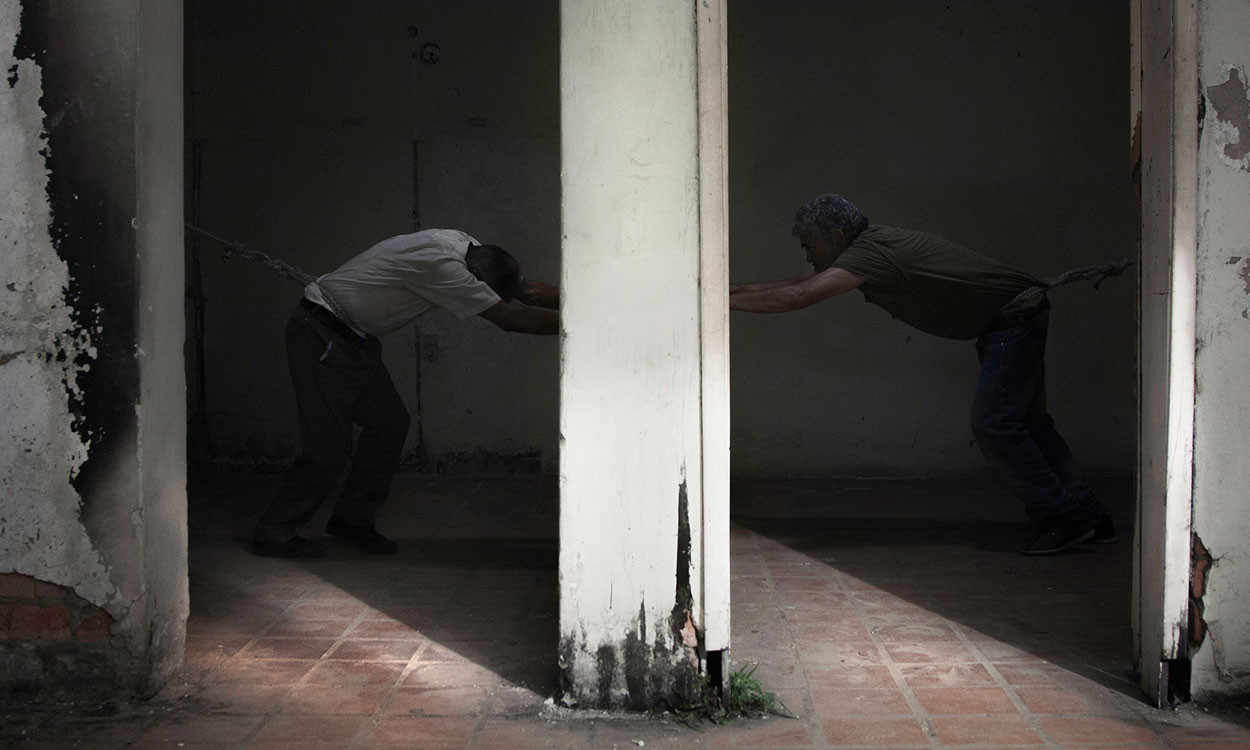
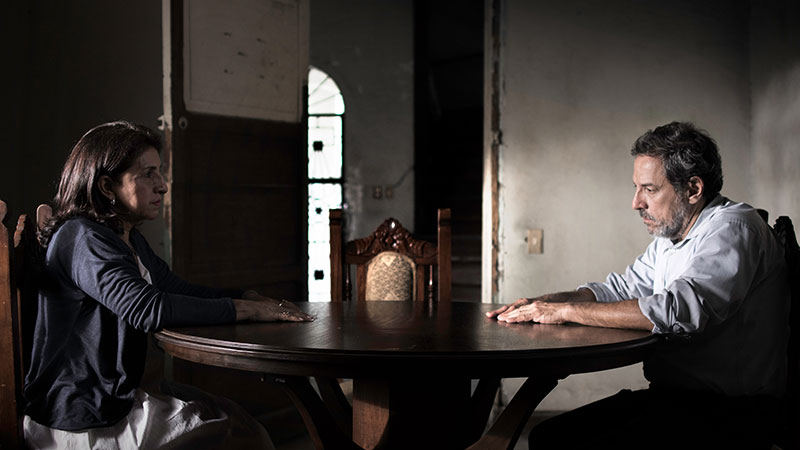
In Jungian dream symbolism, it’s said that a house represents the self. In Ashes plays out in such a setting. Mournful, and in a state of collapse, its structural integrity has long since been savaged by the elements, inside and outside, merging in the places where water drips and seeps, while floors are pulled up, overgrown. In other spots, it has the traditional (albeit austerely decorated) look of a family home, but one fallen into disuse. A man seated on a bed holds a torch, flashing on and off, honed on a childhood portrait (of him?) on the wall as if sending it coded signals for help as much as to illuminate it, seeking a way back across fractured identity lines to his roots of selfhood. He is one of three men that we understand as dreamlike manifestations of the same person. Two will typically be frozen, more or less motionless in a room, as the other performs some action. The film is based on the real-life story of Marco who, at one time, was a communist guerrilla severed from his family, having to twice reinvent himself via undercover identity. He now has a disorder and, as he sifts through the house, his loss and devastation are palpable in his timeless, urgent attention to ghostly matters.
remembering has its own beguiling, sustaining beauty
«One day your sister told me that she thought she saw you, and you were with strange men.» It’s a line that recurs, in a letter cleared from a keepsake drawer, then again emanating from a cassette tape. It’s from Marco’s mother, who doesn’t know where he is and fears what he is getting into — the absence and dislocation resulting from going underground in a society electric with everyday fear of authority and reprisals. Another family member does not leave the house these days, frightened of what may happen to him, she confides in the missive. Marco remembers, also, a girlfriend, and evenings together on a balcony. Heartbroken, he «sees her everywhere, day and night,» lamenting her death with the poetry of romantic obsession: «I loved her like she was a god, but God loved her more.» On the house’s old dial phone, calls are made, but nobody answers, the metaphorical line long cut. Dreams recalled are ones peopled by soldiers pointing weapons and demanding names that cannot be revealed.
Unstoppable fate
Radios in the house broadcast rousing speeches. Priest and ELN head Camilo Torres Restrepo, who became a martyr when killed in his first combat outing, and who is known for declaring «If Jesus were alive today, He would be a guerrillero,» can be heard wooing crowds. Marco slumps with head in hands as socialist anthem The Internationale rings out. In a striking tableau vivant shot, the figures inhabiting this memory-house are posed as if in a family portrait, but one very much awry: Marco is embodied by no less than three men at the back (his two alter-egos face the wall, their backs to us, flanking his sides), while mother and children sit in front. It’s indoors but rain falls on them steadily as we hear wood creak and splinter — destruction by elements of nature or fate that is all-consuming in its power, and unstoppable. Within all this, however, remembering has its own beguiling, sustaining beauty, and these visions conjured bring an undeniable force of regeneration in spite of all. A snippet from left-wing Chilean poet Pablo Neruda’s work «Sonata and Destructions» reinforces this sense. It places us «after so much… confused by domains, uncertain of territories,» but speaks of «the tenacity that survives in my eyes». It’s from this poem that the film gets its name. To vigilantly look for, and at, previously hidden truths, and to connect them back into Colombia’s national narrative, is a way to excavate the wreckage; to again become whole.