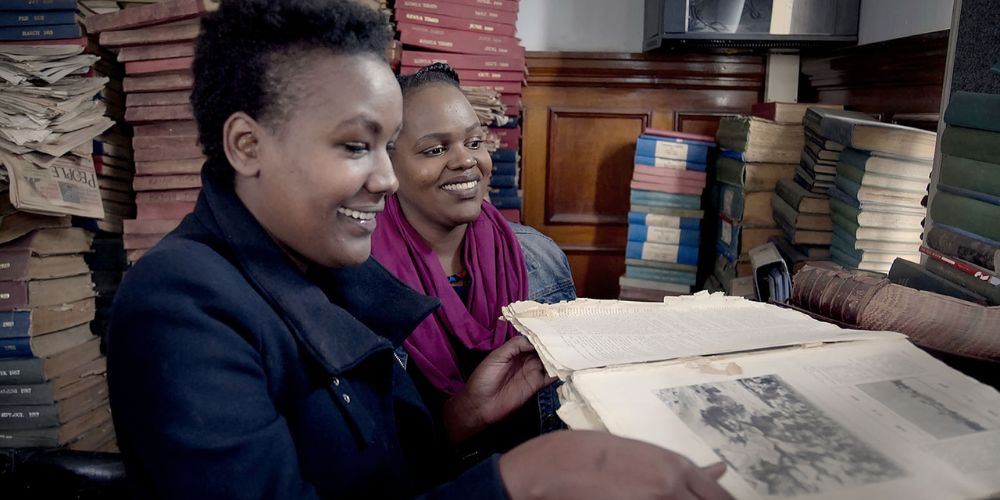
Cultural institutions and practices can quickly be perceived as a risk in states tending toward #autocracy. Placing them under #surveillance is standard practice. Maia Lekow and Christopher King demonstrate that this can even apply to libraries in their film How to Build a Library, which premiered at #Sundance and screened in competition at the Thessaloniki International Documentary Festival. The film takes us to Kenya, where writer #Shiro Koinange# and editor #Angela Wachuka#, both influenced by their shared experience of the profound significance of literature for their development, take the initiative to restore three dilapidated libraries that had become a dumping ground for their inventory.

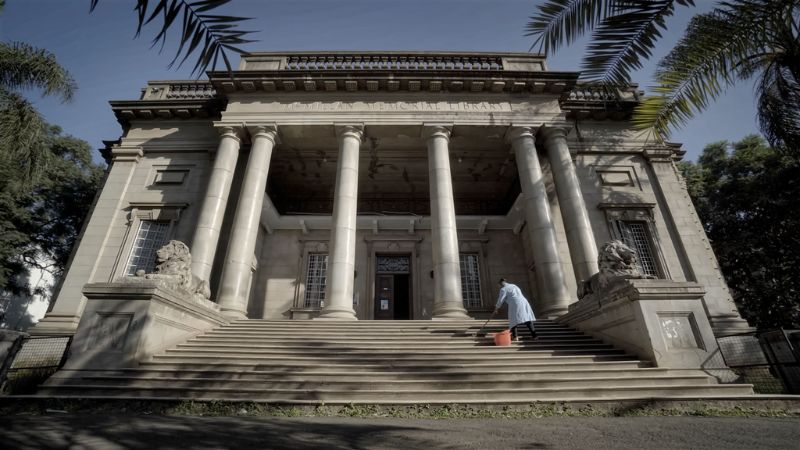
McMillan Memorial Library
The McMillan Memorial Library in #Nairobi was founded in 1931 during the British colonial period. Consequently, it was closed to Africans until 1958. The two women were warned early on that they were strangers and did not know what they were getting into with their project to revitalise, renovate, and manage these spaces, which house 400,000 dusty books. The Kenyan state owns the libraries.
Maia Lekow and Christopher King recorded numerous meetings with officials, residents, and potential library users. Various problems soon became apparent, such as the outdated, colonial-influenced book collection, which urgently needed updating, especially for schoolchildren and students. The digitisation of fragile works in the book collection and photo archive required enormous work. The cataloguing process also creates an initial conflict, as the women have doubts as to whether the internationally recognized but Eurocentric Dewey classification system, which, for example, compresses the more than 400 different African languages into just one category, really serves the interests of decolonization.
Furthermore, the first explosive images are already being reviewed in the previously dormant archive. In addition to the historically first executions of Kenyans by their colonialists, who, of course, also imposed their #Christian religion on them, there are testimonies of a brutal #prison camp# for women, which had always been taboo, as well as visual documents of the population’s helpless armed resistance against the invaders’ air raids. Most of those kinds of documents had already been transported to London in 1963 and classified as «too hot to return to Kenyans.»
Maia Lekow and Christopher King, using Kenya as an example, offer an intensive and critical view of unstable African power structures in which culture can hardly escape business-as-usual patterns.
A cafe of history
Despite a bureaucratic and protocol-based obstacle course on the part of the state, an initial fundraising gala is organised, and state aid is promised for the first time. However, the cultural director envisions a library not as a place of «silence for the dead» but rather as a cafe.
On the other hand, Shiro Koinange and Angela Wachuka want to turn the library into a place of information about Kenya’s historical milestones. Their impression is soon confirmed: even though they are no longer officially colonised, a new form of control and oppression by their leaders has taken hold. They note that in most uncoordinated African societies, often based on #nepotism, those in positions of power quickly succumb to corruption.
Sheikha Bodour al-Quasimi from the United Arab Emirates brings urgently needed international assistance. Sheikha Bodour al-Quasimi, who holds multiple national and international leadership positions, including at the American University of Sharjah, and is also the founder of various research institutes and projects, promises the library project, quoting the beautiful phrase «Read till no strangers remain,» not only $50,000 plus a $10,000 purchasing budget for books of her choosing but also covers the renovation costs. As the daughter of the since 1972 leader of the Emirate of Sharjah, her promises are substantial.
Work began in 2020, but the unstable and dysfunctional Kenyan government delayed the renewal of the library administration’s contract. The two women knew that the renovation work would be a waste of money without the government’s cooperation. They also saw that Kenya’s struggle for fundamental rights had generally declined. In 2021, the government signalled that it would demand compensation for the subsidies, such as the commercial use of the planned coffee shop and the toilets, which were to be made public and subject to payment.
Only a five-year contract extension will be granted after new elections in 2023, too short to guarantee renovation and repairs. The two initiators also noted with unease the ostentatious visit by Prince Charles and the Queen, which they perceived as a repetition of colonialist patterns assisted by the current African leadership. However, the British Council had invested up to one million in the libraries.
Unstable structures
Another fundraising gala will be organised in 2025. However, the street protests against the corrupt government that began shortly thereafter overshadowed their gains. A population that lacks even basic services begins to rebel. The two project leaders can only hope that the provision of public libraries will also be considered a fundamental right.
Maia Lekow and Christopher King, using Kenya as an example, offer an intensive and critical view of unstable African power structures in which culture can hardly escape business-as-usual patterns. Moreover, great caution is required to avoid producing unwelcome results.