Sevillian filmmaker Alejandro Salgado brings his documentary Barzaj (Barzakh) to this year’s IDFA, vying for the festival’s award for Best First Appearance. It is Salgado’s second documentary film, after Bolingo. The Forest of Love, which was shown at IDFA in 2016.
Barzaj is a poetic account of a group of Moroccan boys who find shelter in Harbour Melilla, situated on the north coast of Africa, as they are bound for a perilous journey towards continental Europe. The youngsters find themselves in limbo, caught between two worlds – Morocco that they are fleeing and «the country of light». The camera stays with the boys like a faithful nocturnal companion – it never leaves the darkness. It is the absence of light that seems to define the boys’ present lives. As the night falls, the children speak about their dreams, eat bream fish and make some sweet tea to cheer themselves up «like we Moroccans do», as one of the boys remarks. And they always sing. As they see a boat departing, the boys pour their pleas into a song: «Oh, sailor, take me with you! […] Take me to the country of light. I’m a wanderer here. I have no home, nor town. Oh, sailor, take me with you!»
https://youtu.be/gNbJG9VByt8
Home
The film is void of narrative tension, drawing all the attention to the boys’ ruminations. The viewer is riveted to the boys’ conversations in the dark of the night, illuminating their struggles – which the outside world has cast them into. In his book Sculpting in Time: Reflections on the Cinema, Andrei Tarkovsky wrote that there was no need for a film to be «a canvas crowded with happenings» as man contained «a universe within himself». Echoing Tarkovsky’s sentiments, Salgado rid his film of what the Russian director called «anything irrelevant or incidental» that would stand in the way of portraying man «in a state of profound alienation from the world and himself, unable to find a balance between reality and the harmony for which he longs.»
Despite the friction with the external world and within themselves, the boys have not hardened, they remain tender. Their nights are filled with vivid memories of the lives that lie behind them. In a state of nostalgia, they often recall their mothers. «It is the story of the future, I cry and am still a child», bursts into a song from one of the boys.
The boys have not hardened, they remain tender
Being only afforded the view of the boys’ shadows as they play with a ball, one cannot help but wonder if these boys have been robbed of their childhood. Their lives are now dominated by questions like: «What are we going to do? When will we cross this sea? And will we be here forever?» Would they leave their homes if they had not had «a rough time in this land», as they themselves put it? As Somali-British writer Warsan Shire once wrote, «You only leave home when home won’t let you stay – no one leaves home unless home chases you.»
No future
The film silently observes the boys who dream of reaching the European shores, painting a picture of their ordeal amid the lingering crisis. Theirs is the story of thousands of children who wait to cross the sea in hopes of reclaiming their rights, of finding a job and a home in an unknown land after being forced from their homes. «Patience is the art of being hopeful», says one of the boys jokingly yet shrewdly. «We suffer now because we have no future. At least, we fight to have it. No matter what … Hiding if we need to. Until we can get out.»
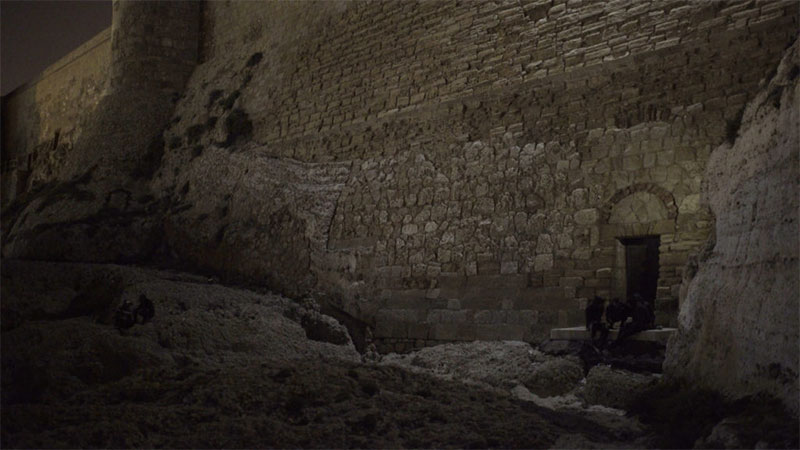
The teens are adrift, like unmoored boats in the open sea. And as the waves break, they are joined by a 13-year- old boy. A few moments later, the 13-year-old is asked if he is hungry to which he responds without hesitation, «Yes». An uneasy feeling creeps in, as the film concludes with one of the boys saying to the newcomer, «Have some stones then».