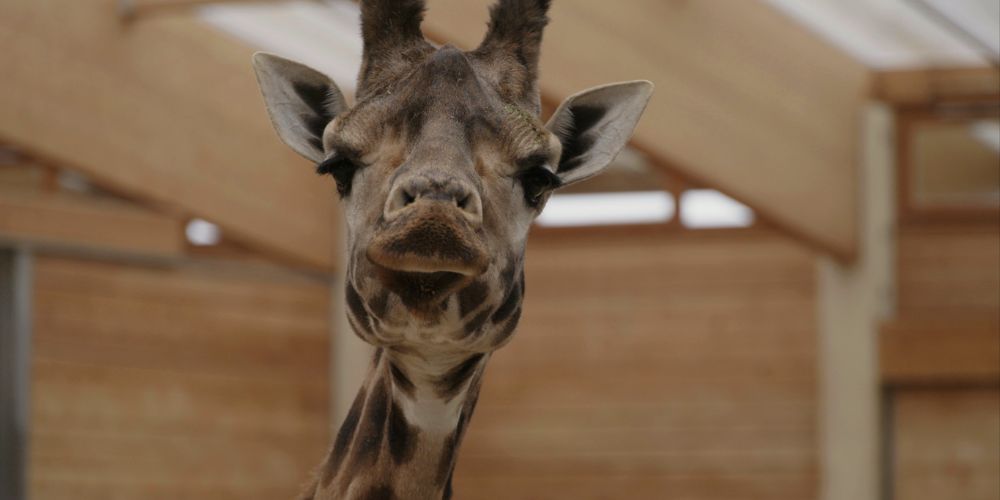
In Life and Other Problems, two narratives evolve throughout the film. One is the story about the killing of an 18-month-old, perfectly healthy giraffe in #Copenhagen Zoo#. The other is the director Max Kestner’s musings about his fatherhood, prompting him to interview the world’s leading natural scientists about their latest discoveries regarding life on earth.

Our living environment
It happened in 2014. The Zoo’s decision to cull the giraffe because they had a surplus of giraffes and the genes of this one were not essential to the species sparked an international outcry. People from all over the world were sending hate mail, and several offered millions of dollars to save the animal or give it a home, from a wealthy Hollywood fixer to the Chechen President. When Bengt Holst, the then-scientific director of Copenhagen Zoo, defended his decision, claiming that death is part of life, he stressed that their Zoo is not a Disneyland. This remark has a bitter end today. Compared to the global endeavour to save a giraffe, humanity has shown much less effort to quit human slaughtering in Gaza.
Kestner understood the curious humanisation of the animal, Marius, as a sign of a change in how humans understand ourselves and our living environment. This change has been around for some time; it manifests, for example, in how close people live with their pet dogs, and it indicates that human self-perception is moving away from human exceptionalism. One radical example is the image of women breastfeeding animals, which appears in contemporary art as well as in research on remote tribes in the #Amazon forest. Kestner took an even broader perspective, challenging the notion that humans are significantly different from other living beings and the exceptionalism of life itself. Starting with a very open premise that human bodies are composed of the same elements as death matter, he asked a simple question: what makes life – life? What is life? His inquiry among contemporary researchers, from biologists to botanists to environmentalists and veterinarians, showed that, indeed, the ruptures in the human knowledge about matter, nature, and life have been on the way, and many of the old beliefs cannot hold anymore.
if we try to understand the living world as a big collection of individuals, we’re not going to get very far.
The biologist #Merlin Sheldrake#, for example, challenged any exceptionalism with his «collectivist» idea that organisms co-create each other through their relationships. With a premise very close to structural linguists’ theory of the difference as constitutive of meaning, Sheldrake claims that the smallest unit of analysis in the world is the relationship. Meaning that if we try to understand the living world as a big collection of individuals, we’re not going to get very far. We’re shaped by our gut communities, and they shape us. Bacteria live inside us, as do fungi, and small bacteria live in big bacteria, and all these shape each other. František Baluška, a cellular botanist, argues that «genes are just libraries.» If we want to understand life, we should instead concentrate on cells. Cells are the ones that use the genes and switch them on and off as needed. Meaning that, Baluška leaves no doubt, the cells have a sense of self, and a sort of intelligence because «without #cognition they could not survive.» Similarly, biologist Michael Levin claims that «every single cell in the universe can process information and make decisions.»
Curiously, the conception of cells as a sort of omnipresent intelligence oddly resonates with the current technological development of the Internet of Things and the possibility of algorithmically influencing and altering any element of human existence and the world around us.
Of course, these are just ideas. Kestner carefully underlines the «working» nature of the scientific theories he presents in his film by pointing to the innovative and extraordinary methods applied, such as those of the Oxford veterinarian #Charles Foster#, who attempts to better understand the consciousness of various animals, such as wolves or bears, by trying to live as they live. And also by presenting moments of unexpected interruption, such as a walker interrupting an interview in the woods, and a mistake, for example, a misunderstanding between cells having «motion» or «emotion.»
A challenge to viewers
Life and Other Problems is not about final answers. The smart combination of the most rudimentary form of explanatory documentary with a complex web of emerging knowledge about life on earth is a challenge to the viewers to think for themselves. The film is a good opportunity to reflect on what we know about ourselves and how we know. This is particularly urgent today, when contemporary science, equipped with ever-new instruments, is obtaining new knowledge, but the traditional modes of transmitting this knowledge to common people have been shattered at the roots, from public schooling to public media. This film’s odd combination of public events and scientific research regarding the same, apparently simple fact, life, eventually prompts every one of us to think about what we, as humanity, know and how to act accordingly. How much do we know about contemporary science, and will what we know be enough to responsibly influence the way it will be introduced into our lives?