The story of artist #Leonard Cohen# and his Norwegian girlfriend and muse #Marianne Ihlen# has been told by #Nick Broomfield# in his 2019 documentary Marianne & Leonard: Words of Love, as well as in books and various media. Their relationship also attracted public attention with the moving farewell letter Cohen wrote to Ihlen just before she died in 2016 – only a little more than three months before Cohen passed away too.
Ihlen met the young Canadian poet and then aspiring novelist on the Greek island of #Hydra in the early sixties. She was living there with her newly born son from a recently ended marriage (even though they formally divorced a little later) with the famous Norwegian writer #Axel Jensen#, with whom she had moved to the international artist community at Hydra in the fifties. The new Norwegian documentary Little Axel tells the story of this boy, also named Axel, and is in many ways a sadder tale than the love story in Broomfield’s film.

Mental illness
The two directors, Fabien Greenberg and Bård Kjøge Rønning, have made a series of interviews with Axel Jr., who hardly can be called little anymore (he is around sixty at the time of the interviews). Axel has a long history of #mental illness# and has been institutionalised most of his adult life. He now lives in a more open institution, which he describes in the film as “being in a very nice place”. In the film, he comes across as a man of few words and short sentences but open-hearted nonetheless.
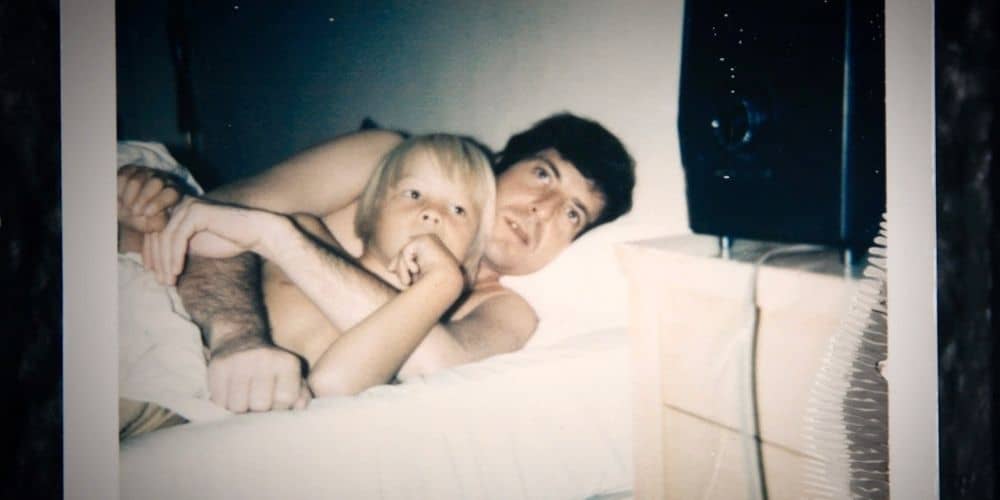
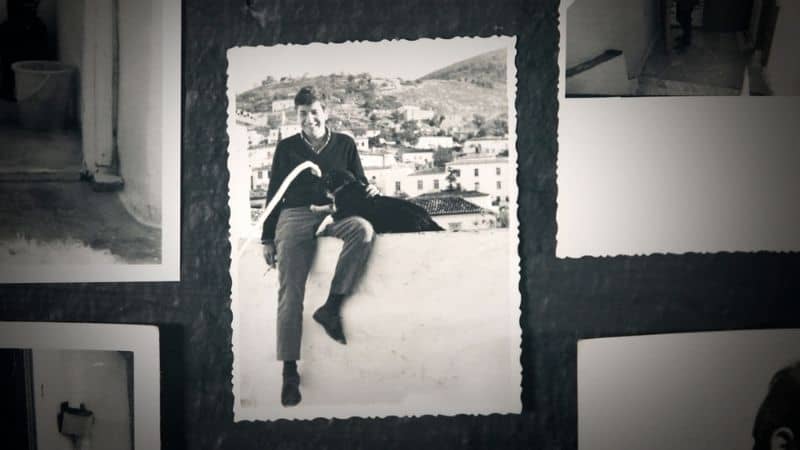
The filmmakers have gotten access to a rich amount of private archive material from Axel’s childhood and youth, not least from Hydra, mostly consisting of still photos – but also letters he and Ihlen wrote to each other when they were apart. The film furthermore contains interviews with people who knew Ihlen and her son from their time at Hydra, including the before-mentioned Broomfield. In a rather original take on the conventional talking heads, some of them speak directly to Axel, whose reactions are also shown, reflecting on their shared memories.
In a rather original take on the conventional talking heads, some of them speak directly to Axel, whose reactions are also shown, reflecting on their shared memories.
Too much freedom
Growing up in this environment was, in some ways, both exciting and idyllic, and Axel himself expresses that he has fond memories of the time. However, it was clearly not an ideal place for a child. The bohemian community was one of free love, #sex, and huge amounts of drink and #drugs, to which the young also were exposed. The children seem to have been left to themselves quite a lot and, in general, given way too much freedom. Axel tells that he started smoking when he was 7, without anyone really objecting, and that he was frequently drunk at a very young age. Later on, he was no stranger to neither #hashish nor #LSD.
Axel was estranged from his father more or less all his life. The film shows a clip from an old archive interview, where the writer explains his rather unconventional view of parenthood. There are lots of positive things to be said about Jensen, but he was clearly not a good father to his firstborn child, being mostly absent. When Axel Jr. visits him at the age of 14 or 15, his father gives him LSD. This seems to have been a very disturbing experience for the young teenager.
Leonard Cohen, on the other hand, was definitely a father figure for Axel, taking on the role of stepfather when Ihlen and Axel moved into Cohen’s house at Hydra. Axel speaks warmly of him in the film, in relatively stark contrast to what he says about his biological father.
Cohen’s growing success – and fame, one might add – as a singer/songwriter led, however, to him being away for long periods, and his and Ihlen’s relationship did not last. Nonetheless, the artist continued to be caring and supportive of Axel all through the seventies and paid for Axel’s boarding schools in #England and #Switzerland.
Tender and thought-provoking
With Axel still being mentally ill, one can question the ethics of portraying him in a documentary. Yet Axel seems happy to participate, and his legal guardian is allegedly supportive of the project.
Little Axel is a story of having been given too much freedom at a too young age, but also about neglect and abandonment – although not with a complete absence of love. Some parts of Axel’s story that most likely are related to the problems he would meet as an adult are not depicted in too much detail. This is a sympathetic and perhaps also necessary choice, as Axel himself does not want to talk about the most traumatic episodes of his life. The film points in certain directions to what might have happened but seems to acknowledge that the causes of Axel’s illness are various and complex. The result is both a tender and thought-provoking portrait of a man who, to quote Axel himself, has lived quite a life.