Film and #video games# have long been in close interaction with each other. In addition to games being based on specific films, video games more largely use many of the film medium’s formal and narrative traits. But the influence also goes the other way. While film adaptations of video games used to be considered destined to fail, both the acclaimed HBO series The Last of Us and the box office success The Super Mario Bros. Movie are recent examples of such adaptations – undoubtedly inspiring a lot more to come.
Machinima, however, is a somewhat different and more direct combination of film and video games. More specifically, machinima refers to animated films made within a real-time virtual 3D environment by the use of video games or game engines. This means that the content of the films is often created in existing computer games, captured by recording options for gameplay. But this material can be significantly altered, and machinima is not simply recorded gaming. Machinima enfolds a range of film genres and categories, including narrative fiction, documentaries, music videos and experimental art projects.
Machine, film and animation
Under the title Against Gravity: The Art of Machinima, this year’s edition of The International Short Film Festival in #Oberhausen presented an extensive machinima theme program, curated by Vladimir Nadein and Dmitrij Frolov.
Rapidly growing from its start as a hobby among hardcore gamers, machinima is now recognised as a new artistic medium and a distinct form of filmmaking. Gradually, machinima has been included in various film festivals, where the films have won awards in competition with titles not belonging to this category. Also, festivals dedicated solely to machinima have been established. Oberhausen is not only an example of the former, but the first major film festival to present the relatively young genre in a wide-scale overview with this year’s theme program.
Being a term for films made with computer games and game engines, the word ‘machinima’ is a contraction of ‘machine’ and ‘cinema’. It is said that it was originally meant to be called ‘machinema’ with an e, but this was reputedly misspelt when a couple of early machinima creators came up with the term over a glass and scribbled it down on a napkin. With the letter i instead, however, the name also includes ‘animation’ (or ‘anime’), which is a third central component of machinima and, therefore, stuck.
Liberating format
Machinima originated around the mid-nineties and became increasingly popular after the turn of the millennium. In the beginning, the films had to be viewed through the games they were made in, but eventually, they were saved as video files – and the internet became a natural distribution platform. Allegedly, #YouTube was created in 2005 as a means to distribute machinima.
Whereas the machinima community initially consisted of computer game enthusiasts, ‘ordinary’ filmmakers and other artists gradually began to create machinima as well. Among these was the American avant-garde filmmaker #Phil Solomon# (1954–2019), from whom the theme program in Oberhausen and its title Against Gravity is inspired. Solomon made analogue experimental films for many years, often manipulating the chemical and optical development process of the film as part of their form and expression. Then Solomon rather surprisingly switched to the distinctly digital format of machinima in the 2000s. According to the filmmaker, this was very liberating at a time when he felt burdened by age and illness – but also in contrast to how he had previously felt the ‘gravity’ of heavy technical equipment.
Allegedly, YouTube was created in 2005 as a means to distribute machinima.
In a similar sense, there is a ‘democratic’ aspect to machinima as a way to make films that don’t demand large resources – although it requires access to a computer of a certain capacity, while more conventional filmmaking equipment has become far more accessible.
It should also be noted that there are some complicated legal issues related to machinima since these films are based on other creators and producers’ intellectual property. Game companies’ attitudes towards machinima have varied from strong scepticism to encouragement and support, but the practice does not seem to have resulted in any lawsuits. Machinima can be considered a form of ‘fan fiction’ (similar to how fans create their own stories from established fictional universes) and can obviously function as advertisement for the games from which they derive their material.
Critical reflection
The selection of machinima in Oberhausen was in line with the festival’s profile, emphasising experimental works. Nonetheless, the program included a wide range of different machinima films – as the following description of some of them will demonstrate.
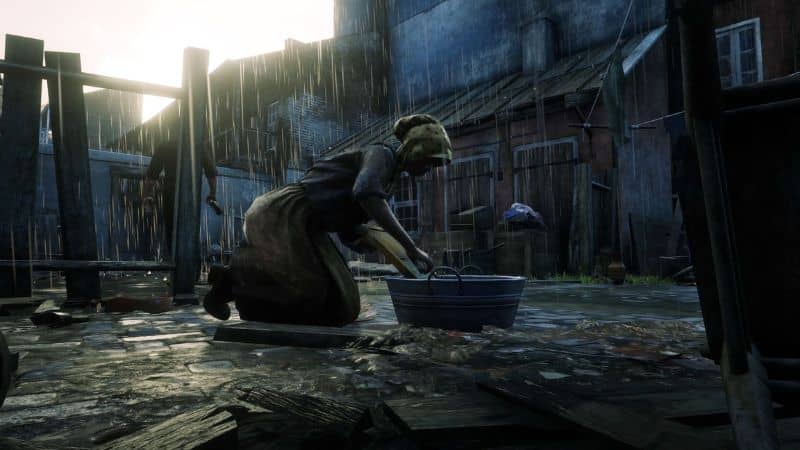
The film Hardly Working, credited to the group Total Refusal, is an observational study of a selection of ‘non-player characters’ (pre-programmed game characters not controlled by the players) in the western genre video game Red Dead Redemption 2 – a carpenter, a street sweeper, a woman washing clothes, and a stablehand – accompanied by a voice-over narrator reflecting on their routine actions. Hardly Working can be categorised as a documentary and is both a political and poetic exploration of class differences, monotony of work, and the possibility to control one’s existence.
Hardly Working by the group Total Refusal is a political and poetic exploration of class differences, monotony of work, and the possibility to control one’s existence.
Somewhat more classical documentary elements can be found in Tracing Utopia by Catarina de Sousa and Nick Tyson. This film portrays a group of queer teenagers in New York who have created a virtual free space for gender identity in the game Minecraft, a space that is a significant part of the film as well. A related topic is discussed in Jamie Janković’s A Woman on the Internet (or, The Eternal Scream), which deals with the stereotypical gender representation among game characters, even when players have the opportunity to shape their own avatars, and how this affects people’s actions and self-esteem in virtual worlds. Thus, machinima can also be an arena for critical reflection on video games as a medium.
Free exploration
A widely used game in machinima is the Grand Theft Auto (GTA) series due to its diverse possibilities for staging action within vast and realistic environments. These games feature a hugely detailed, expansive world consisting of fictional cities strikingly similar to Los Angeles, New York and other existing locations in the United States – open for players to freely explore and interact with. The previously mentioned Red Dead Redemption, also produced by Rockstar Games, offers a similar concept in a 19th Century world clearly inspired by the western film genre.
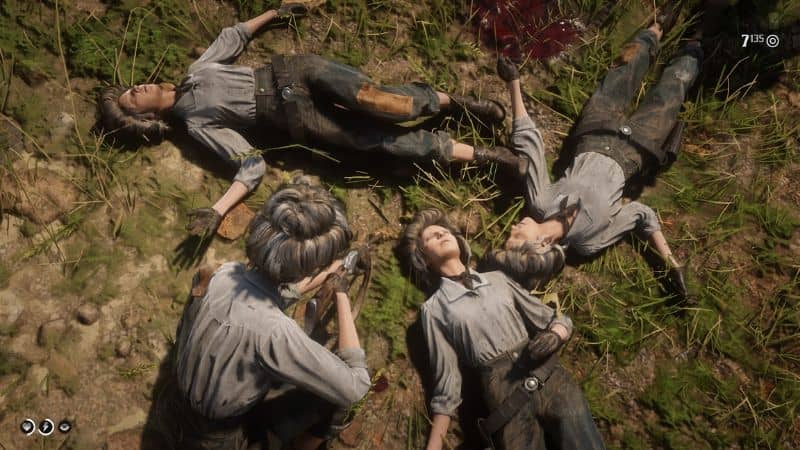
A version of the latter, Red Dead Online, is explored to its boundaries in Marie Foulston’s film The Grannies, depicting a group of players who choose not to follow the game’s narrative threads. Instead, they go searching for ‘holes’ in the digital world’s logic and appearance, often with surreal results. Including the players’ reflections on the audio track, this machinima film too should be placed in the documentary category – and offers some interesting perspectives on virtual realities and how to use them. If not to say, digital lives and how to live them.
Jamie Janković’s A Woman on the Internet (or, The Eternal Scream) deals with the stereotypical gender representation among game characters.
Exploratory is indeed also Alice Bucknell’s The Martian Word for World is Mother. This film is not based on any existing computer games but uses game development software to visualise various imagined colonisations of the planet Mars – and sheds critical light on the idea of colonisation itself. Furthermore, with the assistance of artificial intelligence, Bucknell has created an own Martian language for the film – thus pointing towards new directions machinima might develop in. It seems likely that artificial intelligence will be an essential component in this field in the future, also in ways that are difficult to predict.
Several machinima films have recreated well-known feature films in their entirety as a kind of ‘remakes’ through games. Luca Miranda’s The Bowl (La Jatte), screened at the festival together with other machinima films referring to the history of cinema, is perhaps more of a deconstruction of Chris Marker’s experimental classic La Jetée, here assembled by images from a large number of video games.
Other films in the same machinima section included Marlowe Drive by Ekiem Barbier, Guilhem Causse and Quentin L’helgoualc’h, which follows some of the roads from David Lynch’s film Mulholland Drive in the game Grand Theft Auto – and even takes a Lynch-like turn when the players in the film are hacked. Among these films was also Sid Iandovka’s Porcile, an atmospheric and enigmatic non-narrative film with more or less clear echoes of Pier Paolo Pasolini.
Return to Solomon
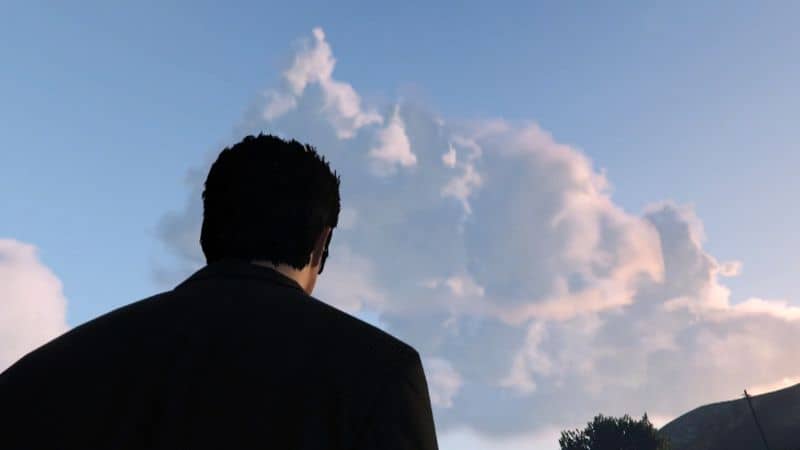
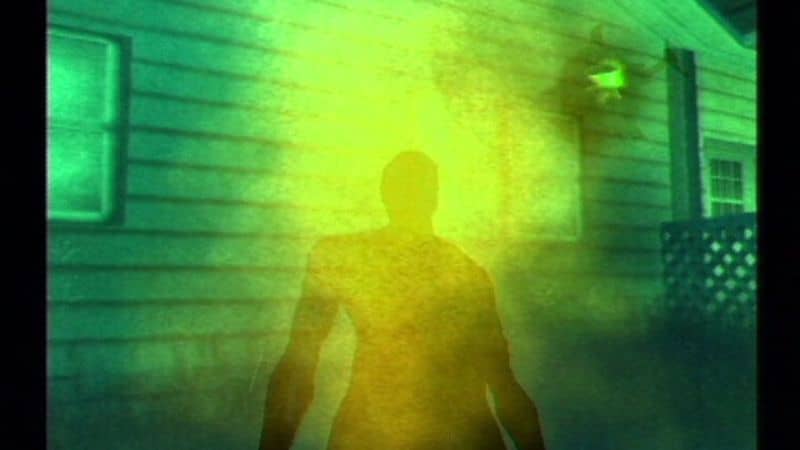
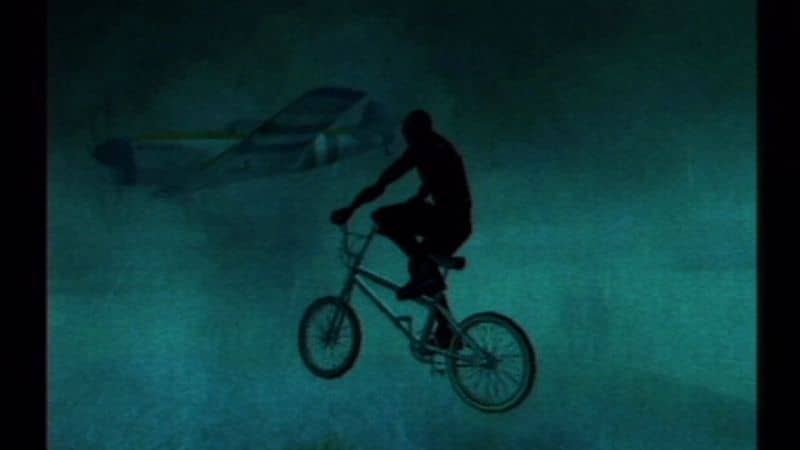
The last program section of machinima in Oberhausen was appropriately dedicated to the before-mentioned Phil Solomon. This section included two of the films he made before moving over to the machinima format, both shown in 16mm prints, followed by a trilogy Solomon made in memory of his late friend and fellow filmmaker #Mark LaPore#, with whom he collaborated on his first machinima film. All three films in this machinima trilogy are created through Grand Theft Auto: San Andreas. In contrast to the game’s reputation for violent content, they are melancholic, pensive and highly poetic avant-garde films – with several similarities to Solomon’s analogue works, albeit clearly different in visual form and texture.
As conventional films and television series become increasingly digital, some even using software for video games, one can debate whether these productions can be called machinima as well. But such questions of definitions and categorisations are, in a way, missing the main point. With its origin in two (or three) existing and already interconnected media, machinima is a hybrid genre by nature, where much of its strength lies in the unrestrained and playful combination of formats, traits and expressions – which can nonetheless result in genuinely innovative works.
First and foremost, machinima seems perfectly suited to reflect and illuminate the digital worlds we are moving ever further into, and it will be exciting to follow this field as the accompanying technologies keep evolving.
The 69th International Short Film Festival Oberhausen (Internationale Kurzfilmtage Oberhausen) took place from 26 April to 1 May 2023.