For confluent reasons of geography and industrial-cultural economics, #Los Angeles# has long been the most filmed city in the world. After 124 years of «La La Land» cinema, how can new angles be found on California’s mega-metropolis? French photographer/anthropologist Marion Naccache — as part of her project chronicling specific urban seasides—finds a fresh approach with Venice Beach, CA, a detached but intimate portrait of the eponymous, raffishly bohemian enclave.
Naccache’s series began with 2010’s 65-minute Coney Island (last summer), focusing on the fabled #New York# amusement-park; the follow-up Arpoador, about a spur of land in Rio de Janeiro (the city where she resides) was reportedly completed around 2015 but has yet to surface publicly. And it appears that the 79-minute Venice Beach, CA was also a time-consuming affair: a version was screened at Los Angeles’ Skid Row History Museum & Archive as long ago as November 2016.

Just over one mile
The completed version, premiering at Cinéma du Réel, begins with a title-card that’s simultaneously precise and vague: we will see «Venice Beach Boulevard between Rose Avenue and Windward Avenue [a distance of 0.7km, just over one mile] at sunrise between 5am and 9am one fall.» Which fall? Overheard news-footage of an electioneering #Donald Trump# suggests the autumn in question may well be 2015. It is also unclear whether the film was shot on a single day or over a period of weeks. The latter seems most likely, given how Naccache freewheelingly discards linear chronology. Venice Beach, CA begins in semi-darkness and returns to the noirishly pre-dawn at semi-regular intervals.
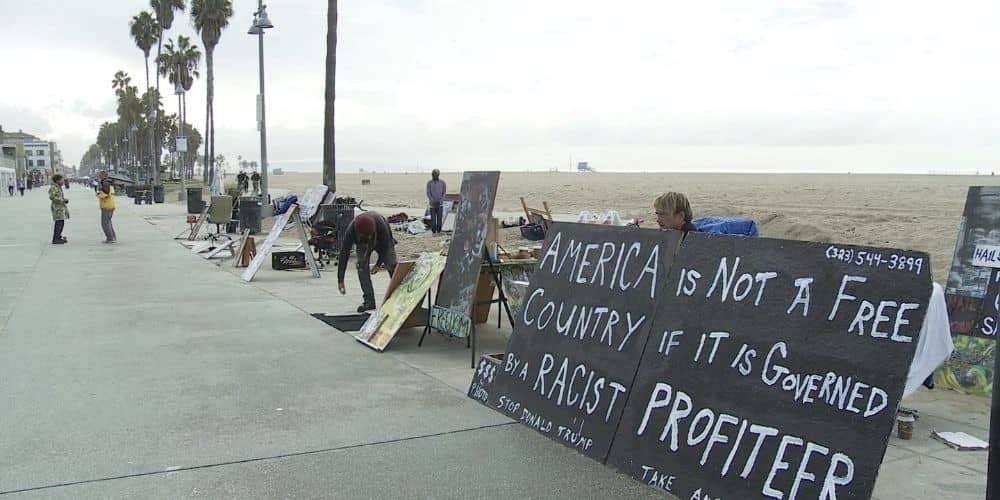
Appearing as it does in the early months of the #Joe Biden# era, the film is endowed with a certain time-capsule quality. AMERICA IS NOT A FREE COUNTRY IF IT IS GOVERNED BY A RACIST PROFITEER reads a hand-written sign propped up on the beach’s busy boardwalk. This strip has been consecrated as a «free speech zone» since its creation in 1905, part of tobacco-magnate Abbot Kinney’s visionary development of the area (complete with six miles of artificial canals, half of which remain) as a reasonably-priced haven for artists and outsiders.
For a hundred years or so, this new Venice offered «actual affordable housing by the sea,» as one speaker puts it in the film’s opening moments. Like all the soundtrack’s contributors, he is heard but not seen, an editorial decision that intriguingly de-emphasises considerations relating to race and ethnicity. «This is a really weird town, » he remarks, «all nice and friendly during the day. But at night…»

Bums and billionaires
Naccache’s selection of voices makes it clear that Venice (pop. 40,000) contends with numerous overlapping socio-economic malaises. These include a large and widening gap between rich and poor («bums and billionaires» rub shoulders here), drug and alcohol issues, undiagnosed and untreated mental illness, homelessness, and rapid #gentrification hastened by the area presence of Snapchat’s headquarters. The internet communications giant, founded here in 2011 eventually moved out in spring 2018 after stirring up considerable enmity among longer-term residents (vocally expressed here).
The dozen or so speakers are allowed to discourse and even sometimes ramble, without any audible input from the director herself. Naccache shares editing duties with the experienced Isabel Monteiro de Castro, whose credits around Latin America include «littoral» notables like Karim Aïnouz’s Futuro Beach (2014) and Lorenzo Vigas’ From Afar, winner of the #Golden Lion# at the other Venice in 2015.
Appearing as it does in the early months of the Joe Biden era, the film is endowed with a certain time-capsule quality.
The resulting effect is similar to a slow, halting meander along this windy waterfront, whereby we encounter myriad «commentators» eager to provide first-person testimony about their own experiences and/or analyse the peculiarities of this particular neighbourhood. But while the subjects covered obviously have much wider applications, it would be a mistake to read Venice Beach, CA (or indeed Venice Beach itself) as a microcosm of #America in the 21st century, nor even of Los Angeles.
For one thing, Venice is right there on the seaside. And despite its sun-and-sand global image fostered via TV programmes such as Baywatch, most residents or visitors to smoggy Los Angeles glimpse the ocean rather rarely, if ever. The centre of Downtown is fully 25km (16 miles) from Venice. Indeed, Venice is of interest exactly because it is so different in so many ways; it retains genuine character (and characters) along with community spirit. The film’s early-morning visuals emphasise the beauty of the sky and the palm-tree-fringed beaches, and many of the shopfronts exude an air of appealingly unvarnished scruffiness — perhaps they still do, half a decade later.
A history in film
Filmmakers have long been drawn here: the first glimpse of Charlie Chaplin’s Little Tramp was via Kid Auto Races At Venice (1914); Orson Welles convincingly dressed it up as a seedy Mexican border-town for Touch of Evil (1958); the laid-back, marijuana-chilled vibe proved an ideal home for both Kris Kristofferson in (and as) Cisco Pike (1972) and Jeff Bridges’ eponymous super-slacker in The Big Lebowski (1998).
Devotees of cult classics, meanwhile, revere Curtis Harrington’s oneiric Night Tide, which played at that other Venice’s film festival in 1961 and recounts the amorous adventures of a sailor played by Dennis Hopper against the alluringly shabby backdrop of the run-down waterfront. Venice Beach CA, with its fixed cameras and leisurely long takes, concentrates with rigid but sympathetic intensity on this area to such a degree that its atmosphere is evoked more directly, more immersively — and, in the end, more persuasively — than ever before.