War cinema is fertile ground for thinking about genre expectations, especially in the post-9/11 era. Countless films have let the tragedies of the Middle East harden into a fixed set of associations, making spectators anticipate an immersive, visceral spectacle seen through – and made through – American eyes. A ruthless yet charming masculine hero holds centre stage, while the local perspective and its people are reduced to scenery, a threat to be neutralised, or a chorus grateful for his sacrifice. Built to please, these films paradoxically often achieved the reverse – hence films on Iraq earned the notorious nickname «toxic genre,» as much for their box-office failures as for an unconvincing anti-war posture that viewers pushed back against.
Into that wounded terrain steps Halkawt Mustafa, the Iraqi-Kurdistan-born, Norway-raised director whose No Paradise If You Are Killed By A Woman premieres Out of Competition at Venice. He takes up the genre’s spectacle and drains its toxicity, offering the feminine perspective war cinema so seldom allows, in an unwitting feminist revenge drama about a virtuoso Kurdish sniper who returns home to avenge herself and the women terrorised alongside her.
Vyan goes home
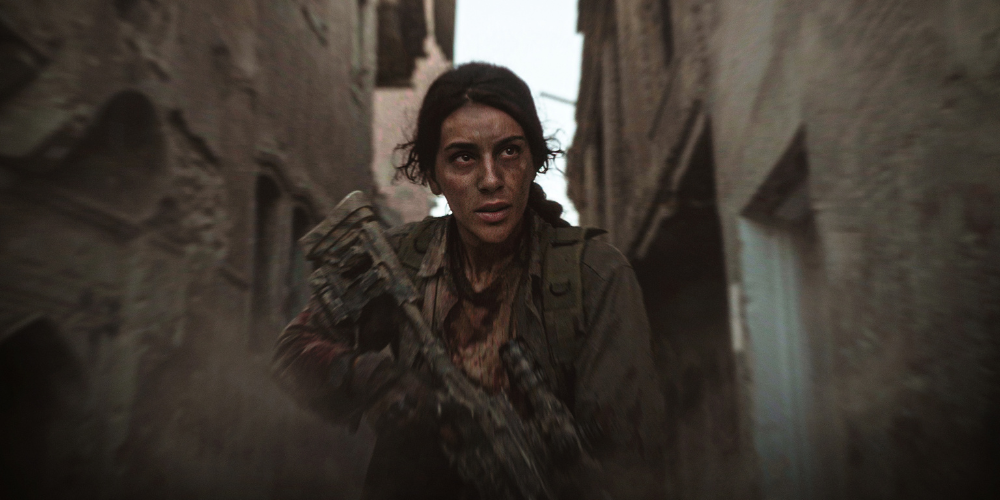
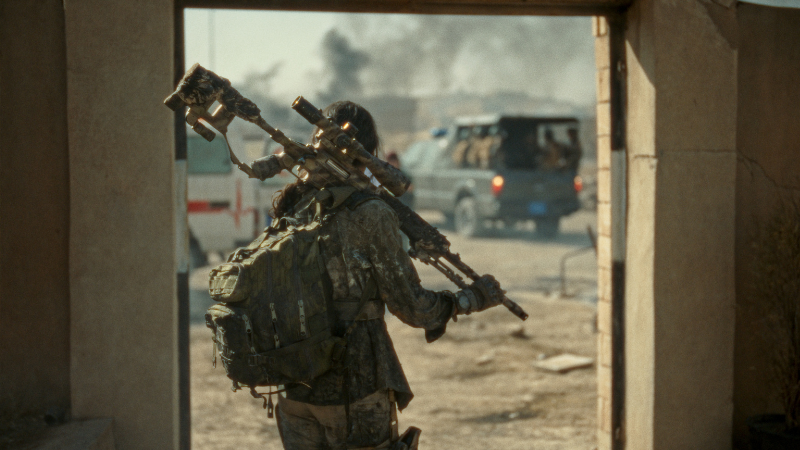
The first thing we see is a sniper’s hole. The camera slowly zooms through, revealing a civilian neighbourhood some 25 kilometres from Mosul in 2016, as the subtitle reads. Two years before, ISIS had seized vast stretches of the Iraq-Syria border and turned the city into a ruined open-air prison, where terrorists ruthlessly shot everything that moved through such sniper holes, wounds cut into what were once someone’s homes. Then the camera settles on a young, beautiful woman in uniform. This is Vyan, a Kurdish woman and preternaturally gifted sniper in a Peshmerga unit, famous for helping to drive the caliphate from northern Iraq. Armed with a silenced pistol, a heavy rifle, and a limitless appetite for revenge, she crawls toward a difficult target and succeeds.
What might, at this point, read as crudely applied feminism runs deeper, as its very title reveals. There is something of rape-revenge cinema in the spiritual logic that a man killed by a woman forfeits paradise. On that structural level alone, Vyan’s gender is already a fact operating inside the war rather than a virtue the film sets out to preach, an idea that only grows more convincing as we come to know both Vyan and the director. This fictional heroine is grounded in Mustafa’s real-life experience. In 2014, working as a war photographer, he met many of the female Peshmerga fighting ISIS. But above all, Vyan is inspired by the heroism of Nadia Murad – the Yazidi woman and Nobel laureate, a vocal advocate who campaigns against the sexual violence used as a weapon of war – something she herself bitterly endured.
To restore the power and dignity of the Yazidi women fallen in the genocide, he makes Vyan a kind of collective voice, echoing the dark destinies of countless women. Through the flashbacks, we learn that ISIS came to her house, killed her parents, and shattered the lives of those they left alive. Torn from her younger sister, Vyan was caged and then sold to a man who beat her mercilessly. Yet she miraculously managed to escape, eventually finding her way to a unit of female Peshmerga snipers.
An almost superhuman woman radiates the dignity, power and defiance long taken from women like her.
From there, the film shifts register just as abruptly as a Norwegian armoured vehicle rolls into the camp to carry her back home. It turns out Vyan has lived in Norway since she was twelve, but when her family wanted to visit their native land, they were swallowed by its new reality. That cold Scandinavian calm sits surreally at odds with the hell her heart belongs to. At the cemetery where her parents’ bodies were evacuated and buried, an official casually reveals that her sister is alive, now taken as a forced wife by a Swedish ISIS fighter. Despite the million-dollar bounty ISIS has placed on her head, and with exhausted faith in yet another promise of Western help and protection, Vyan decides to go home and rescue her sister herself.
This intersection of the Middle East and Norway is far less exotic than it seems, mirroring Mustafa’s own directorial path. Above all, it’s remarkable that the war against ISIS produced Kurdish-diaspora documentaries in Scandinavia, like the decorated Zaradasht Ahmed’s Nowhere to Hide (2016), a Norway-Sweden-Iraq co-production, and Mustafa’s own hybrid documentary Hiding Saddam Hussein (2023), about the farmer who hid the fallen dictator beneath a bed of flowers. Turning now to fiction, he continues to dig further into a modern history that the cinematic genre has tended to flatten, dismantling its conventions from within and down to the smallest touch. For instance, the war-on-terror film’s most familiar cliché is the American soldier sent abroad to ache for home, essentially accompanied by scenes of farewell, flashbacks, or homecoming – Mustafa elegantly reverses that current, immediately driving his heroine back to the home that America betrayed.
War spectacle, reclaimed
Yet nowhere does Mustafa bend the genre more firmly to his gaze than in the film’s sheer spectacle, mounted on a technical scale that rivals, if not surpasses, what Western productions have achieved, but carrying far more emotional and historical nuance. All in all, a convincing war spectacle is a tricky thing to craft, as it risks numbing the viewer or dissolving the story into video game-like immersion. But Mustafa finds an intuitive balance between handheld combat, gunsight POVs, and the suspenseful stillness of a sniper’s wait, weaving in quieter passages where Vyan grieves with the women she saves and weeps for those she could not save. Grounded in that arresting sentimentality and Avan Jamal’s stunning yet physically and morally punishing performance, that overwhelming, flamboyant action feels earned.
Much of that force also comes from the fact that Mustafa shot on location in Mosul, which is as compelling as it is contentious. Whether a real wound in the land may serve as a film set is an ethical debate as old as war cinema itself, one that Mustafa does not sidestep but instead makes essential to the story. To quote the director’s statement: «Filming on location was the only way to capture the city’s physical and emotional reality and to allow the story to feel truthful. The streets, the ruins, and the silence carry a weight that cannot be recreated elsewhere.»
Somehow, out of all that unspeakable horror and pain, the film conjures a kind of cinematic magic, in its weirdest way. In that sense, No Paradise If You Are Killed by a Woman rhymes with last year’s gem of Hasan Hadi’s The President’s Cake, which spun a near-Disney adventure from a little girl’s life amid the poverty and repression of 1990s Iraq and gave childhood back to the place that terror had stolen. Here, an almost superhuman woman radiates the dignity, power, and defiance long taken from women like her, so an Iraq-set war film feels revealing, empathetic, and cinematically pleasing, all at once and at last.