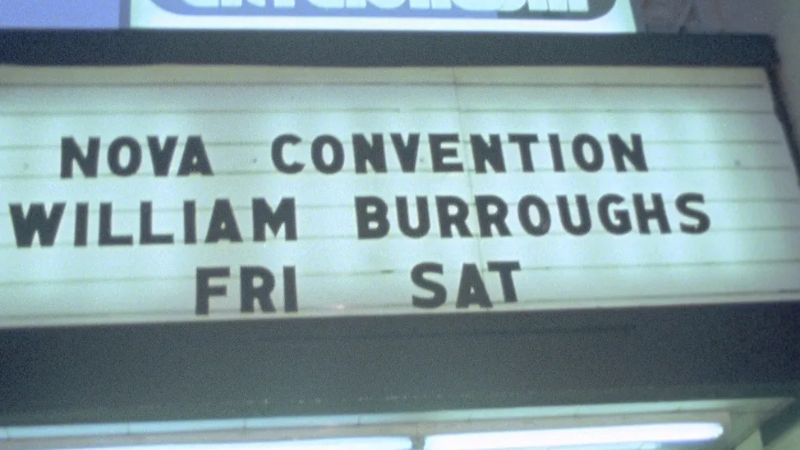
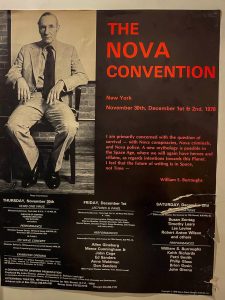
Aaron Brookner and Rodrigo Areias’s Nova ’78 is an archive wired to the mains of mid-century power. The film assembles Howard Brookner’s 16mm footage (with Tom DiCillo also shooting) and Jim Jarmusch’s contemporaneous audio from the 1978 #Nova Convention#, a New York convocation where poetry, performance, and punk-era energy collided with the older counter-culture avant-garde. Live circuitry is the film’s thinking engine, as the convention wrestles with a problem that keeps returning under new names: control.
Legible politics
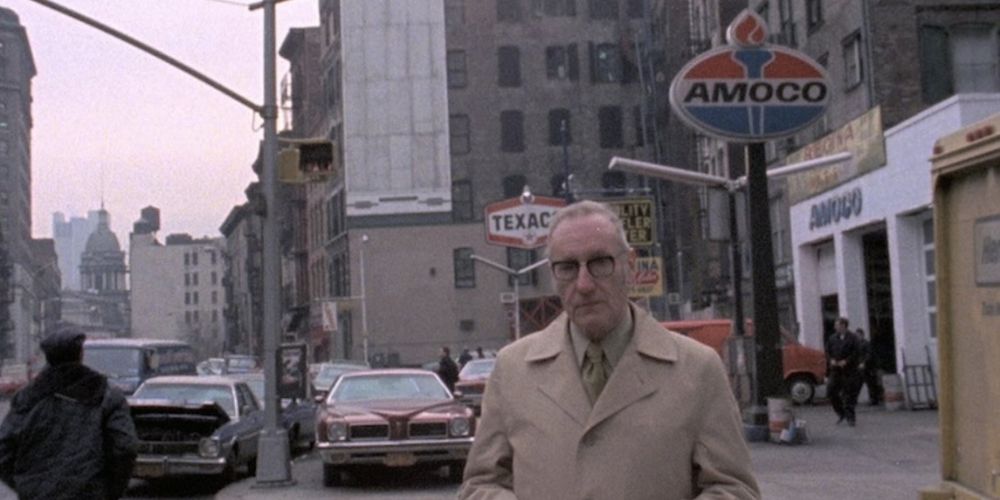
Curator William S. Burroughs reads with his steady Midwestern drawl, threading his «Nova conspiracy» through #nuclear terror, media contagion, language as programmable virus, and the managed delirium of daily life. In his 1990 Postscript on the Societies of Control, #Gilles Deleuze# acknowledged Burroughs for naming the new modulation regime of continuous tracking, laying forth a compact theoretical frame that clarifies both Burroughs’s and the stakes of the convention. Corporate souls, endless training loops, subjects converted to data, Burroughs had already turned this schema of power into a pulp prophecy. «Control can never be a means to any practical end,» he writes in Naked Lunch.
Downtown ecology cross‑pollinates in real time, with the film honouring this genealogy in keeping the floor noisy and the captions sparse. Meanwhile, the roving camera keeps discovering counter-culture accomplices. Allen Ginsberg and Peter Orlovsky raise a chant in Punk Rock / Old Pond; Brion Gysin intones Kick That Habit and Junk Is No Good; Timothy Leary and Robert Anton Wilson surface in panel exchanges; John Cage voices mesostics from Finnegans Wake while Merce Cunningham answers in buoyant movement; Philip Glass sends a lattice of arpeggios across a short synthesizer set as pockets of boos flare near the back; Laurie Anderson and Julia Heyward perform Song from America on the Move, pitch shifting voice in real time; Ed Sanders’ Hymn to Aphrodite and Anne Waldman’s Plutonium Ode build a commons out of the room; Frank Zappa, stoically reading the «talking asshole» from Naked Lunch. Patti Smith has to deliver the news that Keith Richards will not appear. She cites business responsibilities in Los Angeles, though a Toronto heroin case hovers over the sentence. She offers cash refunds from the stage, but no hands rise. Hoarse, she rips a reed-raw clarinet line, scrapes a jagged guitar, and folds in a salute to Jim Morrison.
The film’s compositional approach makes its politics legible. The stock grain reasserts the #Bowery before the realtor’s fairy tale of today. It’s skid-row grit abutting a hotbed of band practice and poetry: CBGB’s battered doorway, the Sunshine Hotel’s flophouse doors, the Bowery Mission’s chapel and breadline. This footage of the Lower East Side, intercut with the convention sequences and featuring Burroughs’s seventies home, The Bunker, shows New York’s battered exteriors reeling from its fiscal crisis. Inside, poets bargain with their breath. Light spills yellow-green across faces; mics squeal; lenses flare; lungs cough between lines; debates drift in about #Iran, #Proposition 6#, nukes, rent (it was still too damn high back then). The Entermedia Theatre turns into more than a host venue; it’s a fully functioning organism.
Burroughs had already turned this schema of power into a pulp prophecy.
Resistance grammers: yesterday vs today…
The film’s archival strategy sits within a lineage of radical listening. Think Black Audio Film Collective’s Handsworth Songs and Thom Andersen’s Los Angeles Plays Itself, where sonic montage becomes dissent and repurposed images read a city, here tuned to a subculture’s operating system that Burroughs named and Deleuze diagrammed.
The operating system of the Nova Convention, taken as a whole, maps the day’s resistance grammars. Gysin slices syntax to expose the command lodged in grammar. Anderson rewires the body through machine. Cage and Cunningham train perception to coincide with chance. Zappa turns grotesquerie into priestly wit. Smith models performer ethics when the night could wobble away. Against these, modern «conventions» often operate as modulation platforms in the Deleuzian sense: themed nostalgia weekends and anniversary packages with appearance fees structured like business bookings, PR deliverables that prewrite the narrative, and sponsor funnels that convert discovery into brand metrics. Think of military-industrial-complex steered festival blocks at #SXSW, Comic-Con’s studio slate rollouts with choreographed press lines, or heritage-venue relaunches that flip addresses into retail flagships. Burroughs’s control vocabulary fits this present as surveillance logistics monitor bodies by default, recommendation systems condition desire while calling the output personal taste or «identity,» and event apps fold audiences into sponsor pathways labelled «access» and «experience.»
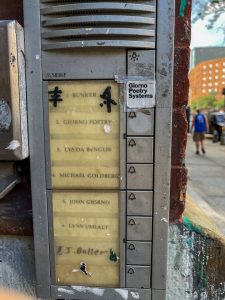
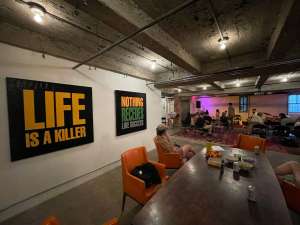
I had just visited 222 Bowery, the Bunker where John Giorno’s (also appearing at the convention and in the film) Giorno Poetry Systems still works. The table and the orange stackable chairs match the ones in the film. The floor’s common area still houses Burroughs’s rudimentary «Orgone Chamber,» tucked in a corner like a practical talisman. To reach the rooms in Burroughs’s day, you passed locked gates and a grey metal door; inside, the old YMCA locker room’s tiled severity remains, softened by books, records, tape boxes, and the daily logistics of a collaborative art space doing its best to hold on to organic artistic resistance. The Nova Convention was conceived here, in a very different New York City.

Friction as the method
Like the ever-lasting kitchen table debates at The Bunker, the Nova Convention was no TED talk. If control organises culture by smoothing risk and prewriting experience, Nova ’78 answers by reintroducing friction as a method. Furthermore, if counter-culture feels missing, was it defeated, or did its supply chain terminate inside the apparatus that now sells it back to us? Nova ’78 briefly gives back the room, while outside, the Bowery continues to carry traffic and trouble. The film knits theory into the tangible practice of cutting the sentence that orders you, testing it in public, and listening to the feedback. The task remains to keep the room alive.