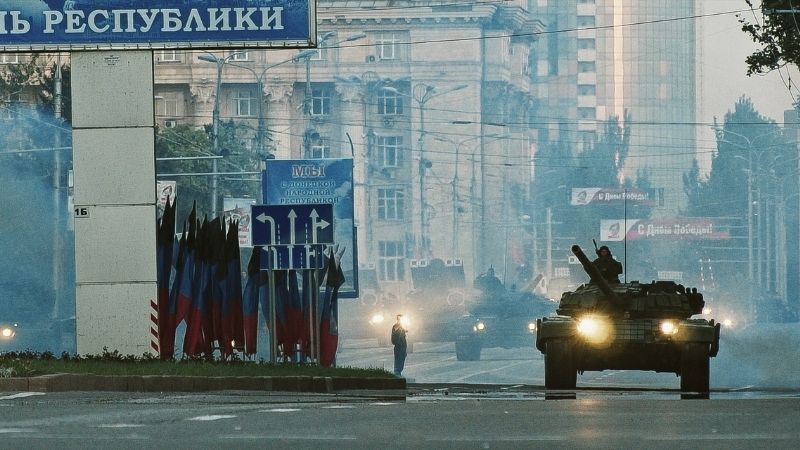
World-premiering in the Special Premieres program at this year’s hybrid #CPH:DOX, Luca Gennari and Enrico Parenti’s Novorossiya is one tragically timely doc – a snapshot of life on the ground in the #Donetsk People’s Republic. It’s a borderland region in which both citizens and soldiers have experienced the #Donbass-Ukraine# conflict up close and personal; intimately and viscerally bearing witness for the more than 13,000 people who’ve died since the DPR was first established back in 2014 (as onscreen titles tell us from the start).
Embedded
Admittedly, in light of Russia’s full-scale invasion of Ukraine, ongoing as I type, I felt a bit uneasy even viewing the 64-minute film. And likely would not have had the filmmakers been Russian rather than Italian. The reason for my reticence involves POV – as the co-directors have chosen to embed themselves almost exclusively with the separatists and their pro-Russian supporters. Not as sympathizers, however, but as foreign outsiders simply trying to make sense of this hermetically sealed world, which is why I ultimately decided to watch – and am grateful that I did.

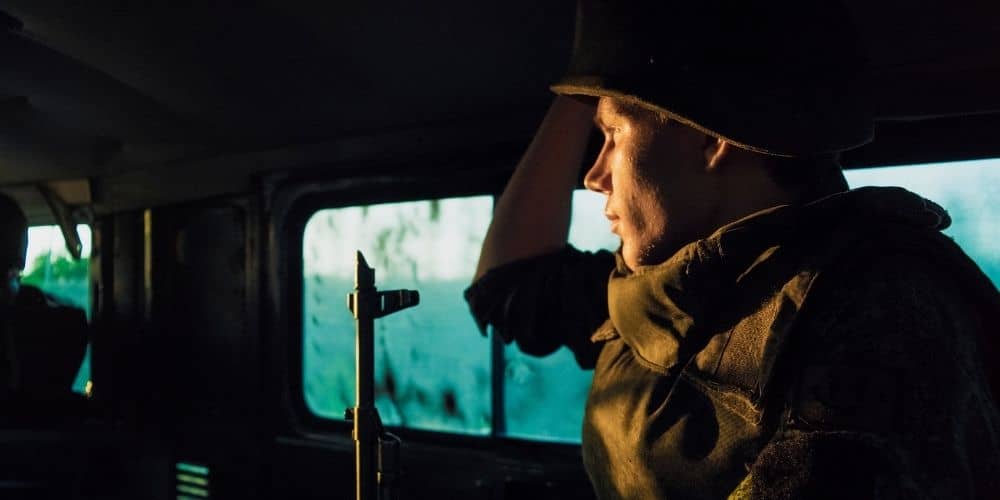
Riding along with a battle-hardened soldier the conversation flows. He seems as puzzled by pro-Ukrainian sentiment as we Westerners are befuddled by him. Scoffing at his naive countrymen, he declares they shouldn’t «seek happiness on the foreign side.» Parroting the Kremlin’s Russian/Slavic supremacist vision – one «that has never been enslaved by the Western civilization» – he seems to cast himself in the existential role of all of civilization’s saviour. Which, ironically, only serves to render this military man all the more ordinary; yet one more dime in the dozens of middle-aged white guys around the globe desperately searching for meaning as patriarchal power fast slips from their grasp.
The faces of war
Guys like the anti-capitalist, country-music-loving, ex-con from #Missouri who’s currently in Donetsk to apply his US military-provided training to mercenary work. (Which, in yet another ironic twist, seems quite the capitalist thing to do.) But there are also the many younger men who never asked to be part of this struggle for, in the words of the battle-hardened soldier, some sort of «Soviet Union 2.0» utopia. Like the long-haired hospital volunteer, a heavy metal musician who can’t seem to shake the «heavy metallic smell» of blood. Or the resigned father, watching his young son happily playing in the sunshine. «The war is like a wild beast that lives next door,» he muses. «As long as it doesn’t notice you, you live.»
Which is what so many of the women and children of Donetsk seem hellbent on doing. Bunker-residing babushkas chat and play cards. Community choirs gather. Children sing. (Indeed, finding solace in music – from patriotic anthems to musical theatre – seems to be the local form of stress relief.) Life in the DPR surreally goes on among the nonstop bombing, even as no one ever really sleeps. But then again, as one tired lady laments, «You can’t wake up from the nightmare of war.»