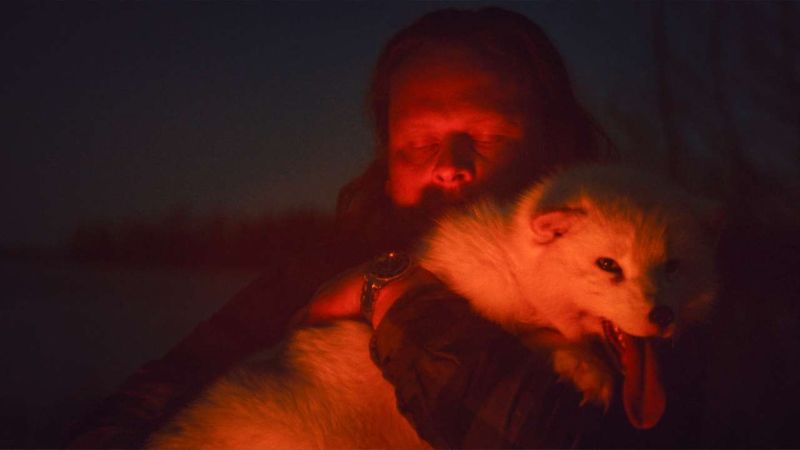
There is a lot of public and informal talk about the connection to #nature that we, as humans, have lost in modern times and how much happier we would be if we could restore it. Pet Farm, which just celebrated its international premiere at the Thessaloniki IDFF‘s Newcomers Competition, focuses on a man living in a modest mountain hut, surrounded by nature – with the vast, breathtaking view of Norwegian landscapes at his feet, forming part of his everyday mundanity. However, instead of seizing the opportunity to reconnect with his primal side, he attempts to domesticate the wildlife in a perhaps not-that-conscious attempt to replace human connection. A connection that has apparently caused him so much pain due to being brought up in a dysfunctional family that he prefers to live and communicate with animals, considering them a family.
This intimacy can hardly combat loneliness but may, perhaps, offer hope for reconciliation with one’s inner self.
Legal and personal crisis
The opening frames feature archival footage in Russian, showcasing a Soviet experiment in domesticating foxes, which is, of course, presented as a successful one, with an enthusiastic tone typical of the era. Middle-aged Joakim, the protagonist of Pet Farm, follows the Soviet example on his small, makeshift farm, built with improvised materials, where he breeds and tames different fox breeds. It is his way of reconnecting—or perhaps never breaking—from his childhood, which he claims was the happiest time of his life when he lived on his grandfather’s farm, who was also a fox breeder. Back then, it was a fur farm, but now Joakim’s dream is to popularise the domestication of foxes and sell them as pets. Online, he can reach clients from all over the world, but is it legal to keep foxes in their homes in their countries? And could it be that the sale of them from Norway also violates the law? Joakim is first visited by representatives of the Norwegian Food Safety Authority, who ask him innocent questions, but things take a serious turn when the Animal Protection Alliance reports him to the Norwegian Environment Agency and calls for an official court hearing. His tiny private paradise has been invaded by the incomprehensible rules of the hostile outside world, with which he, in any case, wants little to do.
Indeed, it is not entirely clear where all the foxes came from on Joakim’s farm, and one inevitably wonders to what extent his fox breeding is a purely decent activity. As the legal closure of all fur farms around Norway is discussed in the film, it’s possible the foxes might have been rescued from such farms, but the eradication of their wild nature is still questionable. What is nevertheless far more questionable is the court’s decision, which, after declaring Joakim’s activity illegal, imposes a fine and a month-long imprisonment but also mandates the euthanisation of the foxes. A decision that can hardly be justified as logical or stemming from genuine concern for #animal welfare#. Promoted as one of the best systems in the world, Joakim sadly concludes that the Norwegian social safety net works excellently for the average person who is “like everyone else,” but it can be harsh and heartless towards those who don’t fit in, including animals. If they cannot be bred for fur or as pets and do not fit into any statistical graph, extermination becomes a satisfying solution for the administration.
Chasing a dream
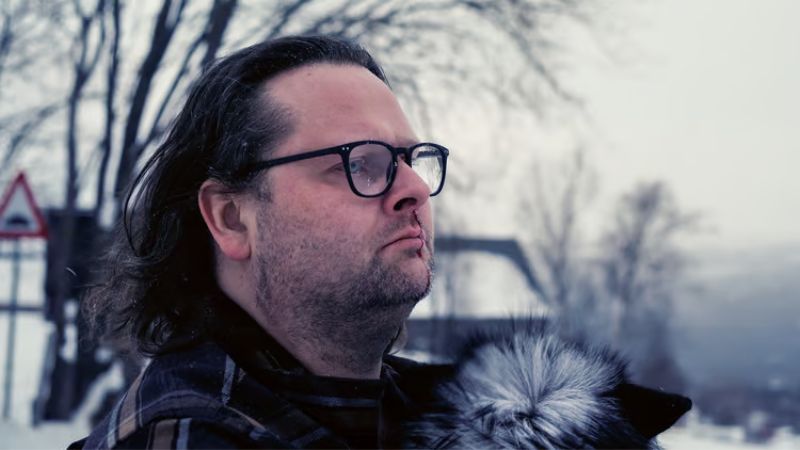
Understandably, Joakim’s mental state, which already seems unstable, is shaken to the core – he is unable to care for his beloved foxes, neglects the farm, and chaos ensues around him. Fortunately, Miro, his Slovak neighbour, is here to help, and for a while, it seems they are forming a human bond that might flourish. However, Joakim’s restlessness prevents him from settling or being content with drinking beer with buddies or whatever makes other people happy. What the directors of Pet Farm, Finn and Martin Walther, call #radicalisation in their artistic statement is perhaps Joakim’s stubbornness in refusing to let himself grow up and become a boring or cruel adult. The eternal little prince in him will not give up taming foxes and is ready to embark on a journey to another planet so as not to abandon his dream.
Kristian Davik Larssen’s cinematography masterfully captures the vast, stunningly beautiful surroundings where Pet Farm predominantly takes place. Thus, the camera work further emphasises and helps the viewer connect with Joakim’s feeling of being lost on Earth while living in an encapsulated private realm, seeking a wordless intimacy – whether among animals, lying on the grass, or alone in the forest. This intimacy can hardly combat loneliness but may, perhaps, offer hope for reconciliation with one’s inner self.