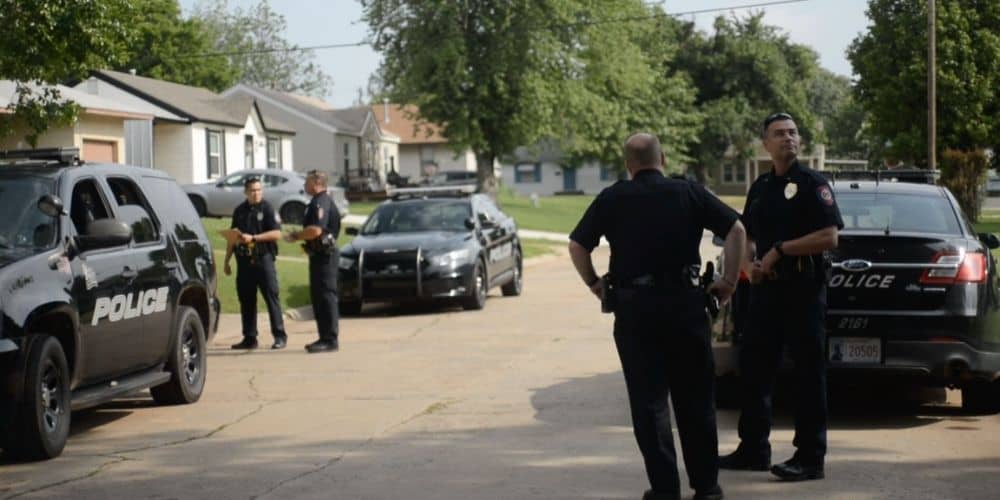
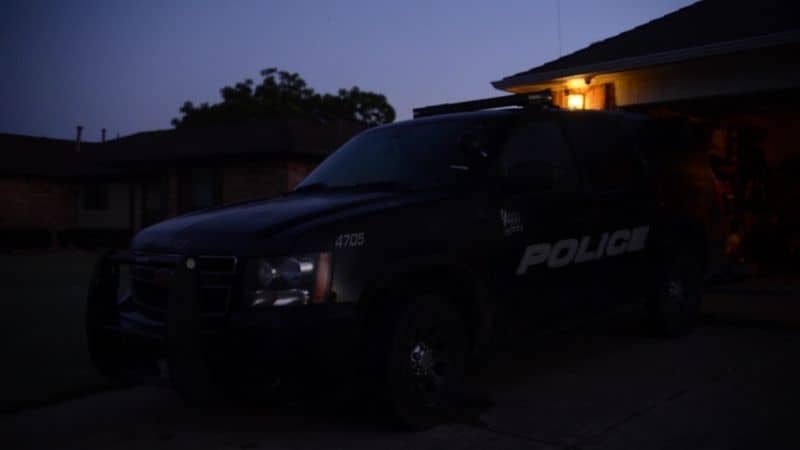
The 30-minute documentary Random Patrol, directed by French filmmaker Yohan Guignard, opens with a view of a #police car at the break of day.

Yukon, Oklahoma
A white man clad in a police uniform, with ‘Yukon, Oklahoma’ emblazoned on his shoulder patch, enters the car. The camera stays within the confines of the police car thereafter, shot almost in its entirety from the passenger seat. At the very onset of this chamber piece documentary, the police officer, who becomes known to us as Matt, utters the words that set the tone of the film. «I wonder if today is the day,» he says succinctly, «I wonder if today is the day I am going to be killed. It’s the first thing I think about when I put my uniform on.»
«I wonder if today is the day I am going to be killed.»
Matt’s day is marked by what the police call «random patrolling», inspecting a given area at random times. However, it is not the dramatic goings-on of his police work that become illuminative, but his daily practices that appear minuscule. As Matt goes about his day, there are things that he does «out of habit, out of reflex,» like drawing a gun as he sees a young unarmed man walking across a parking lot to ask him a question. «I am okay to park there for a work-out, right?» the man asks at last.
Matt attributes his «reflex» to «one of the biggest problems in policing», that is «becoming more and more isolated from regular people» and «thinking the worst about the people, and that they are going to hurt you.» «But it does something to your mind, it does something to your heart. It closes you off from normal people,» he adds.
Tragic failings
Matt’s musings bring to the fore tragic failings of policing in the #United States# that have obstinately shaped the officers’ conduct: a failure to train officers as compassionate servants of the community and a failure to throttle their use of force, constraining them to wield it only as a last resort and when confronted with an immediate threat.
«Law and order are Matt’s duties,» the synopsis of the film elegantly reads, throwing in, albeit indirectly, an imperative question about the police force that historically emerged to help those with economic power maintain order. What is actually the duty of policing in contemporary US reality? As Victor E. Kappeler and Larry K. Gaines poignantly point out in their book Community Policing: A Contemporary Perspective, order is not a commodity that the police can effectively impose on communities, rather it is a «hallmark of communities that participate in social equity and self-governance to improve the quality of life for all people.»
Matt’s musings bring to the fore tragic failings of policing in the United States
Random Patrol is hardly a study of modern-day policing and its larger implications in the United States. What the film does, however, is capture the daily ruminations of a white police officer in an #Oklahoma town who worries about how the job has changed him. «Matt, why are you so angry?» – the officer recalls his fiancee asking on the day he proposed to her. He had no response.