Presented in the Newcomers Competition of the Thessaloniki IDFF, Tomas Elsik’s debut Resilience is a slow-burn, thought-provoking, and aesthetically alluring picture of a struggle for the rights of wildlife to survive and exist alongside humans in almost completely industrialized areas of #Central Europe#. The striking cinematography merges with remarkable sound design, unnoticeably surrounding a viewer and creating an illusion of being in a state of nature, in forests and on meadows, breathing in fresh air full of scents of wildflowers and trees. The film sublimely captures micro and macro phenomena of the natural world and places a human within a cycle of the complex, multilayered, and multidirectional processes creating life on Earth in all its beauty and fragility.
Observing wildlife
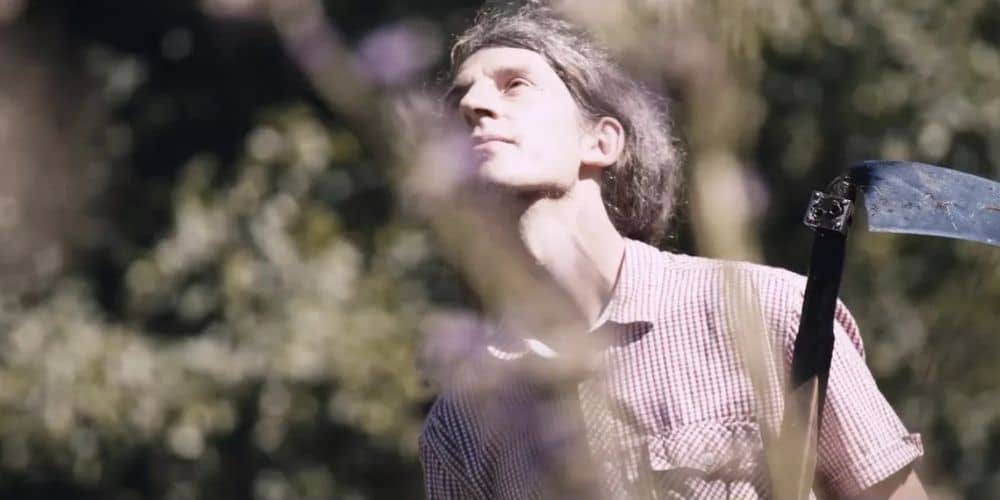
The people are one of many other non-human characters that populate this world. The everyday work and efforts of Pavel, who tries to revive meadows and rare species of wildflowers that are being regularly destroyed by commercial deforestation, and Klara of the Czech Ornithological Society, protecting the birds from illegal bait traps, are the entry points for careful and detailed observation of wildlife in a state of rapid shrinking. Weakened by droughts, commercial #logging, and agricultural practices employing highly toxic substances, the multiple, interrelated layers of nature suffer from various causes at the same time. The sunsets and moonrises seem to be the only constants on earth that are being relentlessly changed and exploited for decades without end. The animals and plants, including the species under strict protection of law, are pushed aside to tiny pieces of land with no space for existence.
Sometimes, as Klara discovers after days of investigation, there are also cases of intentional killings of wild animals by farmers, who, instead of traditional, illegal trappings, use highly toxic chemical poisons (which are also illegal but difficult to track) that make an animal die in excruciating pain for three or four days. The unimaginable cruelty of such actions fused with indifference and ignorance has a truly shocking effect when one sees pictures of suffering and dead birds or small sheep helplessly hovering around their mother’s poisoned carcass for many days. The reasoning for using such toxic substances is full of egotistic drive for «convenience» and unwillingness to share the space with other species under the pretext of it being a man’s «property».
There are, however, people and organizations who consistently work to strengthen nature’s ability to rebuild and grow back, although their might is much smaller than the might of commercial interests.
The currrent state of nature
Resilience presents the picture of the current state of nature that is constantly under pressure from different directions in vast parts of Central Europe. The forests, which need several decades to grow, are being cut down with ease and swiftness of the efficiency of modern technologies. Many of the cut trees are wasted in transportation and processing, lying later for weeks in empty, devastated, moon-like areas. The barren lands formerly covered by deep green of forests are a recurring picture in the region, marking the death of whole ecosystems, many of which are irreplaceable. There are, however, people and organizations who consistently work to strengthen nature’s ability to rebuild and grow back, although their might is much smaller than the might of commercial interests. For decades, there has been a constant push and pull between nature and economy in a thin line on a border of wildlife and domesticated areas that seems to be gradually yet consequently won over by spaces of human-making. Nature’s ability to thrive needs support and tireless, constant efforts from all beings, including humans.
The film moves at a slow pace, punctuated by astonishingly beautiful microshots of nature or insightful and difficult-to-capture scenes of wildlife in Central Europe, to quietly make us realise the value of the pure environment of which we, as humans, are only a part. Passing days and nights, seasons, droughts, rains, and winds shape the lives of all living organisms in ever-interlacing cycles of births and deaths. Resilience recreates the sensual experience of being in nature and asks questions to which we ought to find the answers sooner rather than later, and it does it intelligently and tenderly touching on the philosophy of nature and being in the highly modernized reality of the XXI century.