If you’ve spent much time in Tallinn, Estonia’s capital on the Baltic Sea, you would have noticed a few things about its creative scene. Everyone knows everyone, and who is sleeping with who. As with any tiny city, gossip spreads like wildfire — especially if it’s about one of their actors, or writers, who are esteemed locally like rock stars, despite most being largely unknown outside the country. Since Estonia’s independence was restored after decades of Soviet oppression, its people have been set on reasserting their own language and culture — and any whiff of visionary genius is venerated. But there’s a counter-tendency at work there: a penchant for darkly sardonic, self-ironising humour, and a circumspection that does not suffer fools or blowhards. What then, can we expect of a documentary called #In Bed With A Writer#, which promises to introduce us to Peeter Sauter, «the Estonian Bukowski», a national literary treasure and dedicated boozer who embraces the low life, writing about his chequered track record with women? Indulgent, yet rigorously anti-romantic, the film plays as a running joke on the concept of celebrity even as it functions as an uncritical vehicle for Sauter’s brand of playful emptiness, its voice indistinguishable from his espousal of amoral inaction as art.
A dog from hell
Charles Bukowski has, by now, been immortalised as the quintessential hard-living poet. Intent on wringing as much hedonistic pleasure from the social margins as he could, he scraped enough dimes together through sporadic menial work in Los Angeles just to get his next drink in. His view on women might best be summed up by the title of one of his poetry collections, Love Is A Dog From Hell, but his work is of such a rawly naked, wretchedly honest humanity, it’s impossible not to feel something rare and elemental in it, and that he is wryly mocking his own boorishness. Sauter accurately points out: «He seems rough and simple, but he’s quite fine and multi-layered. There is a lot of self-irony». Sauter has translated both Bukowski and Jack Kerouac into Estonian, and clearly feels an affinity with their freewheeling, womanising, and liquor-swilling ways; their iconoclastic disregard for social respectability and mad willingness to transgress (literary bad boys William Burroughs and Michel Houellebecq are also on his bookshelf). But, in typical Estonian style, he gently derides himself even as he does, saying that he has no pretensions to actually be some kind of Bukowski: «I can be a fool of fame, but there is a limit to how foolish I want to be,» he says. «I want to be myself». Even his depression is not up to the mark, he suggests — while Bukowski had a stint of not writing for seven years, Sauter, manageably despondent, has only made it to one.
The first snow
In today’s era, in which time has been called on a status quo of famous men indulging their power without consequence, the bohemian glamour attached by fans to the sexual conquests of scoundrels such as Bukowski has been under reappraisal in many quarters. Basking in an air of mischievous depravity, Sauter is hardly the kind of figure to worry over whether he has sensitively «read the room» in terms of the current cultural discourse around institutionalised misogyny. Besides, his unrelenting self-irony means that far from glorifying his own lifestyle, he’s the butt of his own jokes, lampooning himself as too old, alcohol-sodden, and boring to be anything but unsuccessful in love. He recounts in dreary, bare-bones but vague terms, the trajectories of several relationships with women initially attracted by his reputation, who lost interest as the banal reality sank in. There is an air of cynically fatalistic inevitability to all this (one woman, wanting to have a baby and considering him unfit father material, says she will leave with the first snow, and duly does).
«Party, drink and find lovers among liberals, but vote for conservatives — this is fucking sustainable»
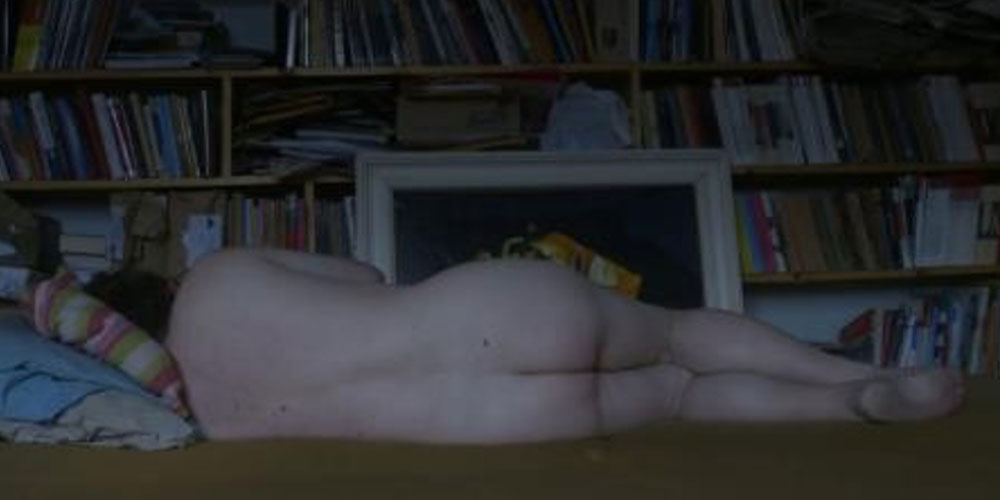
Sauter turns his self-declared unattractiveness and slovenly ennui into quasi-performance art, in teasing affirmation of doing nothing, and being nothing, that is anti-ideology, and a provocation against glossy marketing, and societal expectations. Is this radically non-judgmental, or grotesquely self-indulgent, even nihilistic? He reclines on a divan, pale and naked except for some grimy boxer-shorts, with a sign that reads «Begging for Love». He chats with a dominatrix about her lifestyle, while wearing a gimp mask, in a segment that feels less like a genuine exploration of sexual difference, than adolescent-style appropriation of the underground’s cache (whereas Bukowski hung out with pimps and prostitutes as equals, this feels out of place and staged). There is little human insight to make segments like this interesting, but so far, so okay.
Party, drink, and find lovers
Things take a shocking turn, however, when Sauter models for a mind-bogglingly racist shoot. «Today’s political correctness has killed humour, you cannot make fun of anything anymore,» laments the photographer, Mats Õun. It’s an often-heard sentiment among those who feel today’s outrage culture, underpinned by vigilantly sanctimonious social media, has gone too far. But in its bigotry, the tableau vivant they set up — a young white woman blacked up with paint («to allow equality in the house») posed to dominate a naked Sauter with a rifle beside a Swedish bicycle frame in a parodic comment on the refugee crisis — is brazenly extreme. If the film is meant to be an ironic take on Sauter’s ironic participation in what is itself an ironic caricature of political correctness, the rabbit hole is pointlessly, obtusely deep, but it’s doubtful that critical distance is even there. Õun condemns refugees as deceitful tourists and compares them to cockroaches in a barrage of the laziest far-right tropes around, before whining about losing his right to offend. The moral bankruptcy of going along with anything, and in so doing normalising and legitimising it, is here exposed, particularly in a nation that’s undergone a surge of far-right populism at recent polls. «Party, drink and find lovers among liberals, but vote for conservatives — this is fucking sustainable,» says Õun. Less Bukowski, then, and more Ezra Pound?