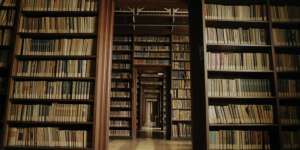
«The world is divided between people who collect things, and people who don’t know what the hell these people are doing,» is said in The Booksellers, a documentary directed by D.W.Young, whose affinity clearly lies with the former. He seeks out the staunchest remaining guardians of the #printed word#, who convey their passion for #books so convincingly one can nearly smell the bound paper. The documentary explores what might become of the book business now that, after a 550-year run, the internet is occasioning a decline in the cultural centrality of printed objects, and antiquarian booksellers are endeavoring to reinvent their industry. With such a celebration of #literary culture#, it’s only natural choice quotes from heavyweights of poetic phrasing are plentiful. «The library will endure, it is the universe,» is one famed line we hear, from Argentine writer #Jorge Luis Borges#. But in these times more than ever, with public space on hold due to the coronavirus and the virtual screen dominating all forms of cultural access, physical books seem like artefacts of a world almost lost.
Book Row
Much of the film is focused on New York, the heart of American literary culture. We’re first thrown amongst the fray of the city’s book fair, a mecca for those wanting to invest in rare finds exhibited by dealers. But the way we talk about what’s rare has changed in the modern market. The hunt has been removed, now that one can simply type into a search engine what one is after to trawl a concentrated mass of listings, from one’s couch. Supply and demand may have been democratised, but the murky, chance aspect that underpins the thrill of digging around has all but dissipated. And for dealers, unless one has the best, cheapest, or only copy, they have little to base a livelihood on (while the position of the few at the very top of the trade has only been further validated). This more centralised landscape has driven ephemera, manuscripts, and other more leftfield printed material to greater popularity among collectors.
Books, with all the emotion that attaches to them as the receptacles of memory and experience, have always had an almost talismanic quality in the human imagination as fetish objects. This, combined with an emphasis on a culture whose very existence is under threat, means the film is drenched in an irresistible, almost tactile #nostalgia for the independent bookstore’s heyday. Social commentator and author #Fran Lebowitz# recalls #Manhattan’s 4th Avenue when in the early part of the last century it was known as Book Row and packed with second-hand bookstores (there is just the renowned #Strand left today), run by «little, dusty Jewish men» whose motivation in being there was to read all day, and as such got aggravated if you wanted to be served. We’re also taken inside New York City’s oldest independent bookstore, the Argosy Book Store, founded in 1925 by Louis Cohen and now run by his daughters, Judith, Naomi, and Adina — rare longevity only possible, in an age of sky-high real estate prices, because they own the building. Many other personality-filled bibliophile havens, including the Village’s Beat-associated Skyline Books (once home to beloved resident cat Linda), have shut down in the wake of customers migrating to online shopping.
Little deaths
The internet connotes less possibility than it does little deaths in this film (just say the word «Kindle» and a shudder goes up the back of rare book lovers’ spines, it’s noted). What is at stake here stretches beyond the printed word itself to notions of the personal and the beauty of eccentricity — aspects flattened by the sameness of hyper-capitalism, mass production and virtually packaged formats. «There’s so much more to a book than just reading,» says illustrator and writer #Maurice Sendak#. The film does a grand job of showing just how much life lies inside this passion through the fascinating characters it assembles, from an #occult book dealer in skull shirt and plaited beard to Rebecca Romney, who inspired a raft of young women to enter the business through her stint as the resident book expert on Pawn Stars. The profession of book dealer is still heavily dominated by men, but its reputation as the sole pursuit of older men in tweed jackets with a pipe and a glass of sherry is on the way out, as other voices and preferences jostle for long-overdue space.
Books, with all the emotion that attaches to them as the receptacles of memory and experience, have always had an almost talismanic quality in the human imagination as fetish objects.
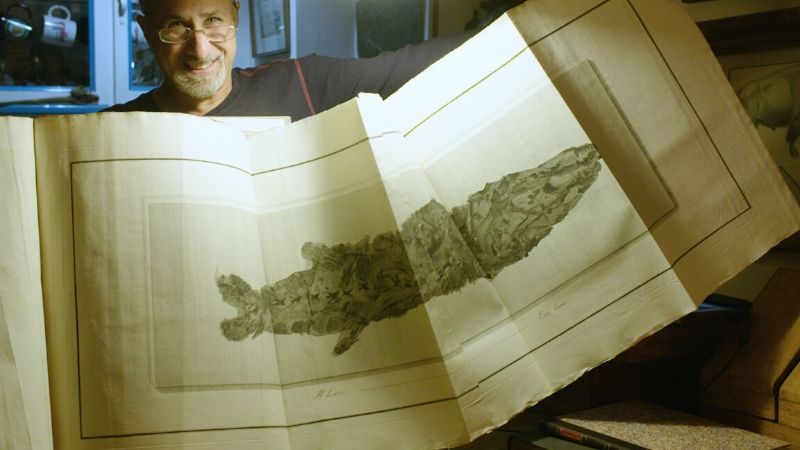
The force of idiosyncratic personality of books themselves as objects is on display in its full glory here, too. A book bound in human skin (Hans Holbein’s Danse Macabre), with a skull on the front made of bone and teeth? Check. A giant book with life-size, intricate pull-out illustrations of fish skeletons? Check («Playboy, eat your heart out, » says an admirer). Unlike works on the art market, books tend to not be one-of-a-kind, so their possession does not accrue quite the same swagger-generating trophy status and power play (the multi-million purchase of Leonardo Da Vinci’s handwritten The Codex Leicester by #Bill Gates# at auction is more the exception than the rule). The antiquarian book world remains an enclave for the distinctive obsessions of true passion and the quirks that differentiate human souls — for now.