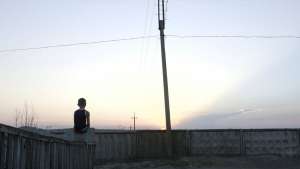
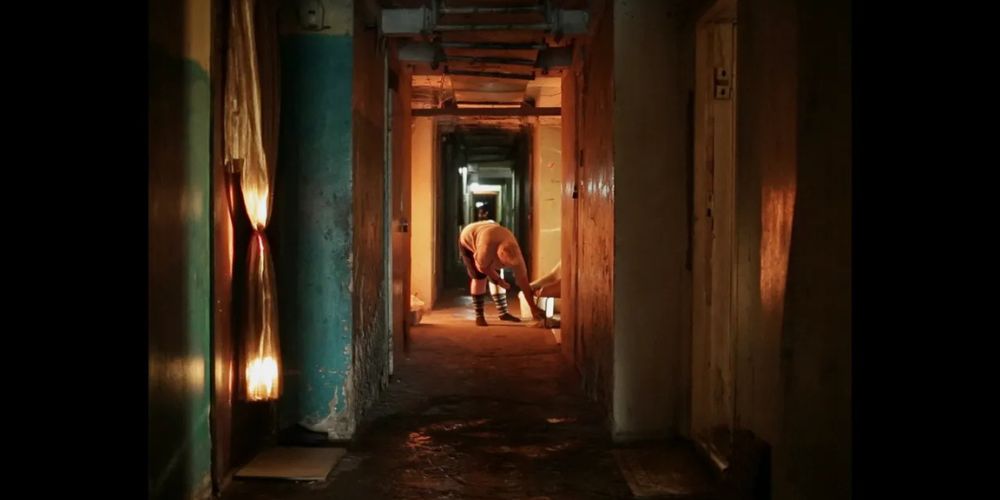
In 2022, a man threw himself to his death from the roof of Kartli, a former Soviet sanatorium for those with cardiac ailments. Like many of the displaced who had fled from their homes in #Abkhazia when war broke out decades before, Zurab Kiria had been living in one of the rooms of the vast, crumbling building on Tbilisi’s outskirts, in a limbo that stretched on as return remained forbidden, and Georgia’s authorities failed to assign proper apartments to them. His ultimate act of protest and despair haunts his neighbours and permeates the frames of The Kartli Kingdom, a documentary co-directed by Tamar Kalandadze and Julien Pebrel and dedicated to Kiria, which had its world premiere at the International Documentary Film Festival Amsterdam. The film is a poetically heartsick and politically anguished portrait of neglect; of a state that worships fallen heroes but turns away from war’s survivors, and a regime that has restricted its #media from disseminating the realities of its shortcomings and moral apathy.
Forgotten in time
Around 300,000 ethnic Georgians were driven from Abkhazia, which had autonomy within #Soviet Georgia#, in the early ’90s when the #USSR broke apart. Ethnic tensions and conflict flared between Georgia and Russia-backed Abkhaz forces, and Georgia lost control over the disputed territory. Archival footage shows the treacherous journey by foot over the mountains through deep snows and biting cold that many, with scant supplies, braved after the fall of Sokhumi, risking starvation or freezing. The drastic state of precarity they were plunged into has, decades on, not ended. The temporary became permanent for the displaced residents in Kartli, where two hundred or so families set up makeshift lodging, having been assured that their stay was simply a stopgap before they could return, in a territorial dispute that remains unresolved to this day. Government inaction over proper housing meant the days stretched into years. The once-grand medical centre, in which cats and dogs now roam up and down the spiral staircase and whole families pass the time in decaying rooms, feels like a place forgotten in time, even as Kiria’s death reignited some official debate around the dire conditions in which he and others had been existing for decades.
The dramatic way in which the tragedies and paradoxes of modern-day Georgia are visibly inscribed within the former resort sanatoriums where the displaced now shelter has made them an inevitable cinematic draw, and it is not the first documentary in which they appear, with Hotel Metalurg (2023) by George Varsimashvili and Jeanne Nouchi another. As evocative and astounding as these places are for audiences, dilapidation holds no charm for Kartli’s tenants, in an unheated, damp building so unmaintained that it is now cracked in two, with half moving centimetres further toward the sea year by year.
The drastic state of precarity they were plunged into has, decades on, not ended.
Embattled beauty
The Kartli Kingdom is a work that leans into lyrical atmosphere, and an embattled beauty it has in spades, over investigative rigour. But the directors take pains to underscore that the fate of the displaced in Kartli, the denial of their basic rights and the indignity they have suffered at the hands of callous government, is tied to the current deep political crisis that Georgia is embroiled in, and the ongoing street protests that erupted when ruling party #Georgian Dream# turned the country away from its #European Union# accession path, with demonstrators facing violent repressions, and the number of political prisoners skyrocketing.
The sound of dissent rings through the air and inside Kartli’s walls. Citizens, amid daily marches to return the Public Broadcaster to the people, can be heard decrying a propaganda-ridden media that, controlled by an increasingly authoritarian regime, does not tell the truth. From a radio or television comes the voice of Andro Chichinadze, a well-known actor currently imprisoned on trumped-up charges for his part in the protests, in comments from the time of his trial, speaking of the state of freedom that can be reached by overcoming one’s fears (new laws banned court recordings mid-way through). This audio weave suggests a nation trapped in a collective struggle, the result of a leadership only too happy to turn critics of its most egregious power abuses into exiles within their own land. The crackdown on #censorship, as the ruling party moves to control the narrative, has devastated Georgia’s culture and media sectors, hence the palpable sense of personal outrage that bleeds through this French co-production.
An inviolable place in history
What begins as a portrait of Kartli, to bring visibility to the plight of an ignored population, becomes a struggle to reckon with the wider catastrophe of a nation wrenched so totally off course. Memory takes on a melancholic, but shimmering hue. The hope for the future that bursts from the frames of archival family wedding footage now persists chiefly in the domain of defiant expressions of resistance, from those determined to afford Kiria, and others who the ruling regime would prefer remain invisible, respect and an inviolable place in history.