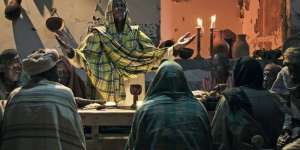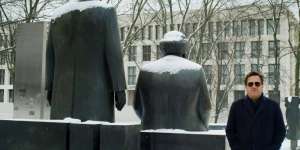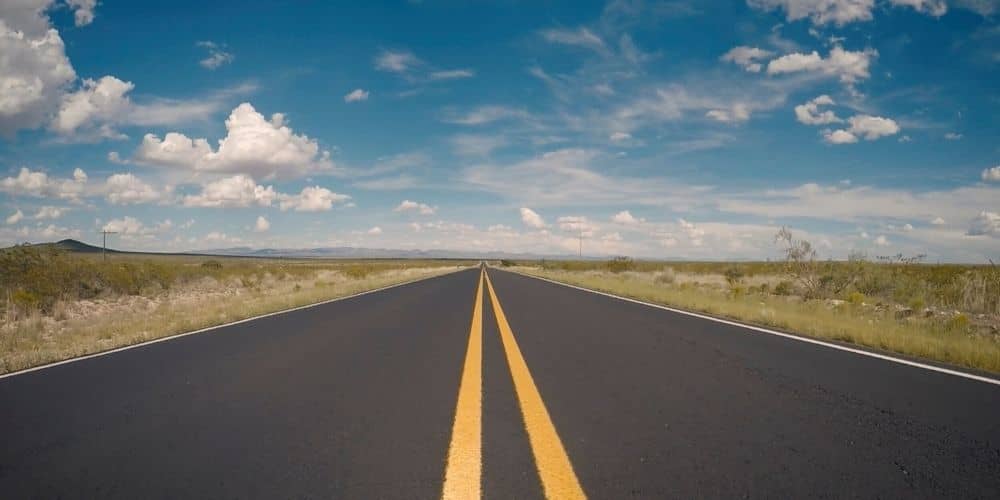
«You had the horse, that was the first mode of transportation for people… then you had a horse and a carriage…and then you had the railroad…and then the car…and then the plane…and then you had commercial space…a way to move between the planets for the longevity of human race». Accompanied by a bird view of a straight two-lane motorway with two yellow lines in the middle, these introductory words to Truth or Consequences, a speculative documentary directed, produced, filmed, written, and edited by Hannah Jayanti, very well illustrate the belief in a linear progression of human history. The idea that with #science and #technology humans can overcome any obstacle is deeply imprinted in the human mind. The idea of progress was the very basis of #modernity and, as in the early 1980s when it became clear that natural resources are limited, became the basis of post-modernist philosophy.
Left behind
In the meantime, it became clear that the idea of unlimited natural resources was actually a myth because modernist prosperity was limited to the #Global North# and was only made possible by #colonialist exploitation of the #Global South# – slavery and the exploitation of free female labour. But the idea of progress persisted to the present. Commercial space travel is one of its most vivid forms: as global warming brought the colonisation of the earth to a halt, the universe seems the most logical next frontier. Yet, after years of struggling with ever more limited natural resources, the human race is more and more obviously divided in two: those few who can afford the travel to other planets, and all the others who will be left behind.
With the large majority of the world population belonging to this last group, there is no need to search long for the contrast. Indeed, the film’s focus is on Spaceport America, the first commercial spaceport, located in #New Mexico# – and a town with an enigmatic name, Truth or Consequences, in its immediate surroundings. As the viewer is informed by the guide to the local Geronimo Springs Museum, the town’s former name is Hot Springs while Truth or Consequences was a program on the radio and TV. By winning a contest presented by this program, Hot Springs also won the right to be named after it. New Mexico itself has gained world fame as the location of the notoriously best TV series of all times, Breaking Bad (2008 – 2013) and its subsequent prequel, Better Call Saul (2015-2020). In these, the use of crime by law obeying citizens such as teachers and lawyers serves as a cynical comment on the bleak future prospects for the poor and the mostly white local community.
Strength of form and character
The director of Truth or Consequences applied a more poetic approach, defined as a speculative documentary. Two features of this approach particularly stand out. One is a subtle play with time and smooth, invisible drifting from the future to the past and back again. The use of various types of archival material, from major architectural achievements to climate damage and images of cataclysm makes this particularly visible. The double exposition in transforming items from the past into futurist objects, the archival shots are played forwards and backward. Even special effects are applied, resulting in black and white images of the local landscape, covered by particles of dust, changing from shimmering glitter to dancing points of light.
the idea of progress persisted to the present.
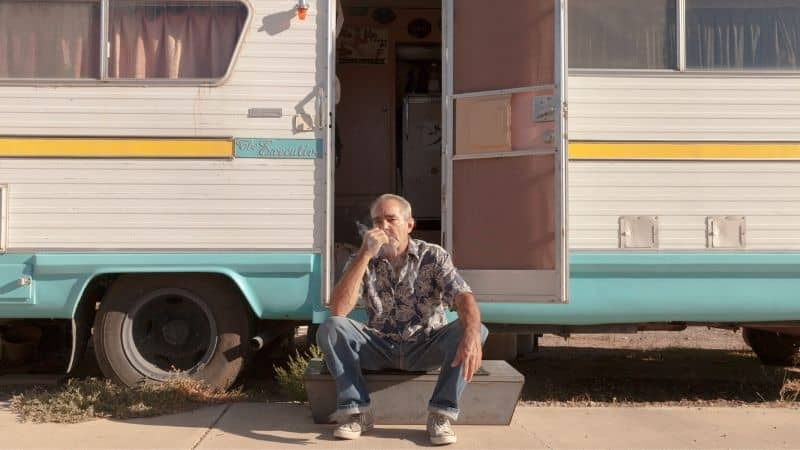
Another strong point of this film is its protagonists. They have the role of the narrator and cover the whole spectre of views, from the worries of the old lady «we live in times of changed logic of progress, how will people deal with it?» to the optimism of the Spaceport’s clerk, «This planet is dying, so for the longevity of human race it is moving elsewhere.» The closing titles list their names in the order of appearance, George Henson IV, Olin B. West, Yvonne A. Farley, Katie Renault, and Philip Giraldi. There is a homeless woman who likes making announcements but is afraid of flying with an airplane; a man who is collecting old stuff with the precision of an archeologist; old lady living in a trailer with a cushion saying «Home is where the heart is» on the couch and a buffalo skull of above it, taking care of dogs and pigeons. Animals play a significant part in this world and in the film. As we see the birds flying high, free under the sun, the pain of the human protagonist dissolves. They are poor and their loneliness makes it even worse. As they narrate their life stories, each dealing with their painful memories in their own way, as they talk about their family and simultaneously interact with the environment, be it found objects, the animals, or as they are catching the insects, for example, one can sense their loneliness as a grip around their souls.
The sublime thing about this documentary is that it explores what keeps these people going. Each of them has such a thing, crystals, birds, or marbles, and as the dust particles turn into floating sources of light, one can see that the human soul is the object that flies, eventually, at last. The improvised score by Bill Frisell provides a perfect soundtrack. In short, there is no wonder that the film already raised the attention of the international documentary community.