Fewer than 4,000 people live in Cinque Terre, yet around four million tourists visit every year. That extraordinary imbalance sits at the heart of The Siege of Paradise, Gar O’Rourke’s sharp and often unsettling portrait of a place caught between preservation and popularity.
Clinging to Italy’s Ligurian coastline, five picturesque villages form one of the world’s most recognisable travel destinations: a landscape of pastel-hued houses, terraced vineyards and dramatic sea views.
For tourists, it is a Mediterranean paradise. For the people who live there, however, it has become something more complicated: a place where tradition, livelihood and progress are in constant conflict.
Gar O’Rourke, whose recent work has marked him out as one of Ireland’s most exciting documentary filmmakers, could easily have followed an established narrative path: frustrated locals pushed to breaking point by the pressures of mass tourism. Instead, he has taken a far more nuanced approach, allowing the competing perspectives of those who live, work and visit there to coexist – resolutely refusing to tip into judgement or blame.
Through figures such as Bartolo, a vintner who spends his days navigating the steep terraces; Guido, a fisherman fighting to sustain a disappearing vocation; Carmelo, a restaurateur considering the future of his family business; and Fabrizia Pecunia, the mayor of Riomaggiore trying to balance preservation with economic necessity, O’Rourke spotlights a community wrestling with an uneasy truth: the industry these villages depend on is slowly but surely reshaping the place they call home.
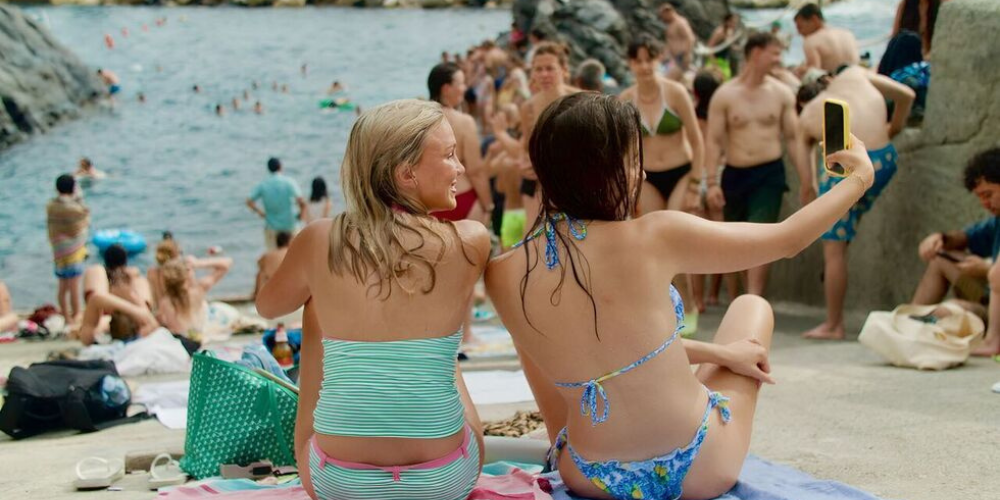
It is a dilemma that extends beyond the residents themselves. Grace and Izabel, content creators who arrive in Cinque Terre to capture its beauty for their social media followers, also find themselves confronting how their work is contributing to the forces altering the area, questioning whether, in drawing more attention to the places they love, they do more harm than good.
It is a complexity with deep historical roots, for Cinque Terre did not simply have tourism forced upon it; rather, the villages themselves helped create the situation they live with today, and the economy that now supports them. It is a place where contradiction and continuity exist side by side – a community dictated to by tourism, unable to fully comprehend what that reliance means for its future.
 The Siege of Paradise, a film by Gar O’Rourke
A product of isolation
For centuries, Cinque Terre existed in near-total seclusion. Hemmed in by steep mountain ridges and connected to the wider world only by sea routes and demanding mule paths, the villages developed around what is locally known as «heroic agriculture\” – miles of hand-built dry-stone terraces carved into the cliffs to cultivate wine, olives and lemons.
That isolation preserved a distinct local culture and centuries-old farming techniques, but it also brought economic hardship. A major turning point came in 1874 with the completion of the Genoa-Pisa railway line, which connected the villages to the wider region. For the first time, residents could easily transport wine, fish and agricultural produce to larger markets, while visitors from nearby cities could reach the coast directly.
But connection also accelerated change. During Italy’s post-war industrial boom, younger generations left for more secure and lucrative jobs in cities such as La Spezia and Genoa. Traditional industries became harder to sustain, terraces fell into disrepair, and the villages faced serious depopulation.
Tourism offered a way forward. From the late 1970s onwards, Cinque Terre began embracing the qualities that made it distinctive, with the brightly coloured facades that now define the villages becoming part of a deliberate effort to attract visitors.
Guidebooks helped introduce the region to international travellers, while UNESCO World Heritage status in 1997 formalised its reputation as a place where human life and landscape existed in harmony. Tourism provided an economic lifeline. Family homes became guest rooms, fishing boats became tour vessels, and businesses adapted to serve the influx of visitors.
But this economic success, perhaps inevitably, also changed the nature of life within the villages. The more Cinque Terre became a destination, the harder it became for locals to preserve the traditions, industries and rhythms of life that had defined the region for centuries.
It is an as-yet unresolved predicament, and one O’Rourke explores with a deftness of touch throughout The Siege of Paradise. This is not a story of locals and outsiders clashing, but an account of a place refashioning itself around the image that has made it a bucket list destination for travellers the world over.
Tourism, in his eyes, is not the enemy; superficiality is.
The theatre of travel
Every morning, before the first tourist ferries arrive, Cinque Terre prepares itself for another performance. Café tables are carried outside. Souvenir shops are rearranged. Holiday apartments are turned over. Behind the beauty that draws millions is a constant effort to maintain the idealised Cinque Terre that exists in countless digital photographs.
Throughout The Siege of Paradise, O’Rourke discreetly pulls back the curtain on this process, revealing the work that sustains the postcard image. Guides deliver rehearsed accounts of local history and wax lyrical about «authentic» experiences, while sightseers move from designated viewpoint to designated viewpoint, phones already in hand, recreating the Instagram images that catalysed their trip.
During one of the film’s more reflective moments, Mayor Pecunia makes a point that is equal parts astute and disconcerting: that Cinque Terre, on its current path, is at risk of becoming something akin to Disneyland – a place built around, and preserved for, visitors. Her warning is straightforward: when a working town feels compelled to spend its energy putting on a show for outsiders, the people who live there are liable to get squeezed out.
Cinque Terre, on its current path, is at risk of becoming something akin to Disneyland, a place built around, and preserved for, visitors.
The people behind the postcard
It would have been all too easy for The Siege of Paradise to paint Cinque Terre itself as the star of the show. Indeed, Lukas Gut’s cinematography, which earned a Special Jury Mention at Tribeca, renders the place as almost impossibly lovely. But O’Rourke uses that sensory pull as a lure, letting the audience fall for the romantic vision before revealing the friction.
It is a choice fundamental to the film’s ambition. Cinque Terre does not exist separately from the people who live there; generations of residents built the terraces, cultivated the vineyards and maintained the villages that visitors now come to admire. The landscape is utterly inseparable from the lives lived within it.
Guido continues fishing despite seeing his trade dwindle. Carmelo wrestles with the future of the family restaurant his daughter may one day inherit, if indeed she chooses to stay. Mayor Pecunia spends her days navigating impossible compromises between economic need and cultural preservation.
But it is the captivating Bartolo who becomes the documentary’s emotional centre. A winemaker in Vernazza, Bartolo spends his days tending vines on the same near-vertical terraces his family worked for generations, rebuilding the dry-stone walls by hand alongside his wife, Lise.
Unlike many of the film’s other contributors, he seems remarkably at peace. Having left Cinque Terre when he was younger before eventually returning, he has found a way to reconcile tradition with the realities of modern tourism.
While he has little patience for visitors interested only in photographing the landscape before hurrying on to the next vantage point, he finds himself enamoured with visitors who arrive with curiosity: those who want to understand how the terraces were built, why they matter, and what life in Cinque Terre has demanded of the generations who have called it home.
Tourism, in his eyes, is not the enemy; superficiality is.
In Bartolo, O’Rourke has found someone who has not escaped Cinque Terre’s contradictions, but has learned to live alongside them. He welcomes the visitors who make his livelihood possible, while refusing to let their expectations define his relationship with the place itself.
A reflective lens
For O’Rourke, telling this story meant navigating an unavoidable tightrope: how do you document a place under pressure from tourism without becoming another force drawing attention towards it? Presenting Cinque Terre as anything other than extraordinary would have been dishonest, yet every carefully composed frame risks contributing to the very pressures the film set out to explore.
It is something O’Rourke has confronted on a personal level. As a Dubliner living in Lisbon, he has witnessed first-hand the ways tourism can transform an environment, while he has admitted that his own instinct to document places for social media fed into the film’s wider exploration of how destinations can become images before they become experiences. It is unsurprising, therefore, that he found Grace and Izabel to be such intriguing subjects.
In The Siege of Paradise, even the act of looking becomes part of a wider conversation, and O’Rourke’s self-awareness plays a crucial role in making the film so compelling. He refuses to present overtourism as a problem with a simple solution, because the dynamic is far more complex: limiting visitor numbers would require enforcement mechanisms that tiny local governments cannot easily implement, while restricting tourism would threaten the area’s economic foundations.
Rather than attempting to offer easy conclusions, he instead raises a bigger question: how can communities like Cinque Terre survive their own popularity, and what role do we play in protecting the places we choose to visit?