Vitaly Mansky’s new film Time to the Target observes his hometown of #Lviv in western Ukraine. Observing the city centre, the work of a military brass band and gravediggers, the film tells the tragic story of how a beautiful tourist city turns into a procession of an endless funeral. This film is also Mansky’s final piece in his unintentional triptych about his hometown.
From East to West
At the 73rd edition of #Berlinale, the great auteur Vitaly Mansky presented his first invasion film, Eastern Front, co-directed with Ukrainian military officer and director Yevhen Titarenko. The film follows a volunteer medical battalion filmed by Titarenko. The film is also saturated with scenes of reflective conversations in the rear front, provoked by Mansky behind the frame. It is an observational film that takes a multimedia approach and is not the most successful work in the director’s career. This may also be because Mansky faced a crisis familiar to the overwhelming number of filmmakers who do not live in Ukraine and, therefore, do not survive the daily routine of war before starting filming it. In Eastern Front, he could not cope with the volume of documented events with which he had no coherent connection.
After the beginning of the war in Ukraine in 2014, the director emigrated to Latvia, where he lives now, and therefore does not have the experience of daily war existence. However, this does not make him less Ukrainian. The personal experience and connection to the chosen subject are vivid in Time to the Target. Mansky travels from East to West to his hometown of Lviv, far from the front line. Through a deeply personal story, he creates a film that becomes a unique addition to the plurality of documentaries about the war in Ukraine.
Everything in this film, from the choice of location and protagonists to the emphasis on small details, speaks of him as a Ukrainian in his current status and once a permanent citizen of Lviv. He is disarmed and distanced from active combat, just like the protagonists of his film. He reflects on his national #identity through his hometown, which occupied him before if one looks at his previous filmography. In other words, his latest film paints a documentary triptych of his extensive career.
Through a deeply personal story, [Mansky] creates a film that becomes a unique addition to the plurality of documentaries about the war in Ukraine.
Triptych
In 2006, when Mansky was starting as an auteur, he made a film called Gagarin’s Pioneers. As the director once put it, it is thirty-three short films about thirty-three classmates from the 52nd school in Lviv that he has assembled into a feature-length film. He travels around the world, compiling their portraits and interviewing them about their childhood and how their lives have developed since. In national release, the film is known as Our Motherland, which makes more sense in the given context. As children in school, they took an oath to join the Gagarin Pioneer Squad. The film reflected what the motherland is for these classmates and the power of the oaths they took in the early 1970s. In this transcultural film, Lviv functions as a common denominator, which, as it turns out, remains a unifying force despite their scattered fates around the world.
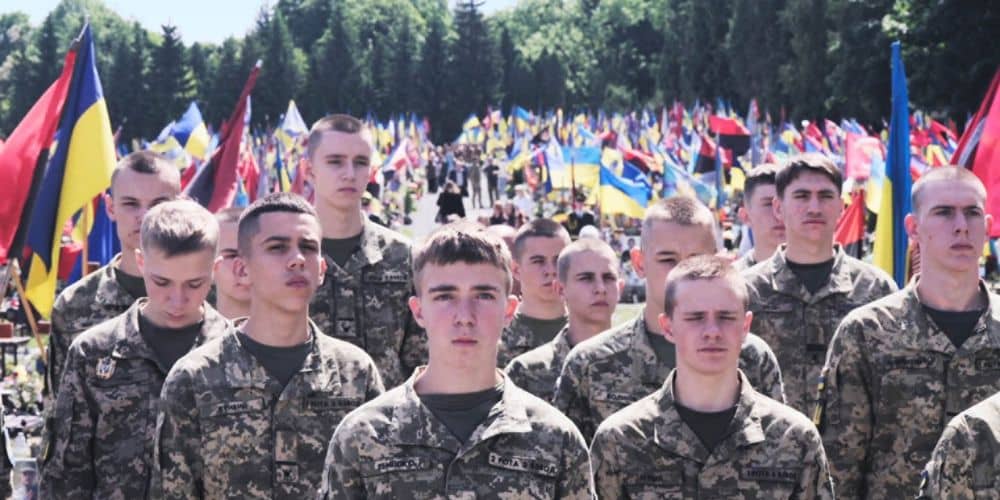
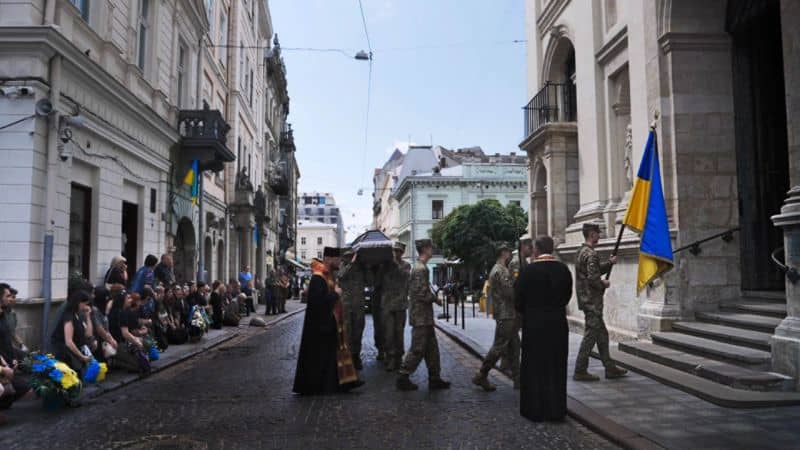
In 2016, the outbreak of war led Mansky to make Close Relations, a film with a similar concept, but this time even more personal. Mansky made a sensual essay film in Ukrainian about his family, who were scattered across the country due to the war. His relatives have polar political views and can’t have a durational conversation without arguments. When his relatives from Western Ukraine and #Crimea call, a fight immediately breaks out, and a harsh phrase is uttered: «If you want to communicate with me, talk about family, not politics.» His family became a metaphorical model of Ukrainian society at the time. It is a kind of family photo album, and the film itself is stylised as a family photo, aged but also very much loved. Although the film is shot across Ukraine, in Lviv, the director also keeps his eye on the centre of the city, and at one moment, his voice is silenced. The funeral procession of an unknown soldier takes place in Rynok Square. A static camera in a long shot observes civilians, soldiers, and priests passing by the frame while the funeral march roars in the air. When the crowd has passed, he cuts away, and the city returns to its everyday routine. And this is what his new film Time to the Target looks like, yet now perplexing in the repetition and escalation of this particular mise-en-scene.
Rynok Square – Cemetery
Most of the Time to the Target takes place in Rynok Square. This is the heart of Lviv, with impeccable Austrian architecture, running trams around the square with cosy cafes, and the famous Garrison Church of Saints Peter and Paul. Until recently, it was a joyful place for special life celebrations, which changed its connotation to death and mourning with the onset of the invasion. Indeed, the main character of the film is Lviv itself. By confining himself to a few square kilometres and the cyclical nature of the four seasons, the director manages to penetrate the atmosphere of the city, showing how war immersed his beloved city into a ceremony of perpetual funeral.
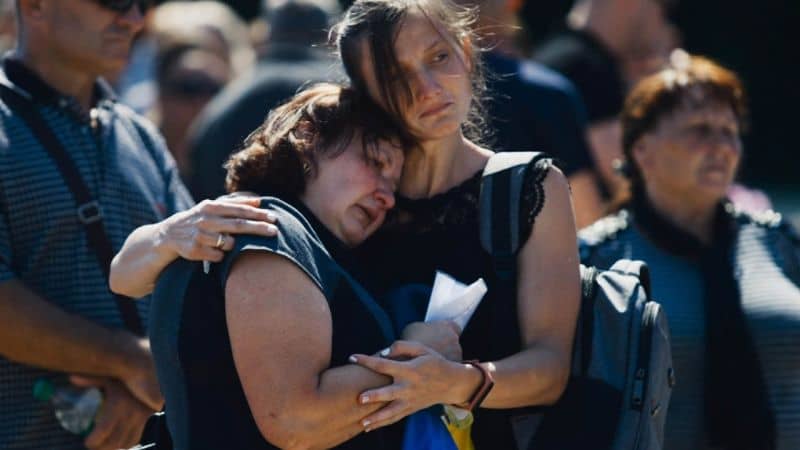
Adopting a portrait-like narrative approach from previous Lviv films, Mansky does not aim to show the binary between funeral processes and everyday life in Lviv, which still retains the pre-war flair of #tourism and fun. On the contrary, he shows how these processes are synthesised and how all infrastructures are forced to adapt to the needs dictated by military time. The film’s great length of 179 minutes allows him to achieve his aim: the small, repetitive shots of the streets of Lviv become recognisable and native, while the funeral march, which is played more and more frequently as the plot progresses, begins to get on one’s nerves and to a certain extent conveys the exhaustion in which the citizens live. If Mansky films outside the city centre, he only goes to the sprawling cemetery, through which he shows the growing scale of the war. Despite the frozen winter ground, a gravedigger’s tractor digs more space for another soldier. To the sound of a funeral march and women’s tears, he takes durational close-ups of grave photographs of these dead soldiers, frozen in time.
The film has another strong side that makes it even more positive. Its protagonists are a military brass band with whom the director establishes a very intelligent and tactful emotional relationship. This is a wise choice of characters for Mansky because what he has in common with them is that he, too, does not hold a gun and pays his debt to his country through art. The music of this band and the camera in Mansky’s hands find common ground and together create a powerful documentary about this war. It’s this personal and crucial connection that he lacked in Eastern Front. Watching the rehearsals over the course of the film, he traces how the soldiers’ enthusiasm changes and their emotions grow darker as they perform. Their conductor once expressed the hope that they would someday play something other than a funeral march. Mansky undoubtedly hopes that the next film he makes about his hometown of Lviv will be a story of peace.