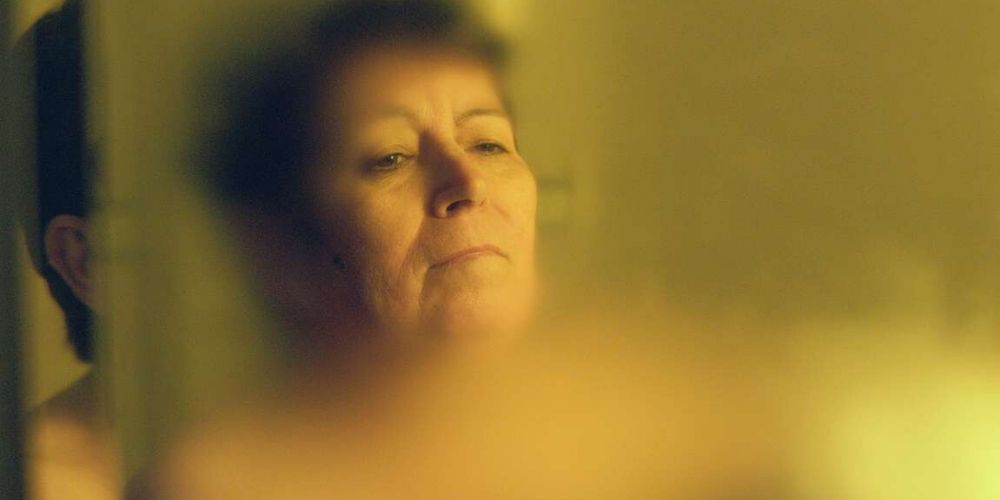
Unskinned is a touching and minimalist portrait of two women - Carla da Costa Leandro and Lúcia Ferreira Pais – who work in a Portuguese tannery. It offers a rare insight into the conditions of production in the European #leather industry#, showing how changes in social and technological treatments of animal skin also imprint on the skin of those processing it.
Few consumer products are as immersed in the culture and charged with diverse symbolic meanings and controversies as processed animal skin. Just think of the legendary erotic novel Venus in Furs (1870) by Leopold von Sacher-Masoch, or the eponymous form of #fetishism. Or, a more recent example, the protests where #activists covered themselves with blood against the fashion industry’s use of leather. Arguments that the technologies of animal skin processing have significantly improved in recent years are often brought up in its defense against, so-called, ecological skin and fur. The tanneries are more like offices nowadays, says a man at the beginning of this documentary. But the tannery in Beira Alta, we are about to see, is not one of them.
Colonial history
The film’s narration intelligently focuses on Patricia, a young woman who used to work in the tannery, which helps the film achieve several objectives simultaneously. Her sudden and unexplained disappearance makes people in the community more eager to engage in conversation. In the tradition of the best Hollywood fiction, starting with Hitchcock’s The Rope (1948), her disappearance acts as the key event, around which a sense of belonging and community articulates. The absent Patricia also serves as a vehicle through which broader cultural, social, and political contexts are introduced. The permanent state of sadness that neither leaving nor staying relieve, poetically described by the musicians of Cabo Verde, a centuries-long Portuguese colony and other cultural centers of the Global South, is strongly felt in the community of Beira Alta. As Patricia’s personal history is revealed, a direct link to Portuguese #colonial history# is established, proving that, not only, did colonialism spread poverty in the colonies, but was often its impact among the coloniser’s populations themselves.
Few consumer products are as immersed in the culture and charged with diverse symbolic meanings and controversies as processed animal skin.
Unskinned is a courageous and scrupulous dive into European modernity where plenty of contrasts are evoked such as before/now, traditional/modern, old/young and so on, but, just as with stay/leave, none of the opposites are better than the other. As the workers perform their routine tasks, a monotonous, quiet rhythm prevails, showing the movements of people perfectly in tune with old and perilous tools. Their slow and carefully measured gestures are in full swing and momentum, yet fully subdued to strict laws of industrial processing. In their dialogues, they gradually evaluate the advantages and disadvantages of their work. The negative ones can almost be felt: the #pollution, constant close contact with chemicals that are damaging the worker’s health, lungs, and skin, and dangerous machinery that can easily cause the loss of fingers or limbs. But, regardless of all this, they fear the factory will close. Location is one of its main advantages, enabling them to work close to home. The women can take care of their families and have time for daily tasks at their farms, like feed their animals.
A playful but cruel dialog with a domestic animal at minute 42 might come as a surprise, but the scene perfectly fulfills its role in showing the world where apples and melons are for pigs while people eat white bread. What indeed comes as a surprise, at least for me, is that this world is not part of the history of European modernity. No, this is the present. This is now. Rudimentary technologies (for example the cord that holds the door closed instead of the lock), basic living conditions, and the memories of a past just as grim as the present form a stark contrast to modernist idea of progress. After decades of poverty and promises of a better future, all that the workers of Beira Alta tannery can hope for is that this world will remain their future.

Contrasts
Several contrasts are evoked in this documentary, but more than anything else it underlines the ongoing continuum between various realms of the contemporary reality it meticulously describes. On the one hand, there is the continuum between people and animals that we literally feel as we observe the two women nurturing their skin, repeating the same monotonous but attentive gestures with which animal skin is treated in the tannery. On the other hand, the continuum between the cream and soap, the products Carla and Lúcia use for their hygiene, and other products of the contemporary #consumer society, a part of which is the leather industry. As they apply the cream to nurture the face and the soap to wash the body, they belong to the same consumer society that consumes the animal skin they attentively process every day.
Yet, on the other invisible, underprivileged site, the poor that mainstream media, artists, and documentarists tend to avoid. As my communication professor used to say, freedom of speech is the freedom of those who have the money. That is, media contents are not made about people with no money to pay for them. Director Inês Gil and her production team deserve respect for proving this wrong and putting this hidden part of contemporary Europe on screen. It is not at all clear if eliminating or preserving this world would be a solution. Probably the answer is somewhere in between, but giving the name, face, and word to the protagonists of this world is already an achievement. It is not easy to watch this film, but it is a necessary part of the solution, whatever it might be.