While Western directors predominantly produce self-referential documentaries about Ukrainian politicians, the new film by Corsican-born veteran Olivier Sarbil offers a highly exclusive view that dives beneath the surface with striking depth. Viktor is a sensual portrait of a deaf man’s experience of the Russian invasion, cinematically presented through his subjectivity. It is a benchmark example of how artfully wartime reality can be treated.

Viktor Korotovskyi
Viktor Korotovskyi is a tall young man with kind eyes who lives in the #Kharkiv region. He has been deaf since age five and now lives with his mother, with whom he explains himself in Russian sign language. At home, he spends his spare time on many of his hobbies, which Sarbil keenly observes.
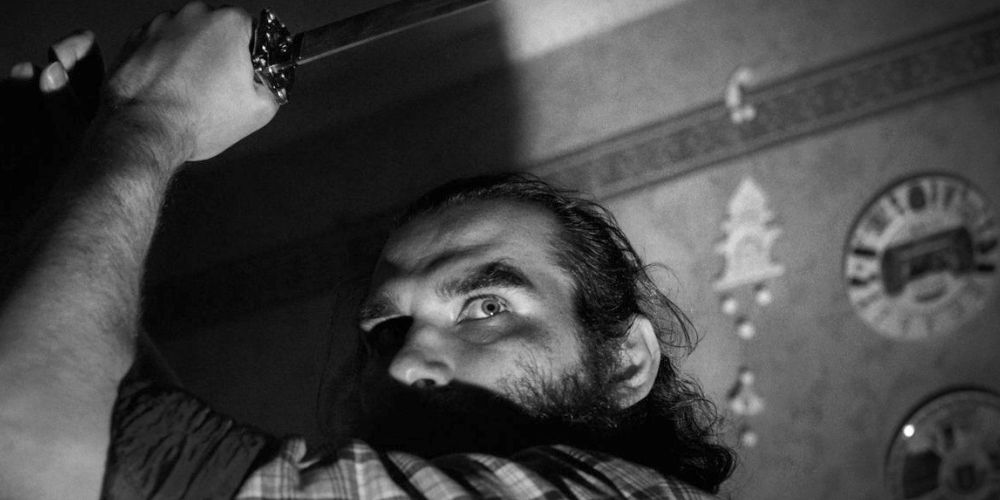
In-depth expositions of Viktor’s personality and worldview are presented in his own words. Viktor has a good command of the words on the page, and in a hypnotic baritone, he whispers his reflective essays on the subjects Sarbil has suggested to him to write about. We gradually learn that Viktor is also a talented photographer who prefers to work in black-and-white – an aesthetic choice that the film naturally adopts, as does his deafness, which provides an auditory sense of perception matching the image. This stylisation makes even more sense when Viktor reveals himself as a great fan of black-and-white Japanese cinema. He is equally obsessed with Miyamoto Musashi’s The Strategy of the Samurai and is constantly practising his moves with a katana in the courtyard. As a genuine samurai, Viktor dreams of going to the front, but he is not accepted as a warrior. After all, war is about communication – as the platoon commander explains while giving his rejection.
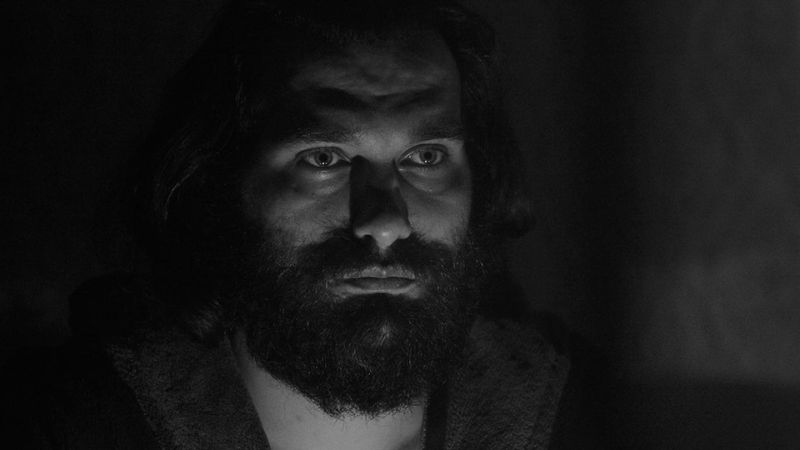
From the intimate at-home observations of these varied interests and feelings, Sarbil paints a profound psychological portrait, aiming to express Viktor through his POV and play up his soul’s poetic dreaminess. Sarbil’s incredible camerawork underscores Viktor with power and charisma, framing him with extra close-ups and expressionistic shadows in the corners of his room. Eventually, the escalating war intensifies his desire to do his military duty, and he ends up going to the front to photograph the war, just as Sarbil himself had done a few decades earlier.
It is a benchmark example of how artfully wartime reality can be treated.
War Photographer
Evidencing the #genocide in Rwanda inspired Olivier Sarbil to begin his career as a professional war photographer. Over two decades, he has documented a staggering number of armed conflicts across the vast geography of the planet and, to date, has directed or filmed several internationally acclaimed feature-length documentaries (Mosul, 2017; On the President’s Orders, 2018; Retrograde, 2022 among others). Those war documentaries have been far more spectacular due to the extensive exposure of battle scenes and the variety of options, while in Viktor, he treats the subject more artistically, as the reasons to make this film were more personal. More than a decade ago, Sarbil partially lost his hearing while documenting the war in Libya, which became a clear motivation to make a film about how deaf people perceive war.
Viktor is a special case of how a character-driven documentary can be deeply personal for both the hero and the director. In fact, without the powerful bond of disability and a shared passion for photography—both of which shaped their destinies—this documentary, which almost burrows into the hero’s mind, would never succeed. Sarbil, sacrificing his established rapid and colourful cinematographic style, adapts to Viktor’s aesthetic sense and eventually finds a common creative language stronger than the verbal one. Thus, the film is based on their shared vision of how war may be felt and filmed, and to some extent, serves as the product of a successful artistic collaboration.
Sonic Space
In war documentaries, creating an immersive experience is a primary goal, nowadays largely accomplished through innovative digital camera technology with a strong accent on hyper-realism. A more significant deficit lies in films that achieve immersiveness through the creative fictionalisation of cinematic language. Formally, Viktor reminds Alina Gorlova’s debut, This Rain Will Never Stop – another talented black-and-white Ukrainian war documentary. Gorlova immersed the viewer in her character’s world through avant-garde montage, while Sarbil achieves this by creating a mesmeric sonic space.
To craft this unique soundscape, Sarbil was assisted by the team that worked on the sound design for the 2019 drama Sound of Metal. Together, they aimed to project what Viktor’s aural perception of current reality might sound like. His everyday life moments are opposed to his dreamy mood, and so this contrast is supported by soundscapes that constantly shift between subjective and objective. This creative sonic space is so vast that the war recedes into the background while at the same time becoming an unusual entry point to the experience. All of this is enhanced by the wonderful instrumental music by Rich Vreeland (DISASTERPEACE), which picks up on the swing of Viktor’s katana. The sounds of artillery, muffled voices, and the dramatic sound of a violin are all immensely intertwined in a constant soundstream. Aural recreations of his hearing reveal that silence, as Viktor says, «is not an emptiness» but a space where he finds his own peace.